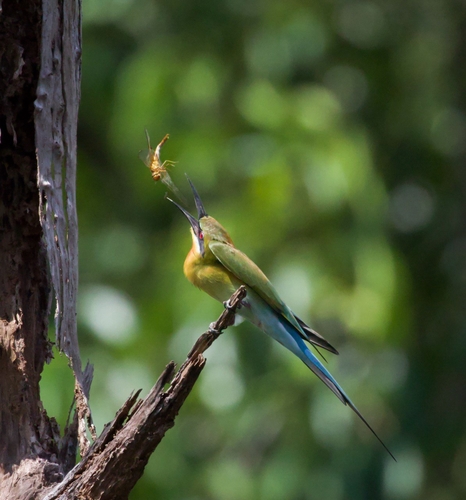
Blue-cheeked Bee-eater vs Blue-tailed Bee-eater
Merops persicus versus Merops philippinus
Play a quiz with Blue-cheeked Bee-eater and Blue-tailed Bee-eater
Blue-cheeked Bee-eater
Blue-tailed Bee-eater
In short
The Blue-cheeked Bee-eater (Merops persicus) and the Blue-tailed Bee-eater (Merops philippinus) are similar in appearance but can be distinguished by their facial markings and tail coloration. The Blue-cheeked Bee-eater has a more prominent blue cheek patch and a longer tail with central feathers that are more elongated. In contrast, the Blue-tailed Bee-eater has a more uniform green body and a blue tail with less elongated central feathers.
Identification tips
- Look for the blue cheek patch on the Blue-cheeked Bee-eater. 2. Check the tail: Blue-cheeked has longer, more pointed central feathers. 3. Observe the overall plumage: Blue-tailed Bee-eater is more uniformly green. 4. Consider the location: Blue-tailed is more likely in Southeast Asia, while Blue-cheeked is found in Africa and the Middle East.
Size
Both species are similar in size, with slender bodies and long wings typical of bee-eaters.
Plumage
The Blue-cheeked Bee-eater has a distinctive blue cheek patch and a more contrasting head pattern, while the Blue-tailed Bee-eater displays a more uniform green plumage with a blue tail. The Blue-cheeked Bee-eater's tail feathers are longer and more pointed.
Behaviour
Both species exhibit similar behaviors, such as aerial insect hunting and perching in open areas. They are often seen in flocks.
Habitat
Both species prefer open habitats near water, such as riverbanks and wetlands, but the Blue-tailed Bee-eater is more commonly found in Southeast Asia, while the Blue-cheeked Bee-eater is more widespread across Africa and the Middle East.
Voice
Their calls are similar, consisting of melodious, rolling notes, but specific differences in tone and pattern may be subtle and are best learned through experience or recordings.
Blue-cheeked Bee-eater · Blue-tailed Bee-eater · My Tricky Birds