Birdr

Blue Dacnis vs Chestnut-vented Conebill

Dacnis cayana versus Conirostrum speciosum

Play a quiz with Blue Dacnis and Chestnut-vented Conebill
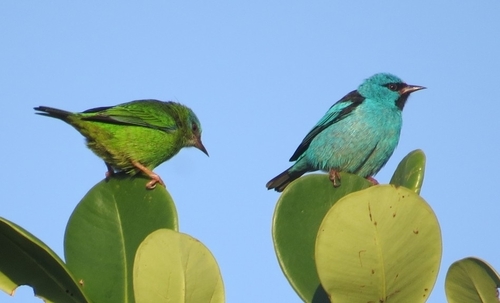
Blue Dacnis (Dacnis cayana) Blue Dacnis
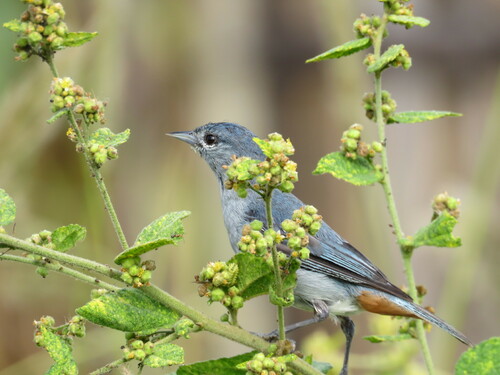
Chestnut-vented Conebill (Conirostrum speciosum) Chestnut-vented Conebill

Media

Loading…

In short

The Blue Dacnis (Dacnis cayana) and Chestnut-vented Conebill (Conirostrum speciosum) are both small tanagers, but they can be distinguished by their plumage and behavior. The Blue Dacnis is notable for its bright blue coloration and black markings, while the Chestnut-vented Conebill has more subdued tones with a distinctive chestnut vent.

Identification tips

  1. Look for the bright blue and black throat of the male Blue Dacnis. 2. Identify the chestnut vent of the Chestnut-vented Conebill. 3. Observe the foraging behavior: Blue Dacnis often targets leaf damage. 4. Note the habitat: Blue Dacnis in canopy, Conebill at various levels.

Size

Both species are small, but the Blue Dacnis is slightly more compact compared to the more elongated Chestnut-vented Conebill.

Plumage

The male Blue Dacnis is bright blue with a black throat and lores, while females are greenish-blue. The Chestnut-vented Conebill has a grayish-blue body with a chestnut vent, which is a key distinguishing feature.

Behaviour

Blue Dacnis often engages in acrobatic foraging, focusing on leaf damage to find insects. The Chestnut-vented Conebill's behavior is less documented but generally involves foraging in mixed-species flocks.

Habitat

Both species inhabit forest edges and clearings, but the Blue Dacnis is more frequently observed in the canopy, while the Chestnut-vented Conebill can be found at various levels of the forest.

Voice

Vocalizations are not well-documented for either species, but they are not a primary distinguishing feature.

Submit a better description

Use the same sections as the comparison. Your text is published immediately.

The Blue Dacnis (Dacnis cayana) and Chestnut-vented Conebill (Conirostrum speciosum) are both small tanagers, but they can be distinguished by their plumage and behavior. The Blue Dacnis is notable for its bright blue coloration and black markings, while the Chestnut-vented Conebill has more subdued tones with a distinctive chestnut vent.

  1. Look for the bright blue and black throat of the male Blue Dacnis. 2. Identify the chestnut vent of the Chestnut-vented Conebill. 3. Observe the foraging behavior: Blue Dacnis often targets leaf damage. 4. Note the habitat: Blue Dacnis in canopy, Conebill at various levels.

Both species are small, but the Blue Dacnis is slightly more compact compared to the more elongated Chestnut-vented Conebill.

The male Blue Dacnis is bright blue with a black throat and lores, while females are greenish-blue. The Chestnut-vented Conebill has a grayish-blue body with a chestnut vent, which is a key distinguishing feature.

Blue Dacnis often engages in acrobatic foraging, focusing on leaf damage to find insects. The Chestnut-vented Conebill's behavior is less documented but generally involves foraging in mixed-species flocks.

Both species inhabit forest edges and clearings, but the Blue Dacnis is more frequently observed in the canopy, while the Chestnut-vented Conebill can be found at various levels of the forest.

Vocalizations are not well-documented for either species, but they are not a primary distinguishing feature.

Discard your changes?

You have unsaved edits. If you leave now, those changes will be lost.

Blue Dacnis · Chestnut-vented Conebill · My Tricky Birds