Birdr

Blue Dacnis vs Shining Honeycreeper

Dacnis cayana versus Cyanerpes lucidus

Play a quiz with Blue Dacnis and Shining Honeycreeper
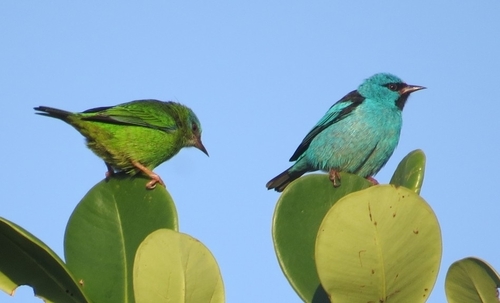
Blue Dacnis (Dacnis cayana) Blue Dacnis
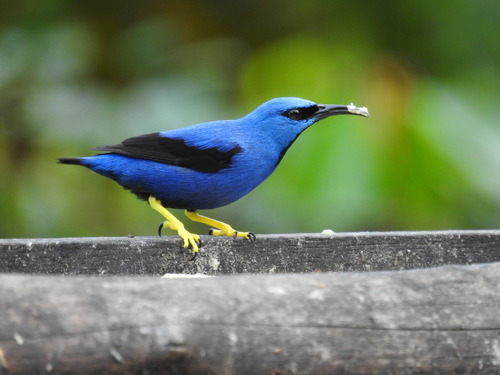
Shining Honeycreeper (Cyanerpes lucidus) Shining Honeycreeper

Media

Loading…

In short

The Blue Dacnis and Shining Honeycreeper are both small, vibrant tanagers often found in similar habitats. The most reliable field mark is the male Blue Dacnis's bright blue plumage with a black throat and back, while the male Shining Honeycreeper is a deeper blue with a distinctive yellow lower mandible. Females of both species are greenish, but the Shining Honeycreeper female has a more uniform green with a blue crown.

Identification tips

Size

Both species are similar in size, small and compact, typical of tanagers.

Plumage

Male Blue Dacnis are bright blue with black on the throat and back. Male Shining Honeycreepers are a deeper blue with a yellow lower mandible and black upperparts. Female Blue Dacnis are green with a blue crown, while female Shining Honeycreepers are more uniformly green with a blue crown.

Behaviour

Both species forage for nectar and insects, often in the canopy. Blue Dacnis may be seen performing acrobatic maneuvers when foraging.

Habitat

Both species are found in forest edges and clearings, often in the canopy.

Voice

Vocalizations are not a primary distinguishing feature; both species have similar high-pitched calls.

Submit a better description

Use the same sections as the comparison. Your text is published immediately.

The Blue Dacnis and Shining Honeycreeper are both small, vibrant tanagers often found in similar habitats. The most reliable field mark is the male Blue Dacnis's bright blue plumage with a black throat and back, while the male Shining Honeycreeper is a deeper blue with a distinctive yellow lower mandible. Females of both species are greenish, but the Shining Honeycreeper female has a more uniform green with a blue crown.

  • Males: Look for the yellow lower mandible in Shining Honeycreeper.
  • Females: Note the more uniform green in Shining Honeycreeper females compared to the blue crown of Blue Dacnis females.
  • Behavior: Observe feeding behavior; Blue Dacnis may perform more acrobatic maneuvers.
  • Habitat: Both are found in similar habitats, so focus on plumage for identification.

Both species are similar in size, small and compact, typical of tanagers.

Male Blue Dacnis are bright blue with black on the throat and back. Male Shining Honeycreepers are a deeper blue with a yellow lower mandible and black upperparts. Female Blue Dacnis are green with a blue crown, while female Shining Honeycreepers are more uniformly green with a blue crown.

Both species forage for nectar and insects, often in the canopy. Blue Dacnis may be seen performing acrobatic maneuvers when foraging.

Both species are found in forest edges and clearings, often in the canopy.

Vocalizations are not a primary distinguishing feature; both species have similar high-pitched calls.

Discard your changes?

You have unsaved edits. If you leave now, those changes will be lost.

Blue Dacnis · Shining Honeycreeper · My Tricky Birds