Birdr

Blue-tufted Starthroat vs Slender-tailed Woodstar

Heliomaster furcifer versus Microstilbon burmeisteri

Play a quiz with Blue-tufted Starthroat and Slender-tailed Woodstar
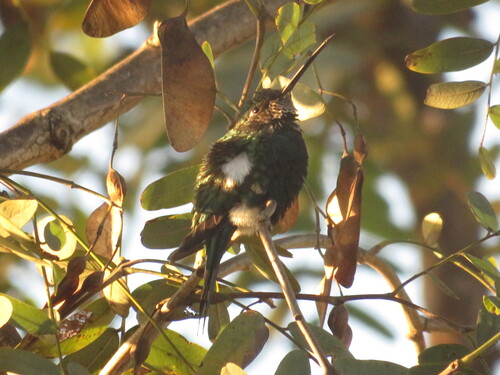
Blue-tufted Starthroat (Heliomaster furcifer) Blue-tufted Starthroat
Slender-tailed Woodstar (Microstilbon burmeisteri) Slender-tailed Woodstar

Media

Loading…

In short

The Blue-tufted Starthroat and the Slender-tailed Woodstar are both hummingbirds, but they can be distinguished by their size and tail shape. The Blue-tufted Starthroat is larger with a distinctive forked tail, while the Slender-tailed Woodstar is smaller with a slender, elongated tail.

Identification tips

  1. Look for the forked tail of the Blue-tufted Starthroat versus the slender, elongated tail of the Slender-tailed Woodstar. 2. Note the blue tuft on the male Blue-tufted Starthroat's throat compared to the reddish-purple throat of the male Slender-tailed Woodstar. 3. Consider the habitat: Blue-tufted Starthroat in open areas, Slender-tailed Woodstar in Yungas bioregion.

Size

The Blue-tufted Starthroat is noticeably larger than the Slender-tailed Woodstar.

Plumage

Both species have bronzy green upperparts. The male Blue-tufted Starthroat has a blue tuft on the throat, while the male Slender-tailed Woodstar has an iridescent reddish-purple throat. Females of both species are less colorful but the Woodstar female is more buffy below.

Behaviour

Both species are territorial around feeding areas, but the Slender-tailed Woodstar may mimic bees and wasps in behavior.

Habitat

The Blue-tufted Starthroat is found in open and semi-open areas, while the Slender-tailed Woodstar inhabits the Yungas bioregion, including shrubby slopes and thicket-filled ravines.

Submit a better description

Use the same sections as the comparison. Your text is published immediately.

The Blue-tufted Starthroat and the Slender-tailed Woodstar are both hummingbirds, but they can be distinguished by their size and tail shape. The Blue-tufted Starthroat is larger with a distinctive forked tail, while the Slender-tailed Woodstar is smaller with a slender, elongated tail.

  1. Look for the forked tail of the Blue-tufted Starthroat versus the slender, elongated tail of the Slender-tailed Woodstar. 2. Note the blue tuft on the male Blue-tufted Starthroat's throat compared to the reddish-purple throat of the male Slender-tailed Woodstar. 3. Consider the habitat: Blue-tufted Starthroat in open areas, Slender-tailed Woodstar in Yungas bioregion.

The Blue-tufted Starthroat is noticeably larger than the Slender-tailed Woodstar.

Both species have bronzy green upperparts. The male Blue-tufted Starthroat has a blue tuft on the throat, while the male Slender-tailed Woodstar has an iridescent reddish-purple throat. Females of both species are less colorful but the Woodstar female is more buffy below.

Both species are territorial around feeding areas, but the Slender-tailed Woodstar may mimic bees and wasps in behavior.

The Blue-tufted Starthroat is found in open and semi-open areas, while the Slender-tailed Woodstar inhabits the Yungas bioregion, including shrubby slopes and thicket-filled ravines.

Discard your changes?

You have unsaved edits. If you leave now, those changes will be lost.

Blue-tufted Starthroat · Slender-tailed Woodstar · My Tricky Birds