
Birdr

Blue-winged Macaw vs Yellow-collared Macaw

Primolius maracana versus Primolius auricollis

Play a quiz with Blue-winged Macaw and Yellow-collared Macaw
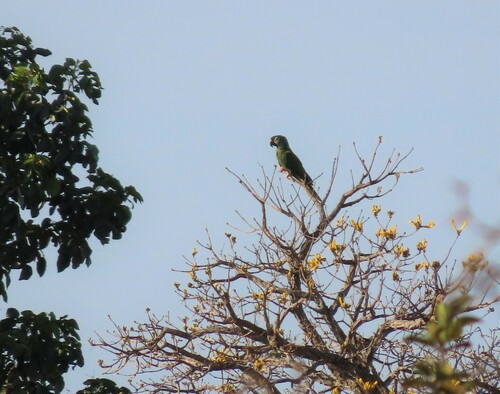
Blue-winged Macaw (Primolius maracana) Blue-winged Macaw
Yellow-collared Macaw (Primolius auricollis) Yellow-collared Macaw

Media

Loading…

In short

The Blue-winged Macaw and Yellow-collared Macaw can be distinguished by their distinct plumage patterns and subtle structural differences. The Blue-winged Macaw has a more uniform green body with blue on the wings, while the Yellow-collared Macaw features a distinctive yellow collar around the neck. Both species are similar in size and shape, but these plumage differences are key for identification.

Identification tips

1. Look for the yellow collar: The Yellow-collared Macaw has a distinctive yellow band around its neck, absent in the Blue-winged Macaw. 2. Check the forehead color: The Blue-winged Macaw has a red forehead, which can be a helpful mark. 3. Observe the wing color: Blue-winged Macaws have blue on their wings, which can be seen in flight or when perched. 4. Consider habitat and behavior: While both species can be found in similar habitats, the Yellow-collared Macaw may show more seasonal movement.

Size

Both species are similar in size, typical of small macaws, with no significant differences in overall body structure.

Plumage

The Blue-winged Macaw (Primolius maracana) has a predominantly green body with blue on the wings and a red forehead. In contrast, the Yellow-collared Macaw (Primolius auricollis) features a yellow collar around the neck, a green body, and a blue crown. The yellow collar is the most distinctive feature for identification.

Behaviour

Both species exhibit similar behaviors typical of macaws, including strong flying abilities and social interactions. However, the Yellow-collared Macaw may show local seasonal movements outside of the breeding season.

Habitat

The Blue-winged Macaw is found in tropical lowland evergreen forests, palm groves, and gallery forests, while the Yellow-collared Macaw also inhabits similar forested regions but may be more adaptable to different forest types.

Voice

Vocalizations are similar between the two species, with both producing typical macaw calls. Specific differences in calls are not well-documented.

Submit a better description

Use the same sections as the comparison. Your text is published immediately.

The Blue-winged Macaw and Yellow-collared Macaw can be distinguished by their distinct plumage patterns and subtle structural differences. The Blue-winged Macaw has a more uniform green body with blue on the wings, while the Yellow-collared Macaw features a distinctive yellow collar around the neck. Both species are similar in size and shape, but these plumage differences are key for identification.

1. Look for the yellow collar: The Yellow-collared Macaw has a distinctive yellow band around its neck, absent in the Blue-winged Macaw. 2. Check the forehead color: The Blue-winged Macaw has a red forehead, which can be a helpful mark. 3. Observe the wing color: Blue-winged Macaws have blue on their wings, which can be seen in flight or when perched. 4. Consider habitat and behavior: While both species can be found in similar habitats, the Yellow-collared Macaw may show more seasonal movement.

Both species are similar in size, typical of small macaws, with no significant differences in overall body structure.

The Blue-winged Macaw (Primolius maracana) has a predominantly green body with blue on the wings and a red forehead. In contrast, the Yellow-collared Macaw (Primolius auricollis) features a yellow collar around the neck, a green body, and a blue crown. The yellow collar is the most distinctive feature for identification.

Both species exhibit similar behaviors typical of macaws, including strong flying abilities and social interactions. However, the Yellow-collared Macaw may show local seasonal movements outside of the breeding season.

The Blue-winged Macaw is found in tropical lowland evergreen forests, palm groves, and gallery forests, while the Yellow-collared Macaw also inhabits similar forested regions but may be more adaptable to different forest types.

Vocalizations are similar between the two species, with both producing typical macaw calls. Specific differences in calls are not well-documented.

Discard your changes?

You have unsaved edits. If you leave now, those changes will be lost.

Blue-winged Macaw · Yellow-collared Macaw · My Tricky Birds