
Blue-winged Teal vs Gadwall
Spatula discors versus Mareca strepera
Play a quiz with Blue-winged Teal and Gadwall
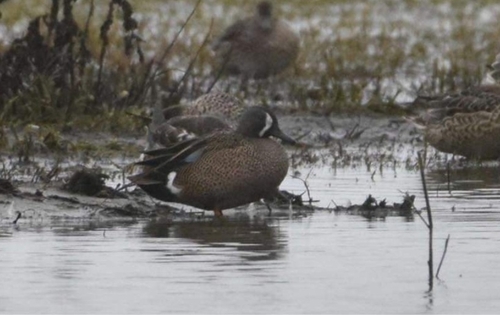 Blue-winged Teal
 Gadwall
In short
The most reliable field mark to separate Blue-winged Teal from Gadwall—especially in flight or among immatures—is the color and pattern of the upperwing: Blue-winged Teal of all ages show a sky-blue patch on the forewing (coverts) and a green speculum, while Gadwall of all ages have a white speculum and chestnut inner wing, lacking any blue. Adult male Blue-winged Teal are small ducks with a bold white crescent on the face, while Gadwall males are larger, gray-patterned, and never show blue in the wing. Females of both species are mottled brown, but female Blue-winged Teal are smaller, with a plainer face and blue in the wing, while female Gadwall show a white speculum and orange-edged bill. Size, structure, and habitat preference can help, but the wing pattern is the most consistent field mark, especially for birds in flight or at a distance.
Identification tips
- Upperwing color in flight (all ages): Blue-winged Teal always show a sky-blue forewing patch and green speculum; Gadwall never shows blue, but has a white speculum and chestnut inner wing. This is the most reliable mark for all ages and sexes.
- Size: Gadwall is much larger and bulkier than Blue-winged Teal. If seen together, the size difference is obvious, but beware of lone birds or distant views.
- Bill shape and color: Blue-winged Teal has a smaller, more delicate bill; females have a plain grayish bill with a pale base. Gadwall females have a darker bill with orange edges, and both sexes have a proportionally larger bill.
- Head pattern (adult males): Blue-winged Teal drake has a distinctive white crescent in front of the eye on a gray-blue head. Gadwall drake lacks any face markings and is finely patterned gray overall.
- Body pattern (adult males): Blue-winged Teal males are light brown with a white patch near the rear and a black tail. Gadwall males are gray with a black rear and white belly, lacking any blue or green on the body.
- Female/immature confusion: Both species' females are mottled brown, but Blue-winged Teal is smaller, with a plainer face and always shows blue in the wing. Gadwall female is larger, with a white speculum and orange-edged bill.
- Eclipse/non-breeding males: Gadwall males in eclipse look more like females but retain the white speculum and chestnut wing; Blue-winged Teal males lose the bold face crescent but still show blue in the wing.
- Juvenile/first-year birds: Wing pattern remains diagnostic—Blue-winged Teal always has blue and green, Gadwall always has white and chestnut, never blue.
- Feeding behavior: Gadwall may dive or steal food from coots; Blue-winged Teal only dabble.
- Flock structure: Blue-winged Teal often in tight, active groups; Gadwall in looser, smaller flocks.
- Habitat: Blue-winged Teal stick to shallow, vegetated marshes and pond edges; Gadwall more often found in open water or larger wetlands.
- Migration timing: Blue-winged Teal migrate earlier in fall and later in spring than Gadwall; large flocks of Blue-winged Teal in early fall are a clue.
- Vocalizations: Blue-winged Teal males whistle; Gadwall males grunt or whistle, females give a higher-pitched quack.
- Resting posture: Blue-winged Teal often perch on rocks, muskrat houses, or mudflats; Gadwall more likely to loaf in open water or on shore.
- When in doubt: If you see blue in the wing, it's a Blue-winged Teal. If you see a white speculum with no blue, it's a Gadwall.
Size
Gadwall is substantially larger than Blue-winged Teal. Gadwall measures 47–58 cm (19–23 in) in length with a 78–85 cm (31–33 in) wingspan and weighs 850–990 g (30–35 oz) [wikipedia]. Blue-winged Teal is much smaller at 40 cm (16 in) long, 58 cm (23 in) wingspan, and 370 g (13 oz) [wikipedia]. In the field, Gadwall looks bulkier and longer-necked, while Blue-winged Teal is noticeably petite and compact. However, size can be hard to judge without direct comparison or in mixed flocks.
Plumage
The most diagnostic plumage feature is the upperwing pattern, visible in flight or when stretching:
-
Blue-winged Teal (all ages and sexes): Show a prominent sky-blue patch on the forewing (coverts) and a green speculum behind it. This blue is visible in flight and often when perched, especially in fresh plumage. The adult male has a grayish-blue head with a bold white crescent in front of the eye, a light brown body, black tail, and a white patch near the rear. Females are mottled brown with a pale area at the base of the bill, but always show blue in the wing. Juveniles and immatures also show the blue wing patch, though sometimes duller.
-
Gadwall (all ages and sexes): Never show blue in the wing. Instead, both sexes have a white speculum (the secondary feathers), which is striking in flight or when the wing is stretched. The inner wing (tertials and coverts) is chestnut in males, adding warmth to the wing panel. Adult males are finely patterned gray with a black rear end and white belly; females are mottled brown, similar to female mallard but with a white speculum and orange-edged bill. In eclipse (non-breeding) plumage, males resemble females but retain the wing pattern.
-
Juvenile/immature birds: The wing pattern remains diagnostic: Blue-winged Teal always show blue and green, Gadwall always show white and chestnut, never blue.
Behaviour
Both species are dabbling ducks, but Gadwall is more likely to dive for food and may steal food from diving birds like coots, which Blue-winged Teal does not do. Blue-winged Teal are often seen in tight, active flocks and are among the first ducks to migrate south in fall and last to return north in spring. Gadwall is less gregarious outside breeding season, forming smaller flocks. Blue-winged Teal tend to feed in shallow water at marsh edges, while Gadwall can be found in slightly deeper open water as well as marshes.
Habitat
Blue-winged Teal prefer shallow, calm water with dense emergent vegetation—marshes, ponds, and slow streams, often close to shore or in flooded meadows. They are rarely found on open, deep water. Gadwall also use marshes and wetlands with dense vegetation but are more tolerant of open water, prairie lakes, and steppe lakes, and may nest farther from water. In migration and winter, Gadwall can be found in a wider range of wetland types, sometimes in larger bodies of water than Blue-winged Teal.
Voice
Blue-winged Teal males give a short whistle, while females have a soft quack. Gadwall is generally quieter, with males giving a grunt ("mep") and a whistle during display, while females have a higher-pitched quack ("gag-ag-ag-ag") compared to Mallard. Neither species is especially vocal outside courtship, but Blue-winged Teal's whistle and Gadwall's grunt-whistle can be useful if heard.