
Blyth's Paradise-Flycatcher vs Indian Paradise-Flycatcher
Terpsiphone affinis versus Terpsiphone paradisi
Play a quiz with Blyth's Paradise-Flycatcher and Indian Paradise-Flycatcher
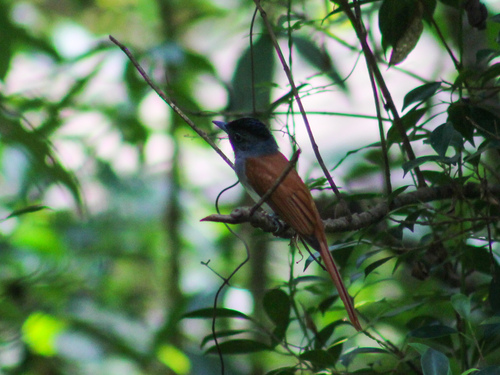 Blyth's Paradise-Flycatcher
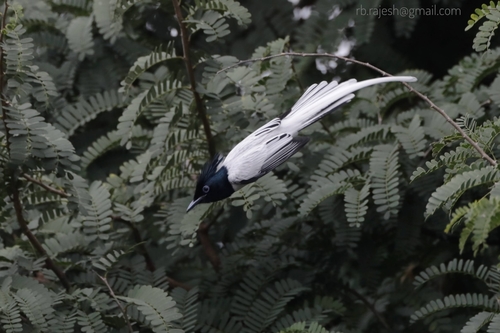 Indian Paradise-Flycatcher
In short
The most reliable field mark between Blyth's Paradise-Flycatcher and Indian Paradise-Flycatcher is the shape and size of the crest: Blyth's has a short, rounded crest, while Indian's is longer and more pointed. For rufous morphs, Blyth's shows a pale rufous undertail and a gradual fade to grey on the underparts, whereas Indian has a white undertail and a sharper contrast between throat and belly. Both species have dimorphic males (rufous or white), long tail streamers in breeding males, and blue eye-rings, but subtle differences in head shape, tail pattern, and underpart contrast are key. Females and immatures are especially tricky, but careful attention to crest shape and undertail color can help. Flight views of juveniles are not described in detail for either species, so perched birds are easier to separate.
Identification tips
- Crest shape is key: Blyth's has a short, rounded crest; Indian's is longer and pointed. This is visible on perched birds of all ages and sexes.
- Undertail color in rufous morphs: Blyth's shows a pale rufous undertail, while Indian's is white. This is especially useful for adult males and females.
- Underpart contrast: Blyth's rufous morphs have a gradual transition to grey on the underparts, lacking a sharp dividing line; Indian's have a sharper contrast between the greyish throat and the rest of the underparts.
- Eye-ring and head color in females/immatures: Blyth's females and young males have a less vibrant blue eye-ring and a slightly paler head compared to Indian's, which have a more distinct blue eye-ring and darker head.
- Tail streamer length: Both species' adult males have long central tail feathers, but Indian's can reach up to 30 cm, sometimes longer than Blyth's. However, this is variable and not always reliable.
- Shaft streaks in white morphs: Blyth's white morphs show dark streaks on the shafts of wings and central tail feathers; Indian's white morphs have black shaft streaks and sometimes black edges on wings and tail.
- Females' underparts: Indian's females are rufous above with a greyish throat and underparts and a white undertail; Blyth's females are similar but with a paler head and rufous undertail.
- Young males: Indian's young males look like females but have a black throat and blue eye-ring; Blyth's young males resemble females with a paler head and less vibrant eye-ring.
- Flight views: No distinctive juvenile or immature upperwing patterns are described for either species, so flight separation is difficult; focus on perched birds for best results.
- Habitat context: Blyth's is more likely in evergreen broadleaf forests and plantations, while Indian is widespread in the Indian subcontinent in various wooded habitats.
- Voice: Blyth's gives a ringing "wiwiwiwiwiwiwi" and nasal "ji-jeh" calls; Indian's voice is not described here, so do not rely on this for separation.
- Intermediate/intergrade birds: Indian Paradise-Flycatcher can show intermediate plumages between rufous and white, especially in the Indian region; these can be confusing and may not be safely separated from Blyth's without close attention to crest and undertail.
- Seasonal variation: Both species show similar seasonal changes, with males acquiring long tail streamers in breeding condition. Young birds of both species are short-tailed and rufous.
- Geographic overlap: Where both species occur, use a combination of crest shape and undertail color for best separation, especially in females and non-breeding males.
- When in doubt: If the crest is not visible and undertail color is ambiguous, identification may not be possible to species in the field, especially for immatures and females.
Size
Both species are similar in overall size and proportions, being medium-sized paradise-flycatchers. Indian Paradise-Flycatcher adults are listed as 19–22 cm in body length, with tail streamers in adult males extending up to 30 cm. Blyth's Paradise-Flycatcher is not given a precise measurement in the notes, but is described as typical for the genus. There is no strong size difference to use in the field.
Plumage
- Juveniles/immatures: No specific upperwing or flight pattern differences are described for young birds in the notes. Both species' young males resemble females: rufous above, short-tailed, with Indian's young males showing a black throat and blue eye-ring, while Blyth's females and young males have a paler head and less vibrant eye-ring.
- Adult males: Both can be rufous or white morphs. Blyth's rufous morphs have a pale rufous undertail and a gradual fade to grey on the underparts, lacking sharp contrast. Indian's rufous morphs have a white undertail and a more abrupt contrast between greyish throat and underparts. Blyth's white morphs show dark shaft streaks on wings and central tail feathers; Indian's white morphs have black shaft streaks and sometimes black edges on wings and tail.
- Females: Both are rufous above with dark heads, but Blyth's has a paler head and less vibrant blue eye-ring. Indian's females have a greyish throat and underparts, and a white undertail.
- Crest: Blyth's has a short, rounded crest; Indian's is longer and pointed.
Behaviour
Both species are active flycatchers, sallying for insects in the mid to upper canopy. Indian Paradise-Flycatcher is noted for capturing prey in the air, sometimes beating it on a rock before eating. No unique behavioral differences are described that are diagnostic in the field.
Habitat
Blyth's Paradise-Flycatcher is found in evergreen broadleaf forests, forest edges, secondary growth, gardens, and plantations, mostly in lowlands and foothills. Indian Paradise-Flycatcher is native to the Indian subcontinent and adjacent regions, occurring in a wide range of wooded habitats, often below dense canopy. There is some overlap in habitat, but Blyth's is more associated with evergreen forests and plantations, while Indian is more widespread in the subcontinent.
Voice
Blyth's Paradise-Flycatcher has a ringing series of "wiwiwiwiwiwiwi" notes and a nasal "ji-jeh" call. No specific vocalizations are described for Indian Paradise-Flycatcher in the notes, so voice is not a reliable separator based on the current information.
Blyth's Paradise-Flycatcher · Indian Paradise-Flycatcher · My Tricky Birds