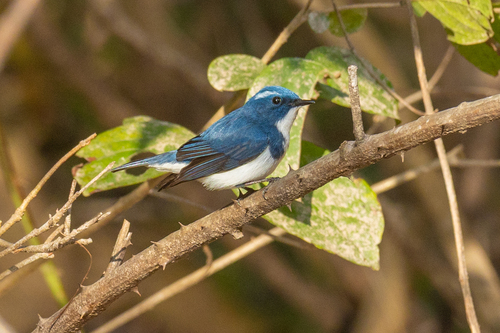
Blyth's Paradise-Flycatcher vs Ultramarine Flycatcher
Terpsiphone affinis versus Ficedula superciliaris
Play a quiz with Blyth's Paradise-Flycatcher and Ultramarine Flycatcher
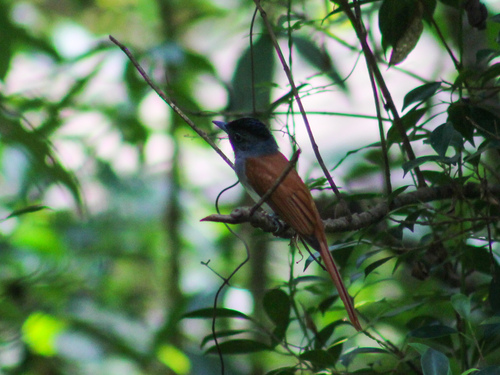
Blyth's Paradise-Flycatcher
Ultramarine Flycatcher
In short
Blyth's Paradise-Flycatcher and Ultramarine Flycatcher can be distinguished by their structural features and plumage. Blyth's has a distinctive long tail and shorter crest, while Ultramarine is more compact with a striking blue and white coloration. Vocalizations also differ, with Blyth's having a low-pitched song.
Identification tips
- Look for Blyth's Paradise-Flycatcher's long tail and shorter crest. 2. Note the Ultramarine Flycatcher's striking blue and white plumage with a white supercilium. 3. Listen for Blyth's low-pitched song, as Ultramarine's calls are less documented. 4. Consider habitat: Blyth's is more likely in gardens and mangroves, while Ultramarine prefers forested areas.
Size
Blyth's Paradise-Flycatcher is generally larger with a longer tail compared to the more compact Ultramarine Flycatcher.
Plumage
Blyth's Paradise-Flycatcher males in the white morph have a contrasting black throat and long tail streamers, while females are more rufous. Ultramarine Flycatchers have a striking blue upperparts with a white belly and a prominent white supercilium.
Behaviour
Blyth's Paradise-Flycatcher is often seen in pairs or mixed-species flocks, while Ultramarine Flycatcher behavior is less documented but typically solitary.
Habitat
Blyth's Paradise-Flycatcher inhabits low elevation forests, mangroves, and gardens. Ultramarine Flycatcher prefers forested areas but specific habitat details are less documented.
Voice
Blyth's Paradise-Flycatcher has a low-pitched, ringing song, while the Ultramarine Flycatcher's vocalizations are not well-documented.
Blyth's Paradise-Flycatcher · Ultramarine Flycatcher · My Tricky Birds