Birdr

Boat-tailed Grackle vs Great-tailed Grackle

Quiscalus major versus Quiscalus mexicanus

Play a quiz with Boat-tailed Grackle and Great-tailed Grackle
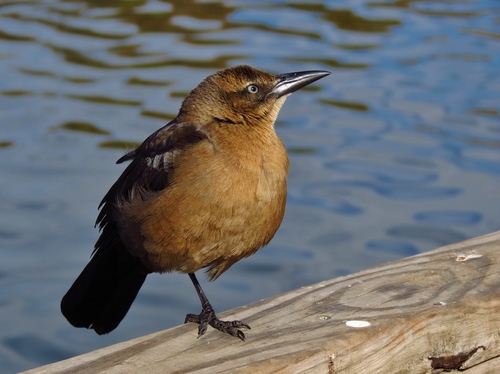
Boat-tailed Grackle (Quiscalus major) Boat-tailed Grackle
Great-tailed Grackle (Quiscalus mexicanus) Great-tailed Grackle

Media

Loading…

In short

The Boat-tailed Grackle and Great-tailed Grackle are large blackbirds with iridescent males and smaller, brown females. The most reliable distinction is their habitat preference: Boat-tailed Grackles are typically found in coastal marshes, while Great-tailed Grackles prefer drier, inland areas. Tail shape and eye color also help differentiate them.

Identification tips

Size

Both species are sexually dimorphic, with males being larger than females. The male Boat-tailed Grackle is pigeon-sized, while the Great-tailed Grackle is similarly sized but has a more massive bill.

Plumage

Male Boat-tailed Grackles have iridescent blue-green plumage, while Great-tailed Grackle males are glossy black with purple iridescence. Female Boat-tailed Grackles are cinnamon-colored, whereas female Great-tailed Grackles are dark brown with yellow eyes.

Behaviour

Both species exhibit polygynous mating systems, but Boat-tailed Grackles form harem colonies in marshes, while Great-tailed Grackles defend smaller territories in drier areas.

Habitat

Boat-tailed Grackles inhabit coastal marshes and are found in the eastern U.S., while Great-tailed Grackles prefer drier habitats, such as grasslands and urban areas, in the midwestern and western U.S.

Voice

Both species have complex vocal repertoires, but specific song differences are not well-documented. Vocalizations may play a role in maintaining reproductive isolation.

Submit a better description

Use the same sections as the comparison. Your text is published immediately.

The Boat-tailed Grackle and Great-tailed Grackle are large blackbirds with iridescent males and smaller, brown females. The most reliable distinction is their habitat preference: Boat-tailed Grackles are typically found in coastal marshes, while Great-tailed Grackles prefer drier, inland areas. Tail shape and eye color also help differentiate them.

  • Habitat: Look for Boat-tailed Grackles in coastal marshes and Great-tailed Grackles in drier, inland areas.
  • Tail: Great-tailed Grackles have a longer, keel-shaped tail compared to the Boat-tailed Grackle.
  • Eye Color: Female Great-tailed Grackles have yellow eyes, while female Boat-tailed Grackles do not.
  • Plumage: Note the iridescence; Boat-tailed males are blue-green, while Great-tailed males are purple.

Both species are sexually dimorphic, with males being larger than females. The male Boat-tailed Grackle is pigeon-sized, while the Great-tailed Grackle is similarly sized but has a more massive bill.

Male Boat-tailed Grackles have iridescent blue-green plumage, while Great-tailed Grackle males are glossy black with purple iridescence. Female Boat-tailed Grackles are cinnamon-colored, whereas female Great-tailed Grackles are dark brown with yellow eyes.

Both species exhibit polygynous mating systems, but Boat-tailed Grackles form harem colonies in marshes, while Great-tailed Grackles defend smaller territories in drier areas.

Boat-tailed Grackles inhabit coastal marshes and are found in the eastern U.S., while Great-tailed Grackles prefer drier habitats, such as grasslands and urban areas, in the midwestern and western U.S.

Both species have complex vocal repertoires, but specific song differences are not well-documented. Vocalizations may play a role in maintaining reproductive isolation.

Discard your changes?

You have unsaved edits. If you leave now, those changes will be lost.

Boat-tailed Grackle · Great-tailed Grackle · My Tricky Birds