Bobolink vs Eastern Meadowlark
Dolichonyx oryzivorus versus Sturnella magna
Play a quiz with Bobolink and Eastern Meadowlark
Bobolink
Eastern Meadowlark
In short
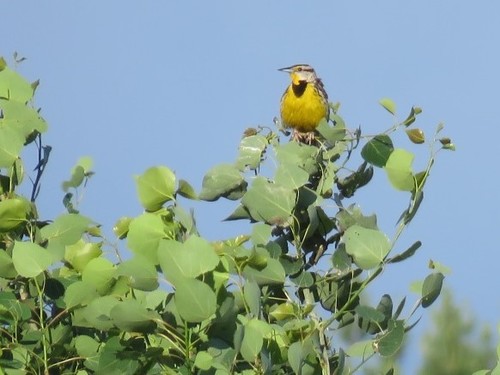
Bobolinks and Eastern Meadowlarks can be distinguished by their plumage and vocalizations. Bobolinks, especially breeding males, have a striking black and white appearance with a yellow nape, while Eastern Meadowlarks have a more muted brown and yellow pattern with a distinctive black 'V' on their chest. Their songs are also distinct, with Bobolinks having a bubbly, melodic song and Eastern Meadowlarks a clear, flute-like whistle.
Identification tips
- Look for the yellow nape and black and white plumage of the breeding male Bobolink. 2. Note the black 'V' on the chest of the Eastern Meadowlark. 3. Listen for the bubbly song of the Bobolink compared to the flute-like song of the Eastern Meadowlark. 4. Consider the season: Bobolinks are more likely to be seen during migration, while Eastern Meadowlarks are more resident.
Size
Both species are similar in size, but the Eastern Meadowlark is slightly larger and bulkier than the Bobolink.
Plumage
Breeding male Bobolinks have a unique black and white plumage with a yellow nape, resembling a 'skunk' pattern, while Eastern Meadowlarks have a brown streaked back and a bright yellow underbelly with a black 'V' on the chest. Female and nonbreeding male Bobolinks are more subdued in color, resembling sparrows.
Behaviour
Bobolinks are known for their distinctive flight song, often performed in a helicopter-like flight. Eastern Meadowlarks are ground foragers and are often seen walking through fields.
Habitat
Both species inhabit open fields and grasslands, but Bobolinks are long-distance migrants traveling to South America, while Eastern Meadowlarks are more resident or short-distance migrants within North America.
Voice
Bobolinks have a long, bubbly song that is often delivered in flight, while Eastern Meadowlarks have a clear, flute-like song that is often given from a perch.