Birdr

Bobolink vs White-browed Meadowlark

Dolichonyx oryzivorus versus Leistes superciliaris

Play a quiz with Bobolink and White-browed Meadowlark

Bobolink (Dolichonyx oryzivorus) Bobolink
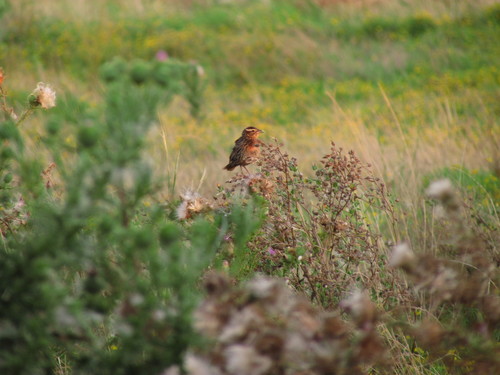
White-browed Meadowlark (Leistes superciliaris) White-browed Meadowlark

Media

Loading…

In short

Bobolinks and White-browed Meadowlarks are both members of the Icteridae family, but they can be distinguished by their plumage and behavior. The Bobolink, often described as wearing a 'backward tuxedo,' is notable for its striking black and white breeding plumage, while the White-browed Meadowlark features a distinctive white eyebrow and red breast. Both species have unique songs that can aid in identification.

Identification tips

Size

Both species are similar in size, typical of medium-sized passerines, but the Bobolink may appear slightly bulkier.

Plumage

In breeding plumage, male Bobolinks are black with a white back and a buffy nape, resembling a 'skunk blackbird.' In contrast, the White-browed Meadowlark has a prominent white supercilium and a red breast, which are key identifiers. Nonbreeding Bobolinks and female White-browed Meadowlarks are more subdued in color, making them harder to distinguish.

Behaviour

Bobolinks are known for their distinctive, bubbly flight song and helicopter-like flight during the breeding season. White-browed Meadowlarks are less aerial in their displays and are often seen perched while singing.

Habitat

Bobolinks breed in North American grasslands and migrate to South America, while White-browed Meadowlarks are resident in South American grasslands. Overlapping ranges during migration are possible but unlikely.

Voice

Bobolinks have a long, bubbly song that is often delivered in flight. The White-browed Meadowlark's song is less documented but generally consists of simpler, melodious notes.

Submit a better description

Use the same sections as the comparison. Your text is published immediately.

Bobolinks and White-browed Meadowlarks are both members of the Icteridae family, but they can be distinguished by their plumage and behavior. The Bobolink, often described as wearing a 'backward tuxedo,' is notable for its striking black and white breeding plumage, while the White-browed Meadowlark features a distinctive white eyebrow and red breast. Both species have unique songs that can aid in identification.

  • Breeding male Bobolink: Look for the black and white 'backward tuxedo' plumage with a buffy nape.
  • White-browed Meadowlark: Identify by the white eyebrow and red breast.
  • Nonbreeding Bobolink: More subdued, resembling sparrows; look for subtle streaking.
  • Behavior: Bobolink's aerial song flights versus the more stationary singing of the White-browed Meadowlark.
  • Habitat: Consider geographic location; Bobolinks are migratory, while White-browed Meadowlarks are resident in South America.

Both species are similar in size, typical of medium-sized passerines, but the Bobolink may appear slightly bulkier.

In breeding plumage, male Bobolinks are black with a white back and a buffy nape, resembling a 'skunk blackbird.' In contrast, the White-browed Meadowlark has a prominent white supercilium and a red breast, which are key identifiers. Nonbreeding Bobolinks and female White-browed Meadowlarks are more subdued in color, making them harder to distinguish.

Bobolinks are known for their distinctive, bubbly flight song and helicopter-like flight during the breeding season. White-browed Meadowlarks are less aerial in their displays and are often seen perched while singing.

Bobolinks breed in North American grasslands and migrate to South America, while White-browed Meadowlarks are resident in South American grasslands. Overlapping ranges during migration are possible but unlikely.

Bobolinks have a long, bubbly song that is often delivered in flight. The White-browed Meadowlark's song is less documented but generally consists of simpler, melodious notes.

Discard your changes?

You have unsaved edits. If you leave now, those changes will be lost.

Bobolink · White-browed Meadowlark · My Tricky Birds