
Bonaparte's Gull vs Short-billed Gull
Chroicocephalus philadelphia versus Larus brachyrhynchus
Play a quiz with Bonaparte's Gull and Short-billed Gull
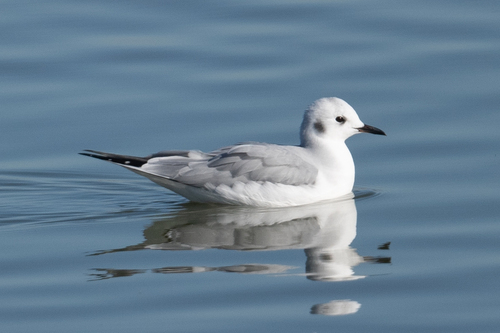 Bonaparte's Gull
 Short-billed Gull
In short
The most reliable field mark between Bonaparte's Gull and Short-billed Gull is the underwing pattern in flight: Bonaparte's Gull of all ages shows a strikingly pale, almost white underwing, while Short-billed Gull has more shadowed, grayish underwings with variable dark markings depending on age. Juvenile and first-winter Bonaparte's Gulls show a brown bar across the forewing and a black tail tip, while Short-billed Gulls in similar plumages are overall browner and smudgier, with dark brown wingtips and a less clean-cut pattern. Structurally, Bonaparte's is much smaller, with a thin, black bill and pinkish to orangish legs, compared to the larger, longer-winged Short-billed Gull, which has a yellow bill (adult), yellow legs, and a rounder head. In breeding plumage, Bonaparte's Gull has a full black hood, while Short-billed Gull always has a white head with only faint brown mottling in winter. Size, structure, and flight style further reinforce the ID when plumage is ambiguous.
Identification tips
- Underwing in flight (all ages): Bonaparte's Gull always shows a very pale, almost white underwing with no dark shading; Short-billed Gull has a duller, grayish underwing, sometimes with dark markings, especially in immatures.
- Juvenile/first-winter upperwing: Bonaparte's has a crisp brown bar across the forewing and a black tail tip; Short-billed Gull is browner overall, with diffuse, smudgy markings and lacks a distinct forewing bar.
- Bill color and shape: Bonaparte's has a short, thin, black bill at all ages. Short-billed Gull has a stouter bill; in adults, it's yellow with no black tip, in immatures, pink-based with a black tip.
- Leg color: Bonaparte's legs are pinkish-red in winter, orangish-red in summer. Short-billed Gull has yellow legs as an adult; immatures may have duller legs but never pinkish.
- Head pattern (breeding): Bonaparte's Gull has a full, slaty-black hood in breeding plumage; Short-billed Gull always has a white head, with only faint brown mottling in winter.
- Head pattern (non-breeding/immature): Bonaparte's has a clean white head or faint smudging; Short-billed Gull has more extensive brown mottling or smudging, especially in juveniles and first-winter birds.
- Size and structure: Bonaparte's is much smaller, with a petite, fine-billed, small-headed look. Short-billed Gull is larger, with a rounder head and longer wings.
- Wingtip pattern (adult): Bonaparte's upperwing above shows black and white striping on the primaries; Short-billed Gull has a 'string of pearls' (white tongue tips) on the outer primaries and a broad white trailing edge.
- Tail pattern (immature): Bonaparte's shows a black tail tip in first-winter; Short-billed Gull may have dark markings on the tail in second and third years but not a crisp black tip.
- Flight style: Bonaparte's is more buoyant and tern-like, often dipping and picking at the water; Short-billed Gull is steadier and more typical of medium gulls.
- Bare part color (adults): Bonaparte's has a black bill and pinkish to orangish legs; Short-billed Gull has a yellow bill and yellow legs.
- Habitat context: Bonaparte's is more likely to be seen in active flocks over water, especially inland; Short-billed Gull is more coastal in winter, less likely inland except in migration.
- First-summer/second-year marks: Bonaparte's rarely shows a hood in first summer (if present, it's dull and incomplete); Short-billed Gull never shows a hood at any age.
- Primary projection: Short-billed Gull has longer, narrower wings in flight, giving a more pointed look compared to Bonaparte's compact, rounded wings.
- Plumage wear: Bonaparte's first-year birds become paler and more worn by summer, but retain the brown forewing bar and black tail tip; Short-billed Gull's immatures remain browner and more smudged overall.
Size
Bonaparte's Gull is significantly smaller (28–38 cm length, 76–84 cm wingspan, 180–225 g) than Short-billed Gull (40–45 cm length, 100–120 cm wingspan). Bonaparte's is among the smallest gulls in North America, noticeably more petite and delicate than Short-billed, which is itself the smallest of the 'common gull' complex but still much larger than Bonaparte's. In the field, Bonaparte's appears small-headed and fine-billed, while Short-billed Gull looks chunkier with a proportionally larger, rounder head and longer wings.
Plumage
Juvenile/first-winter birds are the most frequent confusion point:
- Bonaparte's Gull (juvenile/first-winter): Shows a brown, scalloped back and patchy brown on the head as a juvenile, transitioning to a gray back with a distinct brown bar across the forewing, blackish secondary tips, and a black tail tip. The underwing is always pale, lacking any dark shading or extensive markings. Fewer than 5% show a hood in first summer, and if present, it is dull and incomplete.
-
Short-billed Gull (juvenile/first-winter): Is overall browner, with a smudgy, dark-marked head and neck, and dark brown wingtips. The upperwing lacks the crisp brown forewing bar of Bonaparte's, instead showing more diffuse, darker markings. The bill is pink-based with a black tip by first winter. Underwing is duller and can show grayish or shadowed areas, especially at the tips.
-
Adults: Bonaparte's Gull in breeding plumage has a full, slaty-black hood, while Short-billed Gull never does, always retaining a white head (with brown mottling in winter). Bonaparte's adult upperwing above is pale gray with black and white striped wingtips; below, the entire underwing is very pale. Short-billed Gull adults have long, narrow wings with a 'string of pearls' pattern (white tongue tips) on the primaries and broad white trailing edge, but the underwing is not as gleaming white as Bonaparte's. Short-billed Gull has yellow legs and bill (no black tip in adults), while Bonaparte's has pinkish-red to orangish-red legs and a black bill.
Behaviour
Bonaparte's Gull is more buoyant and tern-like in flight, with quick, agile movements and frequent dipping or picking from the water surface. Short-billed Gull appears steadier and more typical of medium-sized gulls, with longer, narrower wings and a more direct flight. When perched, Bonaparte's often looks daintier and more upright, while Short-billed Gull is bulkier and more relaxed in posture.
Habitat
Both species can occur together in migration and winter, especially along coasts and large inland waters in western North America. Bonaparte's Gull is more likely to be found in flocks over lakes, rivers, and coastal estuaries, often feeding actively over water. Short-billed Gull breeds in Alaska and NW Canada, winters mainly along the Pacific coast, and is less likely to be found far inland or east. Bonaparte's is more widespread in migration and winter, but both are possible in the Pacific Northwest.