Birdr

Brahminy Kite vs Pallas's Fish-Eagle

Haliastur indus versus Haliaeetus leucoryphus

Play a quiz with Brahminy Kite and Pallas's Fish-Eagle
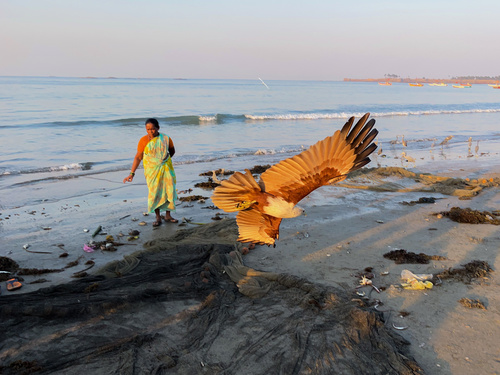
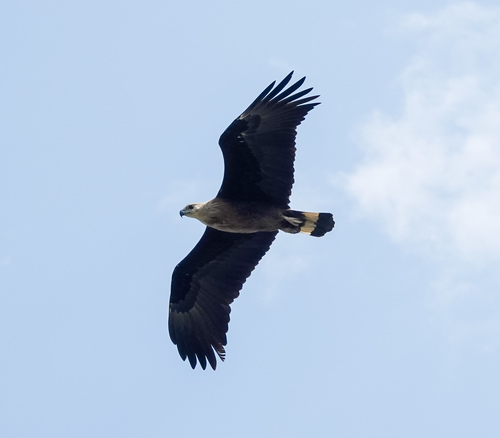
Brahminy Kite (Haliastur indus) Brahminy Kite
Pallas's Fish-Eagle (Haliaeetus leucoryphus) Pallas's Fish-Eagle

Media

Loading…

In short

The most reliable field mark is the Brahminy Kite's bold white head and breast contrasting with rich chestnut body and wings, versus the Pallas's Fish-Eagle's sandy-brown hood, whitish face, and much bulkier, darker brown body with a black tail band and white tail base. Immature birds are a common source of confusion: juvenile Brahminy Kites are paler brown overall with a rounded tail and a squarish pale patch at the underwing carpal, while juvenile Pallas's Fish-Eagles are darker, cooler brown, with a white band on the underwing and lack the adult's tail band. Size is a major clue: Pallas's Fish-Eagle is nearly three times heavier and much longer-winged, appearing massive and eagle-like compared to the much smaller, lighter Brahminy Kite. Both can be seen near water, but the kite is typically coastal or over wetlands, while the fish-eagle is a rare, endangered species of large inland lakes and rivers.

Identification tips

  1. Size and bulk: Pallas's Fish-Eagle is truly eagle-sized, almost three times heavier than Brahminy Kite. If the bird looks massive, with a heavy bill and talons, it's the fish-eagle. If it seems slender and kite-like, it's the kite. This is reliable at any distance with experience.
  2. Tail shape: Brahminy Kite always has a rounded tail, while Pallas's Fish-Eagle has a straight-cut tail with a distinctive black band and white base in adults. Juvenile fish-eagles lack the tail band but still have a straighter tail than the kite.
  3. Adult head and body contrast: Brahminy Kite adults show a striking white head and breast against rich chestnut body and wings. Pallas's Fish-Eagle adults have a sandy-brown hood and whitish face, but the rest of the plumage is much darker and bulkier.
  4. Juvenile underwing pattern: Juvenile Brahminy Kites show a squarish pale patch at the underwing carpal, separated from the rest of the underwing. Juvenile Pallas's Fish-Eagles have a white band across the underwing (coverts and inner primaries), but not a squarish patch. This is a key flight mark.
  5. Flight style: Brahminy Kite soars with wings angled and tail rounded, often gliding lightly. Pallas's Fish-Eagle flies with long, broad wings and a slow, powerful beat, more like a true sea-eagle.
  6. Bill and feet: Pallas's Fish-Eagle has a proportionally larger bill and feet, visible when perched or in good flight views.
  7. Habitat context: Brahminy Kite is common along coasts and wetlands, often near people. Pallas's Fish-Eagle is rare, found only at large, undisturbed inland lakes and rivers.
  8. Perched posture: Fish-eagle perches upright and massive, often on exposed snags; kite perches more lightly, sometimes in groups.
  9. Tail pattern in flight: Adult fish-eagle shows a black tail band with white base; kite never shows this pattern.
  10. Body color: Brahminy Kite is rich chestnut with white head/breast; fish-eagle is dark brown with sandy-brown hood and rufous back.
  11. Juvenile confusion: If the bird is overall pale brown with a rounded tail and squarish underwing patch, it's a young Brahminy Kite. If darker, cooler brown with a white underwing band and no tail band, it's a juvenile fish-eagle.
  12. Relative abundance: If seen in a populated or coastal area, Brahminy Kite is far more likely. Pallas's Fish-Eagle is very rare and local.
  13. Wing shape: Fish-eagle's wings are long and broad, especially in flight; kite's are shorter and more angled.
  14. Plumage transitions: Fish-eagle takes up to four years to reach adult plumage, so intermediate birds may show a mix of brown and sandy tones but never the kite's white head.
  15. Never rely on voice: Vocalizations are not described as diagnostic in the sources; separation should be made on plumage, structure, and context.

Size

Pallas's Fish-Eagle is dramatically larger, weighing around 2900 g (average adult) compared to the Brahminy Kite's 320–673 g [wikipedia][wikidata]. In length, the fish-eagle is 72–85 cm with a 180–215 cm wingspan, while the kite is 45–51 cm long with a 109–124 cm wingspan. In the field, this means the fish-eagle appears truly eagle-sized, with long, broad wings and a heavy build, while the Brahminy Kite is much more slender and kite-like. The difference is especially obvious in direct comparison or when seen near other raptors or large waterbirds.

Plumage

Juvenile and immature birds are the main pitfall. Juvenile Brahminy Kites are paler brown overall, with a rounded tail and a squarish pale patch at the underwing carpal — this pale patch is separated from the rest of the underwing and is diagnostic for Brahminy Kite of all ages, but especially in young birds. Juvenile Pallas's Fish-Eagles are darker, cooler brown with several pale areas on the underwing (coverts and inner primaries), creating a white band across the underwing, but they lack the adult's black tail band. Adult Brahminy Kites are unmistakable with their white head and breast and chestnut body and wings, plus black wingtips and rounded tail. Adult Pallas's Fish-Eagles have a sandy-brown hood, whitish face, dark brown wings, rufous back, and a black tail with a wide white base band — this tail pattern is unique among large eagles in the region. Both species have dark bills and talons, but the fish-eagle's are proportionally larger.

Behaviour

Brahminy Kites typically soar with wings angled and tail rounded, giving a light, agile, kite-like impression. They are often seen gliding or circling over water, sometimes scavenging. Pallas's Fish-Eagle is much heavier in flight, with long, broad, and rather slender wings for a sea-eagle, and a slower, more powerful flight style. They often perch upright and conspicuous near large lakes or rivers, and their hunting is more direct, taking large fish or waterbirds from the surface. The kite's flight is more buoyant and less direct than the fish-eagle's.

Habitat

Brahminy Kite is common and widespread along coasts, estuaries, and large inland wetlands throughout the Indian subcontinent, Southeast Asia, and Australia. It is often seen near human habitation and is tolerant of disturbed areas. Pallas's Fish-Eagle is rare and local, found mainly around large inland lakes and rivers in Central and South Asia, and is much less likely to be encountered, especially away from extensive freshwater bodies. The fish-eagle's presence usually indicates a large, undisturbed water body, while the kite is much more adaptable.

Submit a better description

Use the same sections as the comparison. Your text is published immediately.

The most reliable field mark is the Brahminy Kite's bold white head and breast contrasting with rich chestnut body and wings, versus the Pallas's Fish-Eagle's sandy-brown hood, whitish face, and much bulkier, darker brown body with a black tail band and white tail base. Immature birds are a common source of confusion: juvenile Brahminy Kites are paler brown overall with a rounded tail and a squarish pale patch at the underwing carpal, while juvenile Pallas's Fish-Eagles are darker, cooler brown, with a white band on the underwing and lack the adult's tail band. Size is a major clue: Pallas's Fish-Eagle is nearly three times heavier and much longer-winged, appearing massive and eagle-like compared to the much smaller, lighter Brahminy Kite. Both can be seen near water, but the kite is typically coastal or over wetlands, while the fish-eagle is a rare, endangered species of large inland lakes and rivers.

  1. Size and bulk: Pallas's Fish-Eagle is truly eagle-sized, almost three times heavier than Brahminy Kite. If the bird looks massive, with a heavy bill and talons, it's the fish-eagle. If it seems slender and kite-like, it's the kite. This is reliable at any distance with experience.
  2. Tail shape: Brahminy Kite always has a rounded tail, while Pallas's Fish-Eagle has a straight-cut tail with a distinctive black band and white base in adults. Juvenile fish-eagles lack the tail band but still have a straighter tail than the kite.
  3. Adult head and body contrast: Brahminy Kite adults show a striking white head and breast against rich chestnut body and wings. Pallas's Fish-Eagle adults have a sandy-brown hood and whitish face, but the rest of the plumage is much darker and bulkier.
  4. Juvenile underwing pattern: Juvenile Brahminy Kites show a squarish pale patch at the underwing carpal, separated from the rest of the underwing. Juvenile Pallas's Fish-Eagles have a white band across the underwing (coverts and inner primaries), but not a squarish patch. This is a key flight mark.
  5. Flight style: Brahminy Kite soars with wings angled and tail rounded, often gliding lightly. Pallas's Fish-Eagle flies with long, broad wings and a slow, powerful beat, more like a true sea-eagle.
  6. Bill and feet: Pallas's Fish-Eagle has a proportionally larger bill and feet, visible when perched or in good flight views.
  7. Habitat context: Brahminy Kite is common along coasts and wetlands, often near people. Pallas's Fish-Eagle is rare, found only at large, undisturbed inland lakes and rivers.
  8. Perched posture: Fish-eagle perches upright and massive, often on exposed snags; kite perches more lightly, sometimes in groups.
  9. Tail pattern in flight: Adult fish-eagle shows a black tail band with white base; kite never shows this pattern.
  10. Body color: Brahminy Kite is rich chestnut with white head/breast; fish-eagle is dark brown with sandy-brown hood and rufous back.
  11. Juvenile confusion: If the bird is overall pale brown with a rounded tail and squarish underwing patch, it's a young Brahminy Kite. If darker, cooler brown with a white underwing band and no tail band, it's a juvenile fish-eagle.
  12. Relative abundance: If seen in a populated or coastal area, Brahminy Kite is far more likely. Pallas's Fish-Eagle is very rare and local.
  13. Wing shape: Fish-eagle's wings are long and broad, especially in flight; kite's are shorter and more angled.
  14. Plumage transitions: Fish-eagle takes up to four years to reach adult plumage, so intermediate birds may show a mix of brown and sandy tones but never the kite's white head.
  15. Never rely on voice: Vocalizations are not described as diagnostic in the sources; separation should be made on plumage, structure, and context.

Pallas's Fish-Eagle is dramatically larger, weighing around 2900 g (average adult) compared to the Brahminy Kite's 320–673 g [wikipedia][wikidata]. In length, the fish-eagle is 72–85 cm with a 180–215 cm wingspan, while the kite is 45–51 cm long with a 109–124 cm wingspan. In the field, this means the fish-eagle appears truly eagle-sized, with long, broad wings and a heavy build, while the Brahminy Kite is much more slender and kite-like. The difference is especially obvious in direct comparison or when seen near other raptors or large waterbirds.

Juvenile and immature birds are the main pitfall. Juvenile Brahminy Kites are paler brown overall, with a rounded tail and a squarish pale patch at the underwing carpal — this pale patch is separated from the rest of the underwing and is diagnostic for Brahminy Kite of all ages, but especially in young birds. Juvenile Pallas's Fish-Eagles are darker, cooler brown with several pale areas on the underwing (coverts and inner primaries), creating a white band across the underwing, but they lack the adult's black tail band. Adult Brahminy Kites are unmistakable with their white head and breast and chestnut body and wings, plus black wingtips and rounded tail. Adult Pallas's Fish-Eagles have a sandy-brown hood, whitish face, dark brown wings, rufous back, and a black tail with a wide white base band — this tail pattern is unique among large eagles in the region. Both species have dark bills and talons, but the fish-eagle's are proportionally larger.

Brahminy Kites typically soar with wings angled and tail rounded, giving a light, agile, kite-like impression. They are often seen gliding or circling over water, sometimes scavenging. Pallas's Fish-Eagle is much heavier in flight, with long, broad, and rather slender wings for a sea-eagle, and a slower, more powerful flight style. They often perch upright and conspicuous near large lakes or rivers, and their hunting is more direct, taking large fish or waterbirds from the surface. The kite's flight is more buoyant and less direct than the fish-eagle's.

Brahminy Kite is common and widespread along coasts, estuaries, and large inland wetlands throughout the Indian subcontinent, Southeast Asia, and Australia. It is often seen near human habitation and is tolerant of disturbed areas. Pallas's Fish-Eagle is rare and local, found mainly around large inland lakes and rivers in Central and South Asia, and is much less likely to be encountered, especially away from extensive freshwater bodies. The fish-eagle's presence usually indicates a large, undisturbed water body, while the kite is much more adaptable.

Discard your changes?

You have unsaved edits. If you leave now, those changes will be lost.

Brahminy Kite · Pallas's Fish-Eagle · My Tricky Birds