
Brambling vs Twite
Fringilla montifringilla versus Linaria flavirostris
Play a quiz with Brambling and Twite
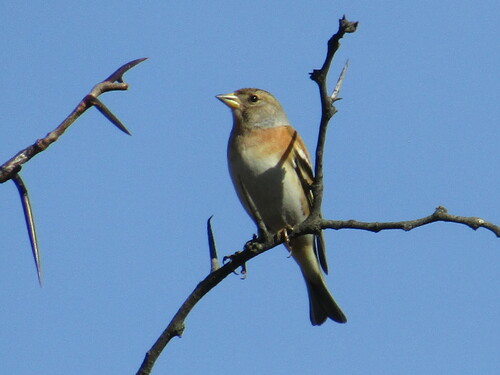 Brambling
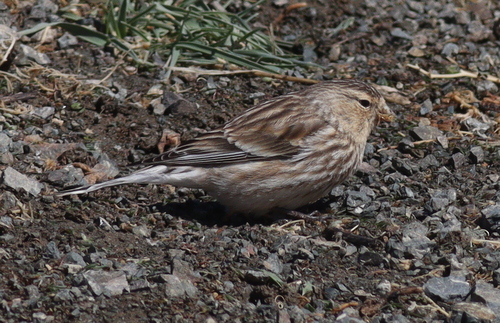 Twite
Twite
In short
The most reliable field mark to separate Brambling from Twite is the Brambling’s bold white rump (all ages), which is especially obvious in flight, versus the Twite’s brown or pinkish rump (brown in females and immatures, pink in adult males). Bramblings also show a striking orange breast and white belly, while Twite are overall brown and streaky below. Bill color is helpful in non-breeding birds: Bramblings have a yellow bill (except breeding males, which have black), while Twite have a yellow bill in winter and grey in summer. Both species can form large flocks, so context and careful attention to plumage are key.
Identification tips
- White rump (Brambling) vs brown/pink rump (Twite): In all ages and sexes, Brambling shows a white rump in flight, while Twite has a brown rump (females/immatures) or pink rump (adult males). This is the single most reliable field mark, especially in flight.
- Underparts pattern: Brambling has a sharply demarcated orange breast and white belly, with dark spots on the flanks. Twite is buff to whitish below, streaked with brown, and lacks any strong color contrast or spotting.
- Scapular color: Brambling scapulars are orange, while Twite’s upperparts are brown streaked with black. This is subtle but can help in perched birds.
- Bill color: In non-breeding plumage, Brambling has a yellow bill (except breeding males, which have a black bill). Twite’s bill is yellow in winter, turning grey in summer. Bill color is not diagnostic in winter, but a black bill in spring indicates a male Brambling.
- Head pattern: Breeding male Brambling has a black head and dark upperparts, which Twite never shows. Females and immatures Brambling have plainer heads, but still lack the overall streakiness of Twite.
- Flank markings: Brambling shows dark spots on the flanks, Twite is streaked but not spotted.
- Tail pattern: Brambling lacks white outer tail feathers (unlike Chaffinch), and Twite’s tail is plain, so tail pattern is not helpful between these two.
- Size and shape: Brambling is slightly bulkier and more robust, with a Chaffinch-like shape. Twite is more slender and linnet-like, but this is subtle and unreliable at a distance.
- Habitat: Brambling is more likely in woodland or mixed habitats, often with Chaffinch. Twite prefers open upland or coastal grasslands, especially in winter.
- Flock composition: Both species can be in large flocks, but Brambling often mixes with Chaffinch, while Twite flocks may include other finches but are more likely in open country.
- Voice: Twite’s nasal 'twaa-it' call is distinctive; Brambling’s calls are less so. If you hear the nasal call, it’s Twite.
- Breeding plumage males: Only Brambling males have a black head and dark upperparts in breeding season; Twite males never show this.
- Seasonal bill color: In spring/summer, a black bill points to male Brambling; a grey bill to Twite. In winter, both can have yellow bills, so use other marks.
- Upperpart streaking: Twite is always streaked above; Brambling is more uniform above, except for the orange scapulars.
- Context: If you see a streaky brown finch in open, grassy, or coastal habitat, especially in Britain or Ireland, Twite is more likely. In wooded or mixed habitats, especially with Chaffinch, suspect Brambling.
Size
Brambling is slightly heavier (22g) and similar in size and shape to a Chaffinch, giving a chunkier impression than Twite, which is more linnet-like and slightly smaller (length for Twite is 13–13.5 cm, but no mass given). In the field, size difference is subtle and not always reliable, but Brambling may appear a bit bulkier, especially around the chest and head.
Plumage
Juvenile and non-breeding Brambling can be confused with Twite due to duller colors, but several key differences remain. Brambling of all ages and sexes shows a white rump in flight, while Twite never does—adult male Twite have a pink rump, females and immatures have a brown rump. Brambling’s underparts are orange on the breast with a sharp contrast to a white belly, and the flanks are dark-spotted; Twite’s underparts are buff to whitish with fine brown streaking throughout and no strong color contrast. Brambling scapulars are orange, while Twite’s upperparts are brown streaked with black. Brambling lacks the white outer tail feathers seen in Chaffinch, but Twite’s tail is plain and not as distinctive. Bill color can help: non-breeding Brambling and winter Twite both have yellow bills, but breeding Brambling males have a black bill and Twite’s bill turns grey in summer. Brambling males in breeding plumage are very distinctive with a black head and dark upperparts, which Twite never shows.
Behaviour
Both species may be seen in large flocks, especially outside the breeding season. Bramblings often join other finches in mixed flocks, sometimes in huge numbers. Twite also forms large flocks, particularly on coasts and saltmarshes in winter, sometimes mixed with other finches. Brambling tends to be more arboreal, feeding in trees or on the ground below, while Twite is more often seen feeding on the ground in open habitats. Flight in both is undulating, but Brambling may appear more robust and less agile than the lighter, more linnet-like Twite.
Habitat
Brambling is a widespread and migratory finch, often seen in woodlands, forest edges, and sometimes gardens, especially in winter. Twite is more specialized, breeding in upland grasslands, coastal machair, and low shrubland, and wintering on coasts and saltmarshes. If you encounter a streaky brown finch in open upland or coastal grassland, Twite is more likely; in wooded or mixed habitats, especially with flocks of Chaffinch, Brambling is the better bet.
Voice
Twite has a very distinctive nasal call, described as 'twaa-it', and a song of fast trills and twitters. Brambling’s calls are not described in detail here, but they are not as nasal or distinctive as Twite’s. If you hear the characteristic 'twaa-it', you are likely listening to a Twite.