Brandt's Cormorant vs Double-crested Cormorant
Urile penicillatus versus Nannopterum auritum
Play a quiz with Brandt's Cormorant and Double-crested Cormorant
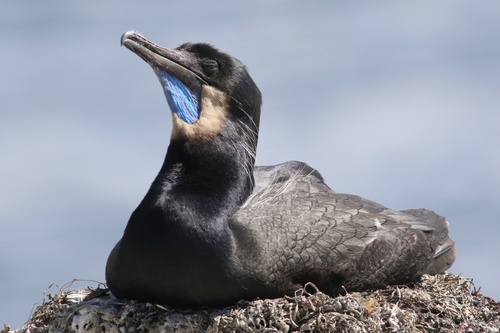
Brandt's Cormorant
Double-crested Cormorant
In short
Brandt's Cormorant and Double-crested Cormorant are both large, dark seabirds found along North America's coasts, but they can be distinguished by their gular pouches and habitat preferences. Brandt's has a distinctive cobalt blue gular pouch during breeding, while the Double-crested shows a yellow-orange gular pouch. Both species are similar in size and structure, making their gular pouch color a key field mark.
Identification tips
1. Gular Pouch Color: Look for the cobalt blue gular pouch in Brandt's during breeding season, versus the yellow-orange in Double-crested. 2. Habitat: Brandt's is more coastal and marine, while Double-crested can be found inland. 3. Breeding Plumage: Double-crested shows white head plumes during breeding, which Brandt's lacks. 4. Range: Consider the geographic location; Brandt's is more restricted to the West Coast.
Size
Both species are similar in size, with robust bodies and long necks typical of cormorants.
Plumage
Brandt's Cormorant has a more uniform dark plumage, while the Double-crested Cormorant may show a slight sheen and has distinctive white plumes on the head during breeding.
Behaviour
Both species exhibit typical cormorant behaviors such as diving for fish and spreading wings to dry, but Brandt's is more often seen in marine environments.
Habitat
Brandt's Cormorant is primarily found in marine and estuarine environments along the West Coast, while the Double-crested Cormorant is more adaptable, found in both freshwater and coastal areas across North America.
Voice
Vocalizations are not a primary distinguishing feature in the field; both species have similar guttural calls.
Brandt's Cormorant · Double-crested Cormorant · My Tricky Birds