
Brent Goose vs Barnacle Goose
Branta bernicla versus Branta leucopsis
Play a quiz with Brent Goose and Barnacle Goose
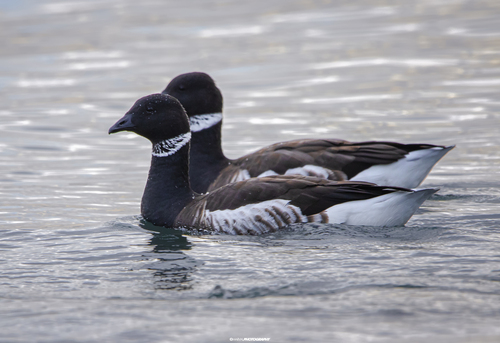 Brent Goose
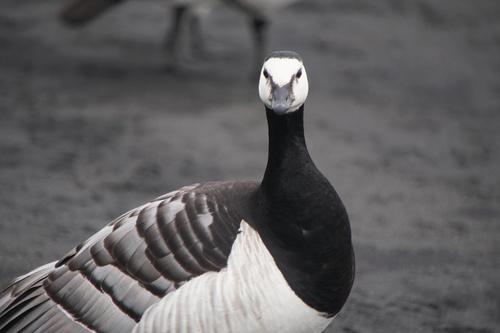 Barnacle Goose
In short
The most reliable way to separate Brent Goose from Barnacle Goose is by head and underpart pattern: Barnacle Goose shows a striking white face and black neck, with a clean white belly and silvery barred upperparts, while Brent Goose (all forms) has a dark head and neck with only a small white neck patch, and never shows a full white face or belly. In flight, Barnacle Goose reveals a bold white rump and silvery underwings, while Brent Goose has a pure white undertail and a very short, black tail. Juvenile Barnacle Geese closely resemble adults, so these marks are consistent across ages. Both are small, compact geese with stubby bills, but Brent Goose is typically a bit smaller and darker overall, especially in the dark-bellied and black forms. If you see a goose with a white face and silvery barred back, it's a Barnacle; if the face is dark with just a white neck spot, it's a Brent.
Identification tips
- Face pattern: Barnacle Goose always shows a bold white face and black crown/neck, visible at any distance. Brent Goose never has a full white face; look for a dark head with a small white neck patch.
- Belly and underparts: Barnacle Goose has a clean white belly and flanks, sharply contrasting with the black breast. Brent Goose varies: dark-bellied birds are uniformly dark below, pale-bellied birds have paler underparts but never as white or sharply defined as Barnacle.
- Back and wing coverts: Barnacle Goose has silvery-grey upperparts with crisp black-and-white barring, often shining in sunlight. Brent Goose is more uniformly brownish or sooty above, lacking the silvery or barred look.
- Rump and tail in flight: Barnacle Goose shows a bold white V-shaped rump and pale underwing linings. Brent Goose has a pure white undertail and a very short, all-black tail (shortest of any goose), but no white rump patch.
- Neck markings: Brent Goose has a small white patch on the side of the neck (sometimes forming a partial collar in black brant), but never a full collar or white face. Barnacle Goose has no neck patch, just a continuous black neck.
- Bill shape: Both have short, stubby black bills, but Brent Goose's is especially small and delicate, matching its smaller head.
- Size and jizz: Barnacle Goose is slightly larger and bulkier, with a longer wingspan and a more upright stance. Brent Goose is smaller, more compact, and often looks shorter-tailed.
- Juvenile plumage: Juvenile Barnacle Geese are similar to adults but have more rounded mantle and flank feathers; they still show the white face and belly. Brent Goose juveniles resemble adults of their respective subspecies, so the same head and underpart contrasts apply.
- Subspecies confusion: Brent Goose comes in three main forms (dark-bellied, pale-bellied, black brant); all are darker and less contrasting than Barnacle Goose, and none show a white face or silvery barred back.
- Flock composition: Mixed flocks are rare but possible in wintering areas. Always check each bird for face and belly pattern, especially in large groups.
- Habitat clues: Brent Goose is almost always coastal in winter; Barnacle Goose is more likely to be found inland, especially in feral populations, but this is not a safe separation mark.
- Flight views: In flight, look for Barnacle's white face and rump; Brent's white undertail and short black tail.
- Pitfalls: Distant or backlit views can obscure the face pattern; always try for a side view of the head and underparts. Juvenile Barnacle Geese are not browner-faced like some other geese, so the white face is reliable at all ages.
- Voice: Not covered in the notes; do not rely on calls for separation unless you know them well.
- Season and sex: No strong seasonal or sex-based differences for either species; the main marks are reliable year-round and for both sexes.
Size
Both species are similar in length (Brent Goose: 55–66 cm; Barnacle Goose: 55–70 cm), but Barnacle Goose is slightly heavier on average (mean mass ~1687 g) and has a broader wingspan (120–145 cm vs. Brent's 106–121 cm). In the field, Barnacle Goose can appear a bit bulkier and longer-winged, but this is subtle and not always reliable for single birds. Both have a compact, short-billed look, but Brent Goose is the smallest Branta in the region, with a particularly short tail.
Plumage
Juvenile and adult Barnacle Geese are similar, so the following marks work for all ages: Barnacle Goose shows a bold white face, black head and neck, clean white belly, and silvery-grey barred upperparts and wings. In flight, look for the V-shaped white rump and pale underwing linings. Brent Goose (all forms) has a dark head and neck with only a small white patch on the neck sides, never a full white face. The underparts vary by subspecies: dark-bellied birds are uniformly dark, pale-bellied have paler flanks and belly, and black brant are very dark with a strong white flank patch. All have a pure white undertail and a very short black tail. No age-specific upperwing pattern is mentioned for either species, so focus on head, belly, and rump/undertail contrasts.
Behaviour
Both species are gregarious and graze in flocks, often on coastal grasslands or estuaries. Barnacle Geese may appear a bit more upright and alert, with a slightly stiffer carriage. Brent Geese often feed low to the ground and can look more compact and horizontal. Both species are wary and quick to take flight if disturbed, but behavioral differences are subtle and not reliable for separation.
Habitat
Both winter mainly in coastal habitats, especially estuaries and saltmarshes. Brent Goose is almost exclusively coastal in winter, rarely venturing inland. Barnacle Goose also favors coastal areas but can be found more readily on inland lakes and grassy fields, especially during migration or in feral populations. If you see a small Branta goose well inland, Barnacle is more likely, but context alone is not diagnostic.