Bridled Titmouse vs Oak Titmouse
Baeolophus wollweberi versus Baeolophus inornatus
Play a quiz with Bridled Titmouse and Oak Titmouse

Bridled Titmouse
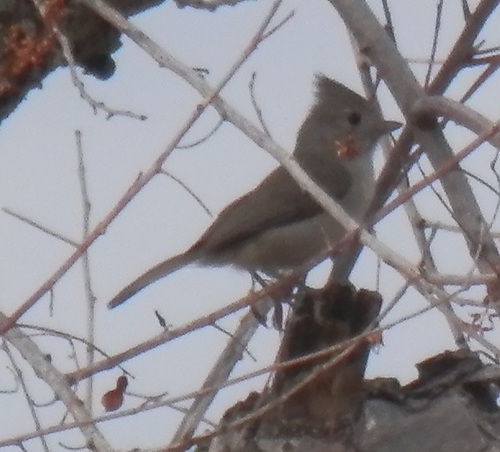
Oak Titmouse
In short
The Bridled Titmouse and Oak Titmouse can be distinguished primarily by their facial patterns and habitat preferences. The Bridled Titmouse has a striking black-and-white facial pattern with a distinctive 'bridle' effect, while the Oak Titmouse is more uniformly gray-brown. Both species are similar in size and structure, but their vocalizations and preferred habitats offer additional clues.
Identification tips
- Look for the black-and-white facial pattern of the Bridled Titmouse, especially the 'bridle' effect. 2. Note the habitat: Bridled Titmouse in oak-pine woodlands, Oak Titmouse in oak woodlands. 3. Listen for vocal differences: Bridled Titmouse has a more complex song. 4. Both are similar in size, so focus on plumage and habitat for identification.
Size
Both species are similar in size, typical of small titmice, with no significant differences in structure such as bill shape or tail length.
Plumage
The Bridled Titmouse features a bold black-and-white facial pattern with a prominent 'bridle' effect, including a black stripe through the eye and a white face. In contrast, the Oak Titmouse is more uniformly gray-brown with a less distinct facial pattern, lacking the striking contrast seen in the Bridled Titmouse.
Behaviour
Both species exhibit typical titmouse behaviors such as active foraging and acrobatic movements. The Bridled Titmouse often has helpers during breeding, which is unusual among titmice.
Habitat
The Bridled Titmouse is typically found in oak-pine woodlands of the southwestern U.S. and Mexico, while the Oak Titmouse prefers oak woodlands and chaparral in California and parts of Oregon.
Voice
The vocalizations of these species differ, with the Bridled Titmouse having a more varied and complex song compared to the simpler, more repetitive calls of the Oak Titmouse.