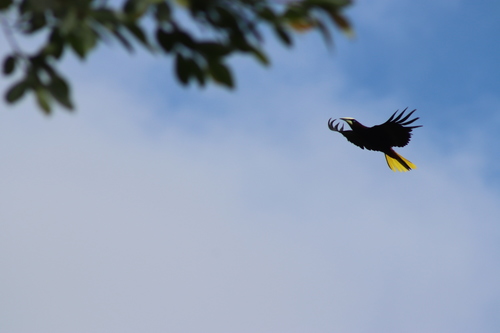
Broad-billed Motmot vs Chestnut-headed Oropendola
Electron platyrhynchum versus Psarocolius wagleri
Play a quiz with Broad-billed Motmot and Chestnut-headed Oropendola

Broad-billed Motmot
Chestnut-headed Oropendola
In short
The Broad-billed Motmot and Chestnut-headed Oropendola are not closely related and differ significantly in appearance and behavior. The motmot is smaller, with a distinctive blue-green chin and large central chest spot, while the oropendola is larger with a chestnut head and black body. Both species have unique vocalizations, but their calls are quite different.
Identification tips
Broad-billed Motmot: Look for a smaller bird with a blue-green chin and a large central chest spot. Chestnut-headed Oropendola: Identify by its larger size, chestnut head, and black body. Note their distinct behaviors and habitats to aid identification.
Size
The Broad-billed Motmot is smaller and more compact compared to the larger, more elongated Chestnut-headed Oropendola.
Plumage
The Broad-billed Motmot has a blue-green chin and a large central chest spot, appearing chunky and large-headed. In contrast, the Chestnut-headed Oropendola has a chestnut head and a predominantly black body.
Behaviour
Motmots are often seen perched quietly in the understory, while oropendolas are more social and often found in colonies, displaying more active and conspicuous behavior.
Habitat
Both species can be found in tropical forests, but the motmot prefers dense forest understory, whereas the oropendola is more often seen in open areas near forest edges or clearings.
Voice
The Broad-billed Motmot has a short, nasal groan given intermittently, whereas the Chestnut-headed Oropendola produces a variety of loud, musical calls.
Broad-billed Motmot · Chestnut-headed Oropendola · My Tricky Birds