
Broad-billed Sandpiper vs Curlew Sandpiper
Calidris falcinellus versus Calidris ferruginea
Play a quiz with Broad-billed Sandpiper and Curlew Sandpiper
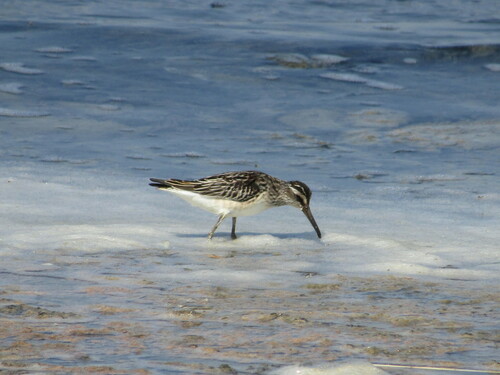 Broad-billed Sandpiper
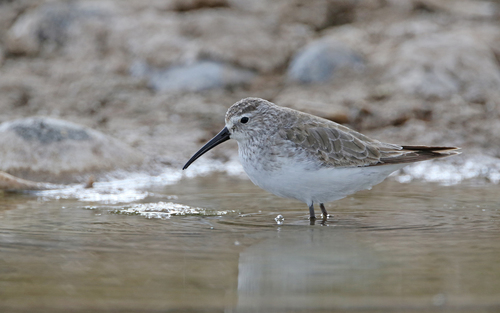 Curlew Sandpiper
In short
The most reliable field mark to separate Broad-billed Sandpiper from Curlew Sandpiper is the Broad-billed's distinctive head pattern: a strong double (split) supercilium and pale crown stripe, visible in all plumages and ages. In flight, Curlew Sandpiper shows a bold white rump patch and a white wing stripe, both lacking in Broad-billed. Juveniles and non-breeding birds can be especially confusing, but careful attention to head pattern, bill shape, and underpart markings will usually clinch the ID. Structure and feeding jizz also differ subtly, with Broad-billed appearing shorter-legged and more compact.
Identification tips
- Head pattern is key: Broad-billed Sandpiper always shows a strong double (split) supercilium and a pale crown stripe, visible in all ages and plumages. Curlew Sandpiper never shows this; it has a plain face with a single white eyebrow.
- In flight, check the rump and wing stripe: Curlew Sandpiper of all ages has a large white rump patch and a bold white wing stripe. Broad-billed Sandpiper lacks both features; its rump is not contrasting, and the wing is plain.
- Bill shape: Broad-billed Sandpiper has a medium-length, straight bill with a distinctly downturned tip (not a long, decurved bill). Curlew Sandpiper's bill is longer, thinner, and more evenly decurved throughout its length.
- Leg length: Curlew Sandpiper is longer-legged and stands taller, especially when feeding. Broad-billed Sandpiper appears shorter-legged and more compact.
- Underpart markings (non-breeding/juvenile): Broad-billed Sandpiper has white flanks and belly with brown-streaked breast, even in juvenile plumage. Curlew Sandpiper is cleaner white below, with only faint pale grey streaks in non-breeding plumage and a scaly, buff-tinged look in juveniles.
- Upperpart pattern (juvenile): Juvenile Broad-billed shows pale 'tramlines' down the mantle; Curlew Sandpiper juvenile has a more evenly scaly and buff-tinged upperpart pattern.
- Breeding plumage: Curlew Sandpiper is rich reddish below and on the head in breeding plumage (especially males), with a white rump and wing stripe. Broad-billed Sandpiper never shows rufous below; instead, look for dark brown upperparts with pale fringes and the split supercilium.
- Face pattern (all ages): Only Broad-billed Sandpiper has the split supercilium and pale crown stripe; Curlew Sandpiper's face is plain except for a single white eyebrow.
- Feeding jizz: Broad-billed Sandpiper is more crouched and compact; Curlew Sandpiper is more upright and graceful.
- Size: Curlew Sandpiper is larger and heavier, but size overlap means this is only a supporting mark.
- Association: Broad-billed is more likely to be with Dunlin flocks; Curlew Sandpiper often with other Calidris on open mudflats.
- Voice: Broad-billed's dry, whistling 'dree-it' and clicking 'dik dik' can help, especially if Little Stint is ruled out. Curlew Sandpiper's calls are less distinctive in this context.
- Seasonal context: In western Europe, Broad-billed Sandpiper is rare and usually only on passage; Curlew Sandpiper is more widespread and regular.
- Sex differences (breeding): Male Curlew Sandpiper is richer rufous below than female, but both sexes differ from Broad-billed by overall coloration and head pattern.
- Pitfall: In dull light or at distance, Curlew Sandpiper's plain face and white rump/wing stripe in flight are the best clues; Broad-billed's head pattern is diagnostic up close but can be missed at range.
Size
Broad-billed Sandpiper is slightly smaller and lighter than Curlew Sandpiper. Broad-billed is 16–18 cm long with a body mass around 37 g [wikidata], while Curlew Sandpiper is larger at 18–23 cm and typically heavier (44–117 g, though no AVONET value is given here) [wikipedia]. In the field, Curlew Sandpiper often looks longer-legged and longer-billed, with a more attenuated rear end.
Plumage
-
Juvenile/First-year birds: Curlew Sandpiper juveniles show a scaly, buff-tinged upperpart pattern with a bold white rump and wing stripe in flight. Broad-billed Sandpiper juveniles have pale 'tramlines' down the mantle, but their underparts are whiter with brown streaking on the breast, and they lack the Curlew's white rump and wing stripe. Broad-billed juveniles also show the split supercilium and pale crown stripe, which Curlew never has.
-
Non-breeding/winter: Both species become greyer above and white below, but Broad-billed always retains its split supercilium and pale crown stripe, while Curlew Sandpiper keeps a plain face with a single white eyebrow. In flight, Curlew Sandpiper's white rump and wing stripe remain diagnostic.
-
Breeding: Curlew Sandpiper adults in breeding plumage are rich reddish below and on the head (males more so), with a white rump and wing stripe. Broad-billed Sandpiper is never rufous below; instead, it has dark brown upperparts with narrow pale fringes, white underparts with blackish breast markings, and the split supercilium. The head pattern is always sharper in Broad-billed.
Behaviour
Broad-billed Sandpiper tends to forage with a more crouched, compact posture and appears shorter-legged. Curlew Sandpiper is more upright, with longer legs and a more graceful gait. Both species are gregarious and often mix with other small waders, but Broad-billed is more likely to be seen in tight flocks with Dunlin, while Curlew Sandpiper often associates with other Calidris species on open mudflats.
Habitat
Both species are long-distance migrants breeding in the Siberian Arctic, but their migration routes and wintering areas differ. Broad-billed Sandpiper is rare in western Europe due to its south-easterly migration and is more likely in eastern Africa, south and southeast Asia, and Australasia in winter. Curlew Sandpiper winters widely in Africa, southern Eurasia, and Oceania, favoring tidal mudflats and saltpans. Overlap occurs, but Curlew Sandpiper is generally more widespread and numerous on coastal mudflats.
Voice
Broad-billed Sandpiper gives a dry, whistling 'dree-it, dree-it' and a clicking 'dik dik', which is similar to Little Stint and higher-pitched than Dunlin. Curlew Sandpiper's calls are not described in detail here, but they are not noted as similar to Broad-billed's distinctive dry, whistling notes.