Birdr

Broad-billed Sandpiper vs Sharp-tailed Sandpiper

Calidris falcinellus versus Calidris acuminata

Play a quiz with Broad-billed Sandpiper and Sharp-tailed Sandpiper
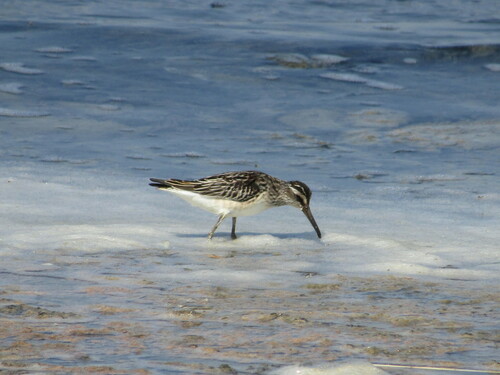
Broad-billed Sandpiper (Calidris falcinellus) Broad-billed Sandpiper
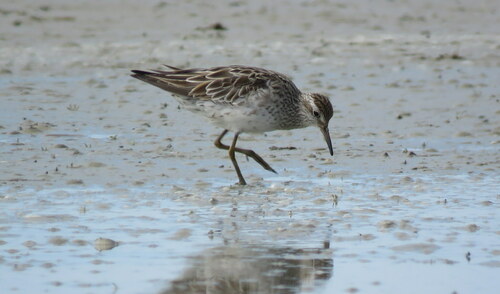
Sharp-tailed Sandpiper (Calidris acuminata) Sharp-tailed Sandpiper

Media

Loading…

In short

The Broad-billed Sandpiper and Sharp-tailed Sandpiper can be distinguished by their bill shape and facial markings. The Broad-billed Sandpiper has a distinctive broad, flattened bill and a prominent split supercilium, while the Sharp-tailed Sandpiper has a more tapered bill and lacks the split supercilium.

Identification tips

Size

Both species are similar in size, but the Sharp-tailed Sandpiper may appear slightly bulkier.

Plumage

The Broad-billed Sandpiper has a more pronounced split supercilium and a darker cap, whereas the Sharp-tailed Sandpiper has a more uniform facial pattern with a less distinct supercilium.

Behaviour

Both species exhibit similar foraging behaviors, often seen probing mudflats, but the Broad-billed Sandpiper may appear more deliberate in its movements.

Habitat

Both species frequent mudflats and coastal wetlands during migration, but the Sharp-tailed Sandpiper is more often found in grassy marshes during its breeding season.

Voice

Vocalizations are not the most reliable distinguishing feature as both species have similar calls, often described as high-pitched and trilling.

Submit a better description

Use the same sections as the comparison. Your text is published immediately.

The Broad-billed Sandpiper and Sharp-tailed Sandpiper can be distinguished by their bill shape and facial markings. The Broad-billed Sandpiper has a distinctive broad, flattened bill and a prominent split supercilium, while the Sharp-tailed Sandpiper has a more tapered bill and lacks the split supercilium.

  • Bill shape: Broad-billed Sandpiper has a broader, flattened bill; Sharp-tailed Sandpiper has a more tapered bill.
  • Supercilium: Broad-billed Sandpiper has a split supercilium; Sharp-tailed Sandpiper's is less distinct.
  • Cap color: Broad-billed Sandpiper has a darker cap.
  • Habitat during breeding: Sharp-tailed Sandpiper prefers grassy marshes.
  • Size perception: Sharp-tailed Sandpiper may appear bulkier.

Both species are similar in size, but the Sharp-tailed Sandpiper may appear slightly bulkier.

The Broad-billed Sandpiper has a more pronounced split supercilium and a darker cap, whereas the Sharp-tailed Sandpiper has a more uniform facial pattern with a less distinct supercilium.

Both species exhibit similar foraging behaviors, often seen probing mudflats, but the Broad-billed Sandpiper may appear more deliberate in its movements.

Both species frequent mudflats and coastal wetlands during migration, but the Sharp-tailed Sandpiper is more often found in grassy marshes during its breeding season.

Vocalizations are not the most reliable distinguishing feature as both species have similar calls, often described as high-pitched and trilling.

Discard your changes?

You have unsaved edits. If you leave now, those changes will be lost.

Broad-billed Sandpiper · Sharp-tailed Sandpiper · My Tricky Birds