
Broad-winged Hawk vs Red-tailed Hawk
Buteo platypterus versus Buteo jamaicensis
Play a quiz with Broad-winged Hawk and Red-tailed Hawk
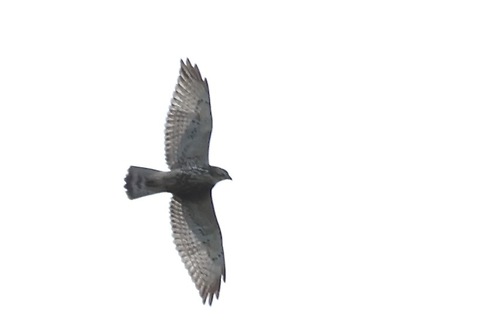 Broad-winged Hawk
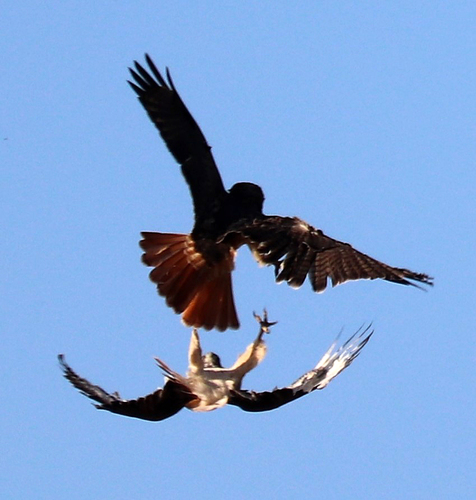 Red-tailed Hawk
In short
The best way to separate Broad-winged Hawk from Red-tailed Hawk is by focusing on tail and wing pattern, especially in flight and among immatures. Broad-winged Hawks show a short tail with bold, narrow white bands and a compact, pointed-wing silhouette, while Red-tailed Hawks (especially adults) have a longer, broader tail that is brick-red above and pale below, with a blockier, heavier build. Immature Red-tailed Hawks lack the red tail but show multiple dark tail bands and a distinctive dark belly band, which Broad-winged Hawks lack. Perched, the difference in size and proportions is also helpful: Red-tailed is much larger and bulkier, with a thick body and broad wings, while Broad-winged is smaller and more compact. Watch for these differences in flight and perched views, especially during migration or in mixed Buteo kettles.
Identification tips
- Tail pattern in flight (all ages): Broad-winged Hawk shows a short, dark tail with 1–2 bold, narrow white bands; Red-tailed Hawk (immature) shows a longer tail with about six narrow dark bands, and adults have a solid red tail with a single dark band near the tip.
- Belly pattern (immatures): Red-tailed Hawk has a distinctive dark belly band of horizontal streaks; Broad-winged Hawk lacks this, instead showing vertical streaks on a pale belly.
- Wing shape in flight: Broad-winged Hawk has relatively short, broad, and pointed wings, giving a compact, tapered look; Red-tailed Hawk has broad, rounded wings and a blocky, heavy silhouette.
- Size and bulk: Red-tailed Hawk is much larger, heavier, and bulkier than Broad-winged Hawk. If seen together or with reference, this is often obvious.
- Perched jizz: Red-tailed Hawk appears thick-bodied with a large head and long tail; Broad-winged Hawk is more compact, with a shorter tail and smaller head.
- Adult tail color: Adult Red-tailed Hawks have a brick-red tail above (light orange below), unique among North American Buteos; Broad-winged never does.
- Juvenile tail color: Immature Red-tailed lacks the red tail but still has a longer, more finely banded tail than Broad-winged.
- Underwing pattern (flight): Broad-winged Hawk shows a clean, pale underwing with dark trailing edge and dark tips; Red-tailed Hawk's underwing is broader, with a patagial mark (dark bar along leading edge, especially in adults) and a more mottled look.
- Morph confusion: Dark morph Broad-winged is rare and can be confused with dark morph Red-tailed, but note the tail pattern and overall size/shape.
- Habitat context: Broad-winged Hawks are rarely seen in open country outside migration; Red-tailed Hawks are common in open habitats, perched on poles, or soaring over fields.
- Migration behavior: Large kettles of soaring Buteos in eastern North America during fall are likely Broad-winged Hawks; Red-taileds are more solitary or in small groups.
- Head and bill: Red-tailed Hawk has a relatively short, thick bill and a head that can look small for its body; Broad-winged's head is proportionately larger for its compact frame.
- Leg color: Both have yellow legs, not useful for separation.
- Vocalizations: Not diagnostic with the available information.
- Seasonal context: Outside of migration, Broad-winged is much less likely in open areas or perched on poles; Red-tailed is common year-round in a wide variety of habitats.
Size
Red-tailed Hawk is substantially larger and heavier than Broad-winged Hawk. Broad-winged measures 32–44 cm in length with a wingspan of 74–100 cm and weighs 265–560 g. Red-tailed Hawk is blockier and heavier for its length, with a thick body and broad wings, and is considered one of the largest Buteos in North America. This size difference is usually obvious when both species are seen together or with familiar reference points. Broad-winged also has a relatively short tail and wings for a Buteo, while Red-tailed has a longer tail and overall more robust proportions.
Plumage
- Juvenile/immature plumage (most likely confusion):
- Broad-winged Hawk immatures have a pale belly with longitudinal (vertical) streaks, and the tail shows several narrow white bands on a dark background. The wings are relatively short and pointed, giving a compact look in flight. There is no dark belly band.
- Red-tailed Hawk immatures have a pale belly but with a bold, dark horizontal belly band formed by streaks, and the tail is brown with about six narrow dark bands (not red). The wings are broad and blocky, and the bird appears much chunkier in flight. The belly band is a key mark for Red-tailed, absent in Broad-winged.
- Adult plumage:
- Adult Broad-winged Hawks have a dark brown back, white underparts with horizontal barring, and a short tail with one or two bold white bands. The wings remain short and pointed.
- Adult Red-tailed Hawks have a brick-red tail above (light buff-orange below) with a single dark subterminal band, a pale underbelly with a dark belly band, and broad, chunky wings. The head can look small relative to the body. The red tail is diagnostic in adults.
- Morphs:
- Both species have light and dark morphs, but dark morph Broad-winged is rare. Dark morph Red-tailed is more frequent in western North America and shows a uniformly dark body but still has the structural and tail differences.
Behaviour
Both species are classic soaring Buteos, but Red-tailed Hawks often perch in open areas, including on utility poles and fence posts, and are tolerant of human-altered landscapes. Broad-winged Hawks are more secretive outside migration, often staying within forest interiors. During migration, Broad-winged Hawks form large kettles, sometimes with other Buteos, but their compact, pointed-wing silhouette stands out. Red-tailed Hawks are more likely to be seen alone or in pairs, except in winter concentrations.
Habitat
Red-tailed Hawk is highly adaptable and found in nearly every North American habitat except deep unbroken forest and high Arctic, including open fields, deserts, woodlands, urban parks, and agricultural areas. Broad-winged Hawk prefers deciduous or mixed forests, especially during breeding, and is less likely to be seen in open country outside migration. During migration, Broad-winged Hawks are widespread and can be seen in open airspace, often in large numbers.