Birdr

Broad-winged Hawk vs Short-tailed Hawk

Buteo platypterus versus Buteo brachyurus

Play a quiz with Broad-winged Hawk and Short-tailed Hawk
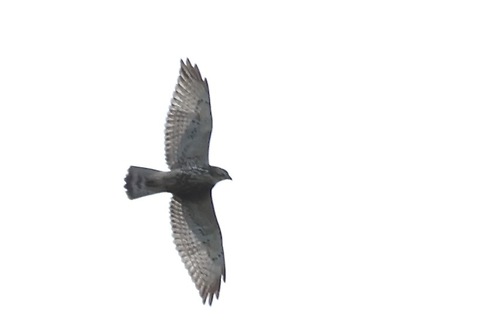
Broad-winged Hawk (Buteo platypterus) Broad-winged Hawk
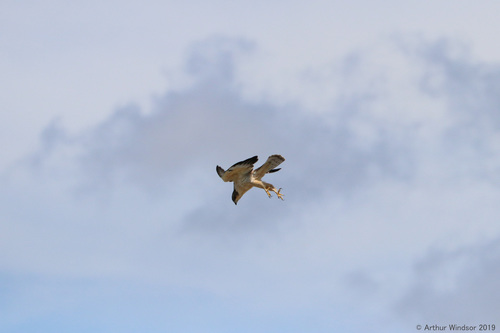
Short-tailed Hawk (Buteo brachyurus) Short-tailed Hawk

Media

Loading…

In short

The most reliable field mark between Broad-winged Hawk and Short-tailed Hawk is the tail and underpart pattern in flight, especially in juveniles: Broad-winged Hawk juveniles show more white below with longitudinal streaking and a tail with multiple narrow white bands, while Short-tailed Hawk (especially dark morph) has a single bold subterminal tail band and a contrasting pale base under the tail. Adults of Broad-winged Hawk have a horizontally barred white chest and belly, and a tail with several white bands, while Short-tailed Hawk adults (light morph) show a mostly white underbody with dark carpal patches, and (dark morph) are uniformly dark below except for the pale undertail. Structure also helps: Broad-winged Hawk is chunkier with broader, more tapered wings and a shorter tail, while Short-tailed Hawk is slimmer, with a shorter tail and narrower wings. Both can be confused in flight, but careful attention to tail pattern and underpart barring by age will separate them.

Identification tips

  1. Tail pattern in flight (all ages): Broad-winged Hawk always shows several narrow white bands across the tail; Short-tailed Hawk shows a single bold subterminal band with the rest of the undertail pale. This is the most reliable mark, especially in juveniles.
  2. Underpart barring (adults): Adult Broad-winged Hawk has horizontal rufous or brown barring on the white belly and chest; Short-tailed Hawk (light morph) is clean white below with little or no barring, only dark carpal patches.
  3. Juvenile underpart streaking: Juvenile Broad-winged Hawk is pale below with vertical (longitudinal) streaks, while juvenile Short-tailed Hawk matches its morph (light or dark) but never shows the same pattern of streaking and always has the single tail band.
  4. Dark morph confusion: Dark morph Short-tailed Hawk is uniformly dark below except for the pale undertail and single tail band; Broad-winged Hawk dark morph is rare and still shows multiple tail bands.
  5. Wing shape in flight: Broad-winged Hawk has relatively short, broad, and slightly pointed wings with a unique tapered look; Short-tailed Hawk's wings are narrower and more pointed, giving a slimmer, more buoyant appearance.
  6. Tail length and shape: Broad-winged Hawk has a relatively short, broad tail; Short-tailed Hawk's tail is even shorter in proportion, often looking stubby in flight.
  7. Perched posture: Broad-winged Hawk often perches in the open on horizontal branches; Short-tailed Hawk is secretive, usually hidden in dense canopy, sometimes only the head visible.
  8. Flight behavior: Broad-winged Hawk soars in tight circles, often in large migratory flocks ('kettles'); Short-tailed Hawk is solitary or in pairs, often seen kiting or performing vertical stoops.
  9. Habitat and range: In eastern North America during breeding season, Broad-winged Hawk is expected; in Florida and the Neotropics, especially outside migration, Short-tailed Hawk is more likely.
  10. Seasonal context: Broad-winged Hawk is migratory and absent from most of its range in winter; Short-tailed Hawk is resident or local migrant in the tropics and subtropics.
  11. Morphs: Only Short-tailed Hawk has a true dark morph that is uniformly dark below with a pale undertail; Broad-winged Hawk dark morph is rare and less uniform.
  12. Underwing pattern: Short-tailed Hawk (light morph) shows strong contrast between white underwing coverts and dark flight feathers; Broad-winged Hawk underwing is less contrasting, more evenly colored.
  13. Size impression: Broad-winged Hawk appears chunkier and more compact; Short-tailed Hawk is slimmer and more buoyant.
  14. Vocalizations: Not diagnostic between these two species based on available notes.
  15. Pitfalls: Juvenile Broad-winged Hawk can be confused with light morph Short-tailed Hawk in flight, but always check for multiple tail bands (Broad-winged) versus single band and pale undertail (Short-tailed).

Size

Broad-winged Hawk is slightly larger overall, with a body length of 32–44 cm and wingspan of 74–100 cm, weighing 265–560 g. Short-tailed Hawk is similar in length but generally appears slimmer and lighter, with a proportionally shorter tail and narrower wings. In the field, Broad-winged Hawk gives a chunkier, more compact impression, while Short-tailed Hawk looks more buoyant and slender in flight. Females of both species are slightly larger than males, but this is not a reliable field mark.

Plumage

Juvenile Broad-winged Hawks are pale below with longitudinal streaking on the belly and a tail with several narrow, evenly spaced white bands; their underwings are relatively plain. Adults have a dark brown upperbody, white underparts with horizontal barring, and a tail with 2–3 broad white bands. Short-tailed Hawk comes in two morphs: light morph adults are white below with dark carpal patches and a single bold subterminal tail band (the rest of the undertail is pale), while dark morph adults are uniformly dark brown below except for the pale undertail. Juvenile Short-tailed Hawks resemble adults in their respective morphs but always show the single subterminal tail band and pale undertail, never the multiple narrow bands of Broad-winged. This tail pattern is the best mark in all ages. Broad-winged Hawk never shows the strong contrast of a single dark tail band and pale undertail seen in Short-tailed Hawk, and Short-tailed never shows the horizontal barring or multiple tail bands of Broad-winged.

Behaviour

Broad-winged Hawk often soars in groups during migration (kettles), with steady, direct flight and less frequent hovering. Short-tailed Hawk is more likely to be seen hunting from the air, often 'kiting' (holding position into the wind with stationary wings) and performing vertical stoops or 'stair-step' descents onto prey. When perched, Broad-winged Hawk favors open branches, while Short-tailed Hawk is more secretive, often hidden in canopy with only the head visible. Short-tailed Hawk is much more difficult to detect when perched.

Habitat

Broad-winged Hawk breeds in deciduous or mixed forests of eastern North America and migrates long distances to winter in the Neotropics; it is rarely found in open country. Short-tailed Hawk is a tropical and subtropical species, found from Florida and the Caribbean through Central and South America, favoring forest edges, open woodlands, and savannas. In Florida, Short-tailed Hawk is local and rare, while Broad-winged Hawk is a common migrant and breeder further north. If seen outside migration in Florida, Short-tailed Hawk is much more likely.

Submit a better description

Use the same sections as the comparison. Your text is published immediately.

The most reliable field mark between Broad-winged Hawk and Short-tailed Hawk is the tail and underpart pattern in flight, especially in juveniles: Broad-winged Hawk juveniles show more white below with longitudinal streaking and a tail with multiple narrow white bands, while Short-tailed Hawk (especially dark morph) has a single bold subterminal tail band and a contrasting pale base under the tail. Adults of Broad-winged Hawk have a horizontally barred white chest and belly, and a tail with several white bands, while Short-tailed Hawk adults (light morph) show a mostly white underbody with dark carpal patches, and (dark morph) are uniformly dark below except for the pale undertail. Structure also helps: Broad-winged Hawk is chunkier with broader, more tapered wings and a shorter tail, while Short-tailed Hawk is slimmer, with a shorter tail and narrower wings. Both can be confused in flight, but careful attention to tail pattern and underpart barring by age will separate them.

  1. Tail pattern in flight (all ages): Broad-winged Hawk always shows several narrow white bands across the tail; Short-tailed Hawk shows a single bold subterminal band with the rest of the undertail pale. This is the most reliable mark, especially in juveniles.
  2. Underpart barring (adults): Adult Broad-winged Hawk has horizontal rufous or brown barring on the white belly and chest; Short-tailed Hawk (light morph) is clean white below with little or no barring, only dark carpal patches.
  3. Juvenile underpart streaking: Juvenile Broad-winged Hawk is pale below with vertical (longitudinal) streaks, while juvenile Short-tailed Hawk matches its morph (light or dark) but never shows the same pattern of streaking and always has the single tail band.
  4. Dark morph confusion: Dark morph Short-tailed Hawk is uniformly dark below except for the pale undertail and single tail band; Broad-winged Hawk dark morph is rare and still shows multiple tail bands.
  5. Wing shape in flight: Broad-winged Hawk has relatively short, broad, and slightly pointed wings with a unique tapered look; Short-tailed Hawk's wings are narrower and more pointed, giving a slimmer, more buoyant appearance.
  6. Tail length and shape: Broad-winged Hawk has a relatively short, broad tail; Short-tailed Hawk's tail is even shorter in proportion, often looking stubby in flight.
  7. Perched posture: Broad-winged Hawk often perches in the open on horizontal branches; Short-tailed Hawk is secretive, usually hidden in dense canopy, sometimes only the head visible.
  8. Flight behavior: Broad-winged Hawk soars in tight circles, often in large migratory flocks ('kettles'); Short-tailed Hawk is solitary or in pairs, often seen kiting or performing vertical stoops.
  9. Habitat and range: In eastern North America during breeding season, Broad-winged Hawk is expected; in Florida and the Neotropics, especially outside migration, Short-tailed Hawk is more likely.
  10. Seasonal context: Broad-winged Hawk is migratory and absent from most of its range in winter; Short-tailed Hawk is resident or local migrant in the tropics and subtropics.
  11. Morphs: Only Short-tailed Hawk has a true dark morph that is uniformly dark below with a pale undertail; Broad-winged Hawk dark morph is rare and less uniform.
  12. Underwing pattern: Short-tailed Hawk (light morph) shows strong contrast between white underwing coverts and dark flight feathers; Broad-winged Hawk underwing is less contrasting, more evenly colored.
  13. Size impression: Broad-winged Hawk appears chunkier and more compact; Short-tailed Hawk is slimmer and more buoyant.
  14. Vocalizations: Not diagnostic between these two species based on available notes.
  15. Pitfalls: Juvenile Broad-winged Hawk can be confused with light morph Short-tailed Hawk in flight, but always check for multiple tail bands (Broad-winged) versus single band and pale undertail (Short-tailed).

Broad-winged Hawk is slightly larger overall, with a body length of 32–44 cm and wingspan of 74–100 cm, weighing 265–560 g. Short-tailed Hawk is similar in length but generally appears slimmer and lighter, with a proportionally shorter tail and narrower wings. In the field, Broad-winged Hawk gives a chunkier, more compact impression, while Short-tailed Hawk looks more buoyant and slender in flight. Females of both species are slightly larger than males, but this is not a reliable field mark.

Juvenile Broad-winged Hawks are pale below with longitudinal streaking on the belly and a tail with several narrow, evenly spaced white bands; their underwings are relatively plain. Adults have a dark brown upperbody, white underparts with horizontal barring, and a tail with 2–3 broad white bands. Short-tailed Hawk comes in two morphs: light morph adults are white below with dark carpal patches and a single bold subterminal tail band (the rest of the undertail is pale), while dark morph adults are uniformly dark brown below except for the pale undertail. Juvenile Short-tailed Hawks resemble adults in their respective morphs but always show the single subterminal tail band and pale undertail, never the multiple narrow bands of Broad-winged. This tail pattern is the best mark in all ages. Broad-winged Hawk never shows the strong contrast of a single dark tail band and pale undertail seen in Short-tailed Hawk, and Short-tailed never shows the horizontal barring or multiple tail bands of Broad-winged.

Broad-winged Hawk often soars in groups during migration (kettles), with steady, direct flight and less frequent hovering. Short-tailed Hawk is more likely to be seen hunting from the air, often 'kiting' (holding position into the wind with stationary wings) and performing vertical stoops or 'stair-step' descents onto prey. When perched, Broad-winged Hawk favors open branches, while Short-tailed Hawk is more secretive, often hidden in canopy with only the head visible. Short-tailed Hawk is much more difficult to detect when perched.

Broad-winged Hawk breeds in deciduous or mixed forests of eastern North America and migrates long distances to winter in the Neotropics; it is rarely found in open country. Short-tailed Hawk is a tropical and subtropical species, found from Florida and the Caribbean through Central and South America, favoring forest edges, open woodlands, and savannas. In Florida, Short-tailed Hawk is local and rare, while Broad-winged Hawk is a common migrant and breeder further north. If seen outside migration in Florida, Short-tailed Hawk is much more likely.

Discard your changes?

You have unsaved edits. If you leave now, those changes will be lost.

Broad-winged Hawk · Short-tailed Hawk · My Tricky Birds