
Bronze Mannikin vs Black-and-white Mannikin
Spermestes cucullata versus Spermestes bicolor
Play a quiz with Bronze Mannikin and Black-and-white Mannikin
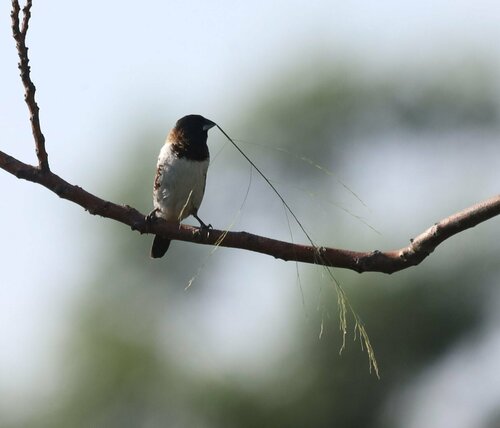 Bronze Mannikin
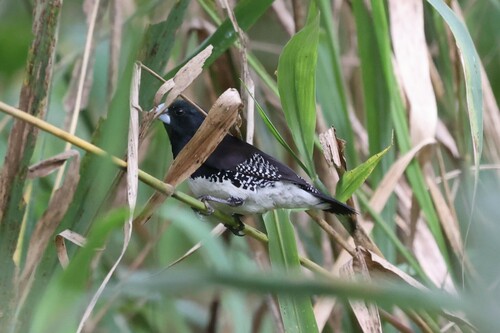 Black-and-white Mannikin
In short
The most reliable field mark for separating Bronze Mannikin from Black-and-white Mannikin is the presence of a black to brownish-black head, chin, throat, and central chest with a purple-green iridescence in Bronze Mannikin, contrasting with the more sharply defined black-and-white pattern of Black-and-white Mannikin. Juvenile Bronze Mannikins are uniformly dull brown above with buff underparts, lacking the crisp black-and-white contrasts of adult Black-and-white Mannikins. Bronze Mannikin also shows a small green iridescent patch on the scapulars and irregular barring on the flanks, while Black-and-white Mannikin typically has a more clear-cut division between black upperparts and white underparts. Both are small, gregarious estrildid finches of sub-Saharan Africa, but subtle differences in plumage and structure are key for confident identification, especially in mixed flocks or immature birds.
Identification tips
- Juvenile plumage: Juvenile Bronze Mannikins are dull brown above with buff underparts, lacking any black-and-white contrast. If you see a uniformly brownish small finch in a flock of mannikins, consider Bronze Mannikin, especially if adults are present. Immature Black-and-white Mannikins are not described here, but generally do not look as uniformly brown.
- Head and chest color (adults): Adult Bronze Mannikin has a black to brownish-black head, chin, throat, and central chest, often with a purple-green iridescence. Black-and-white Mannikin has a more sharply defined black head, throat, and breast, with a crisp boundary to the white belly.
- Iridescent patches: Look for a small green iridescent patch on the outer scapulars and sometimes on the lower breast sides of Bronze Mannikin. This is absent in Black-and-white Mannikin.
- Flank and rump barring: Bronze Mannikin shows irregular barring on the flanks and rump, while Black-and-white Mannikin typically has clean white underparts without barring.
- Bill color: Bronze Mannikin has a stubby black and pale grey (not bluish) bill. Bill color in Black-and-white Mannikin is not described here, but is generally similar; not a strong separator.
- Upperparts: Bronze Mannikin has greyish brown upperparts, while Black-and-white Mannikin may appear darker above, with a more contrasting black-and-white pattern overall.
- Tail: Bronze Mannikin has a short black tail; tail shape and length are not described for Black-and-white Mannikin, but both are short-tailed.
- Sexes: Both species are sexually similar, so do not rely on sex for identification.
- Structural jizz: Both are compact, stubby finches with short tails and thick bills. Structure is not a strong separator.
- Flight views: No distinctive upperwing or flight pattern differences are described for either species, so focus on body and head pattern even in flight.
- Flock behavior: Bronze Mannikin is noted for communal roosting and nest-building; if you observe such behavior, it may support Bronze Mannikin identification, but is not exclusive.
- Habitat context: Both species occur in similar habitats; slight preference for forest edge and savanna in Bronze Mannikin, but not diagnostic.
- Voice: Bronze Mannikin gives a rreep-rreeep in flight and twittering, wheezy calls when perched. Black-and-white Mannikin's voice is not described here; do not rely on calls unless you know the repertoire well.
- Pitfalls: Subspecific variation in Bronze Mannikin (e.g., more barring or less green iridescence) can blur distinctions, so use a combination of marks. Immature birds are especially challenging; look for overall brownness in Bronze Mannikin juveniles.
- Mixed flocks: Both species may occur together or with other mannikins; always check multiple field marks on each individual, especially in large, mobile flocks.
Size
Both species are among the smallest estrildid finches, with Bronze Mannikin measuring 9–10 cm in length and weighing 7–12 grams [wikipedia]. There is no direct measurement for Black-and-white Mannikin in the provided notes, but it is similarly small and compact. In the field, size alone is not a reliable separator, as both are very close in dimensions and may overlap in perceived bulk and length.
Plumage
Juvenile Bronze Mannikins are uniformly dun brown above with buff head and underparts, lacking the strong black-and-white contrasts of adult Black-and-white Mannikins. They acquire adult plumage by about six months. Adult Bronze Mannikins have a black to brownish-black head, chin, throat, and central chest, with some purple-green iridescence on the face and breast sides. Their upperparts are greyish brown, underparts white with irregular barring on the flanks and rump, and a small green iridescent patch on the outer scapulars. The wing coverts and remiges are edged in paler or warmer tones. In contrast, Black-and-white Mannikin adults typically show a more sharply defined black-and-white pattern, with a clear division between the black head/throat/chest and white belly, and lack the green iridescence and irregular barring seen in Bronze Mannikin. Subspecific variation in Bronze Mannikin (e.g., S. c. scutata) may show more barring at the breast/flank junction, but this is variable and not always reliable. Immature Black-and-white Mannikins are not described in detail here, but generally do not show the same uniform brownish tones as Bronze Mannikin immatures.
Behaviour
Both species are highly social and gregarious, often forming flocks and associating with other small finches. Bronze Mannikin is noted for its communal roosting in ball-shaped nests, which are built and rebuilt almost daily, and for its dominance hierarchy within flocks. They often allopreen and may join mixed-species flocks with other mannikins or waxbills. Black-and-white Mannikin is also social, but specific communal behaviors are not detailed in the provided notes. Both feed mainly on seeds and can be seen foraging in groups, but Bronze Mannikin is especially noted for its communal nest-building and roosting habits.
Habitat
Both species are widespread in sub-Saharan Africa and can be found in moist savanna, forest margins, and subtropical or tropical moist lowland forest. Bronze Mannikin is described as resident, nomadic, or irruptive in mesic savanna or forest margin habitats, while Black-and-white Mannikin is found in moist savanna and lowland forest. Their ranges and habitats overlap extensively, so habitat alone is not a strong separator, though Bronze Mannikin may be more likely at the edge of human habitation and in drier savanna patches.
Voice
Bronze Mannikin gives a rreep-rreeep call in flight and a twittering, wheezy or buzzing series of notes when perched. Its song is a repetitive series of notes. There is no detailed vocal description for Black-and-white Mannikin in the provided notes, so voice is not a reliable separator based on current information.
Bronze Mannikin · Black-and-white Mannikin · My Tricky Birds