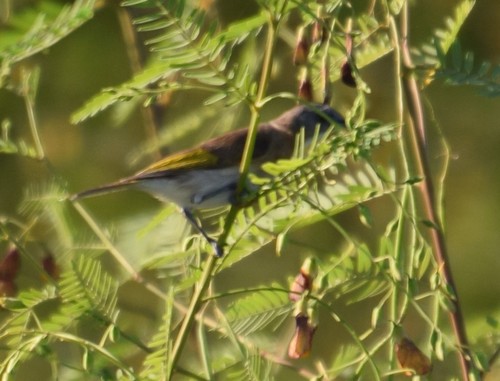
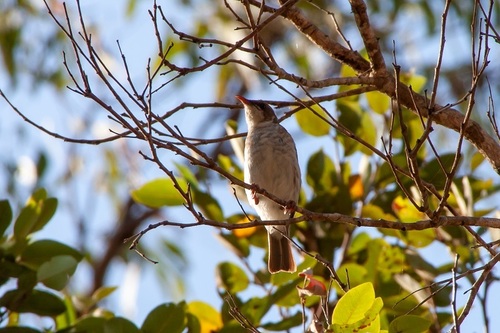
Brown-backed Honeyeater vs Rufous-banded Honeyeater
Ramsayornis modestus versus Conopophila albogularis
Play a quiz with Brown-backed Honeyeater and Rufous-banded Honeyeater
Brown-backed Honeyeater
Rufous-banded Honeyeater
In short
The Brown-backed Honeyeater and Rufous-banded Honeyeater can be distinguished by their plumage and habitat preferences. The Brown-backed Honeyeater has a more uniform brown back, while the Rufous-banded Honeyeater features a distinctive rufous band across its chest. Both species are similar in size and structure, making plumage and habitat the most reliable field marks.
Identification tips
- Look for the rufous band on the chest of the Rufous-banded Honeyeater. 2. Note the uniform brown back of the Brown-backed Honeyeater. 3. Consider the habitat: mangroves for Brown-backed, open woodlands for Rufous-banded. 4. Size and structure are similar; focus on plumage and habitat.
Size
Both species are similar in size, typical of small honeyeaters.
Plumage
The Brown-backed Honeyeater has a uniform brown back and lacks any prominent chest markings. In contrast, the Rufous-banded Honeyeater is characterized by a rufous band across its chest, which is a key distinguishing feature.
Behaviour
Both species exhibit typical honeyeater behavior, often seen foraging for nectar and insects. Behavioral differences are not prominent enough to be reliable for identification.
Habitat
The Brown-backed Honeyeater is often found in mangroves and adjacent areas, while the Rufous-banded Honeyeater prefers more open woodland and forest edges. Habitat preference can be a useful clue when identifying these species.
Voice
Vocalizations are not distinctly different enough to serve as a reliable identification tool in the field.
Brown-backed Honeyeater · Rufous-banded Honeyeater · My Tricky Birds