
Brown Tinamou vs Undulated Tinamou
Crypturellus obsoletus versus Crypturellus undulatus
Play a quiz with Brown Tinamou and Undulated Tinamou
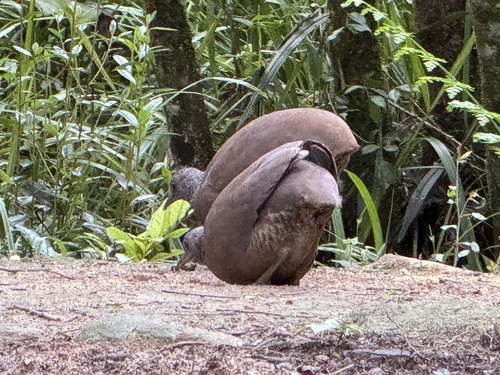 Brown Tinamou
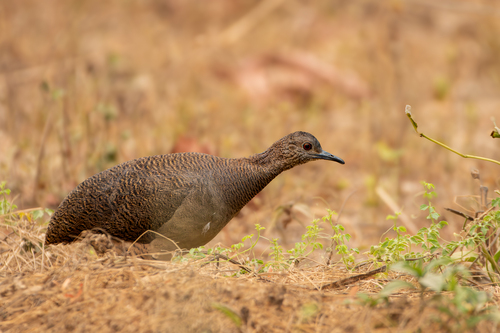 Undulated Tinamou
In short
The most reliable field mark between Brown Tinamou and Undulated Tinamou is the color of the throat: Brown Tinamou always shows a greyish throat, while Undulated Tinamou has a distinctly whitish throat. In addition, Undulated Tinamou is marked by strong black barring or vermiculations on the back and neck, whereas Brown Tinamou is more uniformly brown to chestnut above, lacking these wavy or barred patterns. Both are ground-dwelling birds of South American forests, but careful attention to throat color and upperpart patterning will separate them in most field situations. Subtle differences in underpart color and overall tone can help, but are variable by subspecies and less reliable than the throat and back pattern.
Identification tips
- Throat color is the most consistent field mark: Brown Tinamou always shows a greyish throat, while Undulated Tinamou has a distinctly whitish throat. This is visible on perched birds and often even in poor light.
- Back and neck patterning: Undulated Tinamou displays strong black barring or wavy vermiculations on the back and neck (especially in the nominate form); Brown Tinamou is plain above, lacking any barring or vermiculations.
- Underpart color: Brown Tinamou's underparts are paler than the back, ranging from chestnut to ochraceous, with some subspecies (griseiventris) showing pale buff-grey. Undulated Tinamou has olive-grey to buff underparts, with dark vermiculations on the lower flanks and vent.
- Upperpart tone: Brown Tinamou varies from dark sooty-brown to bright chestnut above, depending on subspecies, but is always unpatterned. Undulated Tinamou is generally browner or greyer, but the presence of barring is more important than tone.
- Bill and leg color: Not reliably diagnostic—Undulated Tinamou's bill is black above and grey below, legs can be grey, dull yellow, or greenish, but these are subtle and variable.
- Sexual dimorphism: Female Brown Tinamous are slightly larger and more rufescent than males, but this is subtle and not a reliable field mark unless birds are side by side.
- Juvenile/immature plumage: No distinctive age-specific wing or flight pattern is described for either species; focus on throat and back pattern for all ages.
- Flight views: Both species flush with a whirring flight, but no unique upperwing or tail pattern is noted for either—look for throat and back pattern even in brief views.
- Habitat overlap: Both species can occur in similar forested habitats; do not rely on habitat alone for identification.
- Plumage pitfalls: Subspecies variation in both species can cause confusion—Brown Tinamou griseiventris has unusually pale underparts, but still a greyish throat and plain back; some Undulated Tinamou subspecies have fainter barring, but never lack it entirely.
- Context: If you see a tinamou with a plain brown back and a greyish throat, it is Brown Tinamou; if it has a whitish throat and any degree of barring or vermiculation on the back/neck, it is Undulated Tinamou.
- Do not use size as a primary mark: Both are similar in length and mass, and apparent size is unreliable in the field.
- Do not use voice for separation: No vocal differences are described in the available notes.
- Avoid confusion with Little Tinamou: Both Brown and Undulated Tinamous are separated from Little Tinamou by throat color (greyish in Brown, whitish in Undulated, but Little Tinamou is not part of this comparison).
- Lighting and distance: In poor light, focus on throat color and the presence or absence of barring on the back/neck, as overall tone and underpart color can be misleading.
Size
Both species are very similar in size, with Brown Tinamou averaging about 25–30 cm in length and a typical mass of 444 g, while Undulated Tinamou is 28–30 cm and somewhat lighter at around 300 g. In the field, size is not a reliable separator, as their dimensions overlap and both appear as medium-small, round-bodied tinamous. Female Brown Tinamous may appear slightly larger and more rufescent, but this is subtle and not easily judged without direct comparison.
Plumage
No age-specific wing or flight pattern is described for either species, so focus is on adult and general plumage. Brown Tinamou is overall brown to chestnut above, with the exact shade varying by subspecies, and paler underparts ranging from chestnut to ochraceous. The key mark is the greyish throat (never white), and the absence of strong barring or vermiculations on the back and neck. In contrast, Undulated Tinamou is brownish to grey-brown above but always shows strong black barring or wavy vermiculations on the back and neck (especially in nominate undulatus), and a clearly whitish throat. Its underparts are olive-grey to buff, with dark vermiculations on the lower flanks and vent. Subspecies of Undulated Tinamou vary in the strength of barring, but some pattern is always present, unlike the plain-backed Brown Tinamou. The bill and legs are not strongly diagnostic in the field.
Behaviour
Both species are secretive, ground-dwelling birds that prefer to walk or run rather than fly, and are most often seen slipping away through dense forest undergrowth. Their behavior is very similar, and not a reliable separator. Both may flush with a whirring flight when startled, but this is typical of tinamous in general.
Habitat
Brown Tinamou is found in humid lowland and montane forests in tropical and subtropical South America, while Undulated Tinamou occupies a wider range of wooded habitats in eastern and northern South America. There is some habitat overlap, especially in forested regions, so habitat alone is not diagnostic, though Undulated Tinamou may be found in more varied woodland types.