
Brünnich's Guillemot vs Common Guillemot
Uria lomvia versus Uria aalge
Play a quiz with Brünnich's Guillemot and Common Guillemot
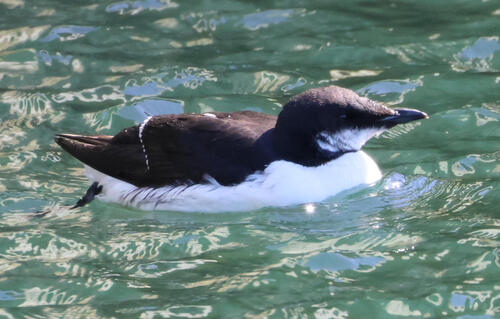 Brünnich's Guillemot
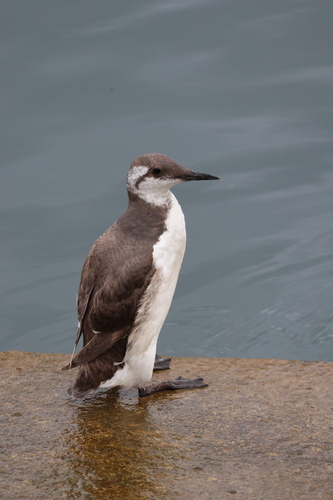 Common Guillemot
In short
The most reliable field mark between Brünnich's (Thick-billed) Guillemot and Common Guillemot is the bill: Brünnich's has a noticeably thicker, shorter bill with a white gape stripe (on adults), while Common Guillemot's bill is thinner and lacks this stripe. In flight, Brünnich's looks shorter and more compact, with a darker head and back, and lacks the 'bridled' white eye-stripe morph seen in some Common Guillemots. For first-year birds, bill shape is less helpful; focus instead on head pattern and overall structure. Both species are similar in size, but Brünnich's averages slightly larger and bulkier, especially in the Pacific. Immature and winter birds are a frequent source of confusion, so pay close attention to the combination of bill shape, face pattern, and overall jizz.
Identification tips
- Bill shape (adults): Brünnich's Guillemot has a noticeably thicker, shorter bill with a white gape stripe; Common Guillemot's bill is thinner, longer, and lacks the white stripe. This is the single most reliable field mark for adults at close range.
- Bill shape (first-years): In first-year Brünnich's, the bill is smaller and the white gape stripe may be faint or absent, making bill shape less reliable. Focus on head pattern for immatures.
- Head and face pattern (all ages): Brünnich's has a darker, more solidly blackish head and back, especially in the Pacific. Common can appear paler, and in the 'bridled' morph (only in Common), shows a white eye-ring and line extending behind the eye. Brünnich's never shows both a white eye-stripe and a white bill-stripe.
- Bridled morph: Only Common Guillemot shows the 'bridled' morph (white eye-ring and stripe). If you see this, it's not Brünnich's.
- Winter plumage: Both species develop white on the face in winter, but Brünnich's retains less white, and the face remains darker overall. Common shows a white face with a dark spur behind the eye.
- Flight jizz: Brünnich's looks shorter and more compact in flight, with a darker head and back. Common appears longer and slimmer, with a paler face in winter and sometimes a white eye-stripe.
- Upperwing pattern (immatures): No strong contrast in upperwing pattern is described for immatures; rely on head pattern and structure.
- Tail: Both have a small, rounded black tail; not a useful separator.
- Leg color: Both have dark legs, but occasional yellow-grey or aberrant colors in Common are rare and not reliable.
- Size: Brünnich's averages slightly larger and heavier, especially in the Pacific, but this is subtle and not diagnostic unless birds are side by side.
- Plumage color (regional): Pacific Brünnich's (U. l. arra) is especially deeply black above, while southern British Common Guillemots can be distinctly brownish.
- Colony context: If you see both species together, bridled birds are always Common; Brünnich's is more likely in denser, more northerly colonies, but overlap is common.
- Voice: Both are noisy at colonies, but calls are similar and not reliably separable in the field.
- Behavior at sea: Both are silent and pelagic outside the breeding season; behavior is not a reliable separator.
- Season: In late winter and spring, first-year birds may still show winter head pattern; use structure and face pattern rather than bill color or size.
Size
Both species are large auks and overlap considerably in size, but Brünnich's Guillemot is, on average, slightly larger and heavier. Brünnich's measures 40–48 cm in length with a 64–81 cm wingspan and weighs 736–1,481 g. Common Guillemot is 38–46 cm long, with a 61–73 cm wingspan and a weight range of 775–1,250 g. The Pacific Brünnich's (U. l. arra) is especially large, mainly in bill dimensions. In the field, this size difference is subtle and rarely diagnostic unless birds are side by side.
Plumage
- Juvenile/First-year birds: For both species, first-year birds resemble adults in winter plumage, but Brünnich's first-years have a smaller bill and the white gape stripe is often faint or missing. Head pattern is the best separator at this age: Brünnich's shows a darker, more solidly blackish head, while Common can show a paler face and, in the 'bridled' morph, a white eye-stripe.
- Adult breeding plumage: Brünnich's is blacker on the head, neck, and back (especially in the Pacific), while Common is black or dark brown (notably brownish in southern Britain). Brünnich's has a white bill stripe at the gape, which Common lacks. The 'bridled' morph (white eye-ring and line) is only seen in Common Guillemot.
- Adult winter plumage: Both species develop more white on the face, but Brünnich's retains less white than Common. Common shows a white face with a dark spur behind the eye; Brünnich's face remains darker overall.
- Flight views: Brünnich's appears shorter and more compact in flight, with a darker upperwing and head. Common can look longer and slimmer, with a paler face in winter and sometimes a white eye-stripe.
Behaviour
Both species are strong, direct fliers with rapid wingbeats and are highly accomplished divers, using their wings to 'fly' underwater. Brünnich's tends to look shorter and more compact in flight, while Common appears longer and slimmer. Both are silent at sea but noisy at colonies. Brünnich's is capable of deeper and longer dives (up to 150 m, though usually less), but this is not a practical field mark. Both species forage singly or in groups, often traveling far from colonies to feed.
Habitat
Both species breed on rocky cliffs and islands in the North Atlantic and North Pacific, often in mixed colonies. Brünnich's tends to breed further north and in larger, denser colonies, but there is broad overlap. At sea, both are pelagic outside the breeding season, but Brünnich's is more strongly associated with Arctic and sub-Arctic waters, while Common is more widespread in boreal and temperate zones. However, habitat is not a reliable separator where ranges overlap.
Voice
Both species are noisy at breeding colonies, producing harsh, cackling or growling calls. Brünnich's is described as having harsh cackling calls, while Common gives a growling "murrrr". Both are generally silent at sea. Vocalizations are not reliably separable in the field unless at close range in colonies.