Budgerigar vs Monk Parakeet
Melopsittacus undulatus versus Myiopsitta monachus
Play a quiz with Budgerigar and Monk Parakeet
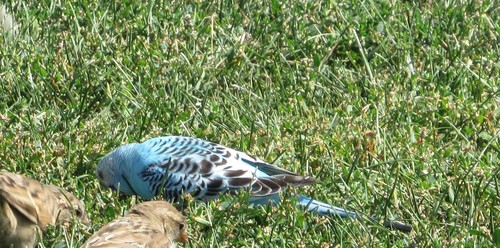
Budgerigar
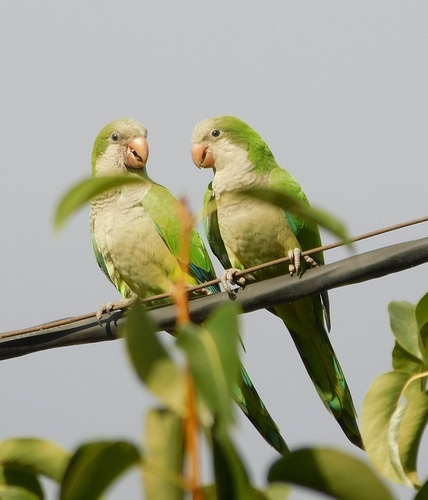
Monk Parakeet
In short
Budgerigars and Monk Parakeets can be distinguished by size, plumage, and nesting behavior. Budgerigars are smaller with a more vibrant green and yellow plumage, while Monk Parakeets are larger and have a distinct gray face and breast. Monk Parakeets are known for their unique stick nests, often built on man-made structures.
Identification tips
- Size: Note the smaller size of Budgerigars compared to the larger Monk Parakeets. 2. Plumage: Look for the bright green and yellow of Budgerigars versus the green and gray of Monk Parakeets. 3. Nesting: Observe the presence of large stick nests for Monk Parakeets. 4. Habitat: Consider the setting; urban areas may indicate Monk Parakeets, while open grasslands suggest Budgerigars.
Size
Budgerigars are smaller, typically around 18 cm in length, while Monk Parakeets are larger, about 29 cm long.
Plumage
Budgerigars have a bright green body with yellow and black markings, especially on the head and wings. Monk Parakeets have a green body with a gray face and breast, lacking the yellow tones of Budgerigars.
Behaviour
Monk Parakeets are unique among parrots for building large, communal stick nests, often on utility poles. Budgerigars do not build such nests and are more commonly seen in flocks feeding on the ground.
Habitat
Budgerigars are native to open habitats in Australia, often seen in grasslands and open woodlands. Monk Parakeets, originally from South America, have adapted to urban environments and can be found in cities, often nesting on man-made structures.
Voice
Budgerigars have a high-pitched, chattering call, while Monk Parakeets produce a series of harsh, squawking notes.