
Buff-barred Warbler vs Chinese Leaf Warbler
Phylloscopus pulcher versus Phylloscopus yunnanensis
Play a quiz with Buff-barred Warbler and Chinese Leaf Warbler
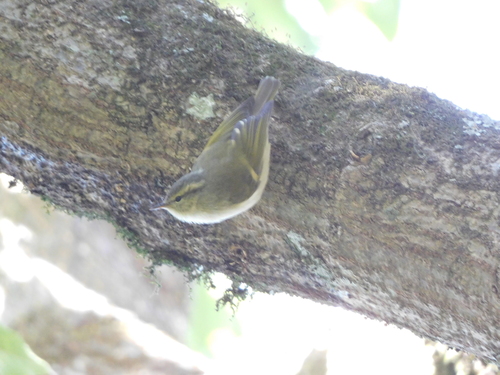 Buff-barred Warbler
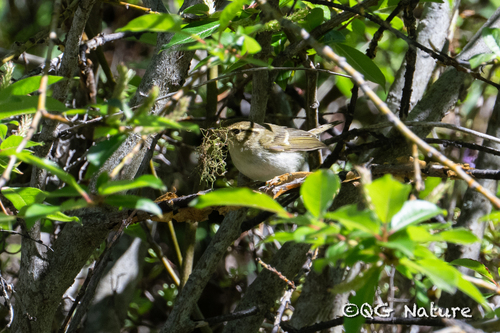 Chinese Leaf Warbler
In short
The most reliable field separation between Buff-barred Warbler and Chinese Leaf Warbler is the head and upperpart pattern: Chinese Leaf Warbler shows a striking pale eyebrow, faint yellow median crown stripe, and olive-green upperparts, while Buff-barred Warbler lacks these strong head markings. In the field, Chinese Leaf Warbler appears brighter and more patterned on the head, whereas Buff-barred Warbler is plainer. Both are small leaf warblers, but Chinese Leaf Warbler is only found in China, while Buff-barred Warbler ranges more widely. Structural differences and subtle plumage cues are key, especially outside the breeding season when colors may be duller.
Identification tips
- Head pattern: Chinese Leaf Warbler shows a well-defined pale eyebrow (supercilium), a faint yellow median crown stripe, and dusky-olive lateral crown stripes. These marks are visible in all adult plumages and are the most reliable field marks for separation.
- Upperparts color: Chinese Leaf Warbler is pale green to olive-green above with a yellowish-white rump, while Buff-barred Warbler is plainer and lacks the bright olive-green tones and contrasting rump.
- Eyering: Chinese Leaf Warbler has a broken eyering, which can be seen at close range; Buff-barred Warbler lacks mention of this feature.
- Tertial pattern: Chinese Leaf Warbler has sepia tertials with whitish tips, which may show as a subtle wing panel; Buff-barred Warbler's tertials are not described as contrasting.
- Bill structure: Chinese Leaf Warbler has a short, pointed, dark brown bill with a brownish-yellow underside. Bill color and shape may help at close range, but are subtle in the field.
- Tail shape: Chinese Leaf Warbler has a slightly forked or notched tail that appears almost square. This may be visible when the bird fans or flicks its tail.
- Leg and foot color: Chinese Leaf Warbler has very dark legs and claws with dusky buff undersides; Buff-barred Warbler's leg color is not described, so this is only useful if a clear contrast is seen.
- Plumage seasonality: Chinese Leaf Warbler is brightest in spring, duller in late summer, but retains its head pattern year-round. Buff-barred Warbler's seasonal changes are not described, but it is likely less contrasting overall.
- Sex differences: Both species are sexually monomorphic, so sex does not aid separation.
- Age differences: No juvenile or immature-specific wing or flight marks are described for either species, so age is not a key separator.
- Range: Outside China, any similar Phylloscopus is almost certainly Buff-barred Warbler. Within China, both are possible, so rely on plumage and head pattern.
- Habitat: In China, Chinese Leaf Warbler prefers dry forests and high-altitude shrubland. Buff-barred Warbler may be found in a wider range of habitats, but habitat alone is not diagnostic.
- Behavior: Both species are active in foliage and show typical leaf warbler behavior; no behavioral cues separate them reliably.
- Vocalization: No diagnostic vocal differences are provided in the sources, so do not rely on song or call for separation.
- Pitfalls: In dull light or worn plumage, Chinese Leaf Warbler's head pattern may appear less obvious, but even then, the pale eyebrow and crown stripes should be sought. Buff-barred Warbler may appear even plainer, lacking these facial contrasts.
Size
Buff-barred Warbler has a recorded body mass of 6.8g [wikidata], while Chinese Leaf Warbler's mass is not specified, but both are small, compact leaf warblers. Chinese Leaf Warbler is described as about 10 cm in length with a 5–6 cm wing, and both species are similar in overall size and jizz, so size alone is not a reliable separator in the field.
Plumage
No age-specific upperwing or flight pattern differences are documented between these two species. For adults in spring, Chinese Leaf Warbler is pale to olive-green above with a yellowish-white rump, a well-marked pale eyebrow, faint yellow median crown stripe, and dusky-olive lateral crown stripes. Its tertials are sepia with whitish tips, and it has a broken eyering. Buff-barred Warbler lacks mention of these strong head and upperpart patterns, suggesting a plainer appearance. Seasonal wear dulls Chinese Leaf Warbler's plumage in summer, but the head pattern remains a key mark. Both sexes are similar in Chinese Leaf Warbler; no sexual dimorphism is noted for Buff-barred Warbler.
Behaviour
Both species are typical leaf warblers, likely active and agile in foliage, but no diagnostic behavioral differences are described in the sources.
Habitat
Buff-barred Warbler has a broad range across the Himalayas and Southeast Asia (Bhutan, China, India, Laos, Myanmar, Nepal, Thailand, Vietnam), while Chinese Leaf Warbler is endemic to China. Chinese Leaf Warbler prefers subtropical or tropical dry forests and high-altitude shrubland. Overlap is possible in China, but context outside China strongly favors Buff-barred Warbler. Within China, habitat type and altitude may provide subtle clues, but are not definitive on their own.
Buff-barred Warbler · Chinese Leaf Warbler · My Tricky Birds