Birdr

Bufflehead vs Hooded Merganser

Bucephala albeola versus Lophodytes cucullatus

Play a quiz with Bufflehead and Hooded Merganser

Bufflehead (Bucephala albeola) Bufflehead
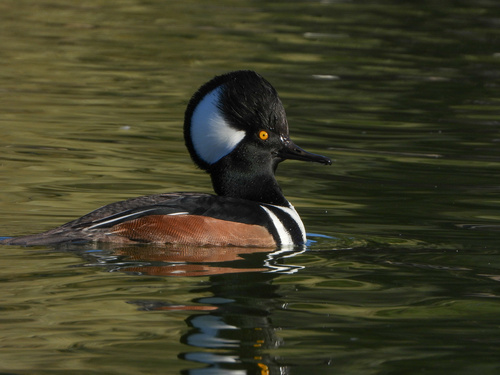
Hooded Merganser (Lophodytes cucullatus) Hooded Merganser

Media

Loading…

In short

The Bufflehead and Hooded Merganser are both small diving ducks, but they can be distinguished by their distinct head shapes and plumage patterns. The Bufflehead has a striking white patch on its head, while the Hooded Merganser is known for its fan-shaped crest.

Identification tips

  1. Look for the white head patch on the male Bufflehead. 2. Note the fan-shaped crest on the male Hooded Merganser. 3. Observe the habitat: Buffleheads are more common in open water, while Hooded Mergansers prefer wooded wetlands. 4. Consider the season: both species are more easily observed in winter when they migrate to more accessible habitats.

Size

Both species are small, but the Bufflehead is slightly more compact than the Hooded Merganser.

Plumage

The male Bufflehead has a large, white patch on the back of its head and a glossy green and purple iridescence on the rest of its head. The male Hooded Merganser has a distinctive black and white fan-shaped crest and a white face patch. Females of both species are more subdued, but the female Hooded Merganser has a noticeable brown crest.

Behaviour

Both species are diving ducks, but the Hooded Merganser is more likely to be seen diving for fish, while the Bufflehead often feeds on aquatic invertebrates.

Habitat

Buffleheads are often found in small ponds and lakes, while Hooded Mergansers prefer forested freshwater wetlands and tidal creeks.

Voice

Vocalizations are not a primary distinguishing feature in the field for these species.

Submit a better description

Use the same sections as the comparison. Your text is published immediately.

The Bufflehead and Hooded Merganser are both small diving ducks, but they can be distinguished by their distinct head shapes and plumage patterns. The Bufflehead has a striking white patch on its head, while the Hooded Merganser is known for its fan-shaped crest.

  1. Look for the white head patch on the male Bufflehead. 2. Note the fan-shaped crest on the male Hooded Merganser. 3. Observe the habitat: Buffleheads are more common in open water, while Hooded Mergansers prefer wooded wetlands. 4. Consider the season: both species are more easily observed in winter when they migrate to more accessible habitats.

Both species are small, but the Bufflehead is slightly more compact than the Hooded Merganser.

The male Bufflehead has a large, white patch on the back of its head and a glossy green and purple iridescence on the rest of its head. The male Hooded Merganser has a distinctive black and white fan-shaped crest and a white face patch. Females of both species are more subdued, but the female Hooded Merganser has a noticeable brown crest.

Both species are diving ducks, but the Hooded Merganser is more likely to be seen diving for fish, while the Bufflehead often feeds on aquatic invertebrates.

Buffleheads are often found in small ponds and lakes, while Hooded Mergansers prefer forested freshwater wetlands and tidal creeks.

Vocalizations are not a primary distinguishing feature in the field for these species.

Discard your changes?

You have unsaved edits. If you leave now, those changes will be lost.

Bufflehead · Hooded Merganser · My Tricky Birds