Birdr

Bufflehead vs Smew

Bucephala albeola versus Mergellus albellus

Play a quiz with Bufflehead and Smew
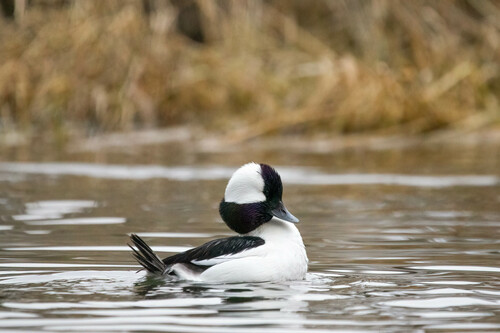
Bufflehead (Bucephala albeola) Bufflehead
Smew (Mergellus albellus) Smew

Media

Loading…

In short

Buffleheads and Smews are both small, diving ducks with striking plumage differences. The Bufflehead male is predominantly white with a large, iridescent green and purple head patch, while the Smew male has a unique 'cracked ice' appearance with a snow-white body and black markings. Females of both species are more subdued, but the Smew female has a distinctive rusty brown head and white cheeks.

Identification tips

1. Look for the iridescent head patch on male Buffleheads versus the 'cracked ice' pattern on male Smews. 2. Note the rusty brown head and white cheeks of female Smews compared to the grayish-brown female Buffleheads. 3. Consider habitat: Buffleheads in North America vs. Smews in Eurasia. 4. Observe behavior: Smews diving for fish more frequently in winter.

Size

Both species are small ducks, but the Bufflehead is slightly more compact and has a shorter neck compared to the more elongated Smew.

Plumage

Male Buffleheads have a mostly white body with a large, glossy green and purple head patch, while male Smews are snow-white with black markings, giving them a 'cracked ice' look. Female Buffleheads are grayish-brown with a white cheek patch, whereas female Smews have a rusty brown head with bold white cheeks and throat.

Behaviour

Both species are diving ducks, but the Smew is more likely to be seen diving energetically for fish, especially in winter, while Buffleheads often feed on aquatic invertebrates.

Habitat

Buffleheads are found in North America, often on small lakes and ponds, while Smews breed in the boreal forests of Eurasia and winter on sheltered coasts or inland lakes in temperate regions.

Voice

Vocalizations are not a primary distinguishing feature, but Buffleheads are generally quieter, with soft calls, while Smews may be more vocal during courtship.

Submit a better description

Use the same sections as the comparison. Your text is published immediately.

Buffleheads and Smews are both small, diving ducks with striking plumage differences. The Bufflehead male is predominantly white with a large, iridescent green and purple head patch, while the Smew male has a unique 'cracked ice' appearance with a snow-white body and black markings. Females of both species are more subdued, but the Smew female has a distinctive rusty brown head and white cheeks.

1. Look for the iridescent head patch on male Buffleheads versus the 'cracked ice' pattern on male Smews. 2. Note the rusty brown head and white cheeks of female Smews compared to the grayish-brown female Buffleheads. 3. Consider habitat: Buffleheads in North America vs. Smews in Eurasia. 4. Observe behavior: Smews diving for fish more frequently in winter.

Both species are small ducks, but the Bufflehead is slightly more compact and has a shorter neck compared to the more elongated Smew.

Male Buffleheads have a mostly white body with a large, glossy green and purple head patch, while male Smews are snow-white with black markings, giving them a 'cracked ice' look. Female Buffleheads are grayish-brown with a white cheek patch, whereas female Smews have a rusty brown head with bold white cheeks and throat.

Both species are diving ducks, but the Smew is more likely to be seen diving energetically for fish, especially in winter, while Buffleheads often feed on aquatic invertebrates.

Buffleheads are found in North America, often on small lakes and ponds, while Smews breed in the boreal forests of Eurasia and winter on sheltered coasts or inland lakes in temperate regions.

Vocalizations are not a primary distinguishing feature, but Buffleheads are generally quieter, with soft calls, while Smews may be more vocal during courtship.

Discard your changes?

You have unsaved edits. If you leave now, those changes will be lost.

Bufflehead · Smew · My Tricky Birds