Birdr

Bullock's Oriole vs Scott's Oriole

Icterus bullockii versus Icterus parisorum

Play a quiz with Bullock's Oriole and Scott's Oriole
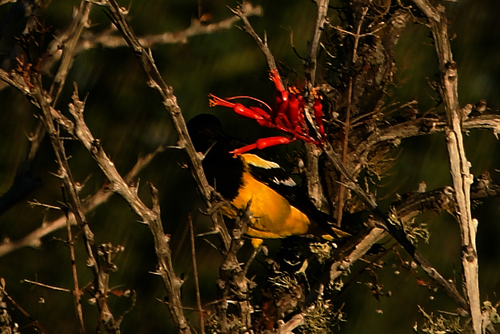
Bullock's Oriole (Icterus bullockii) Bullock's Oriole
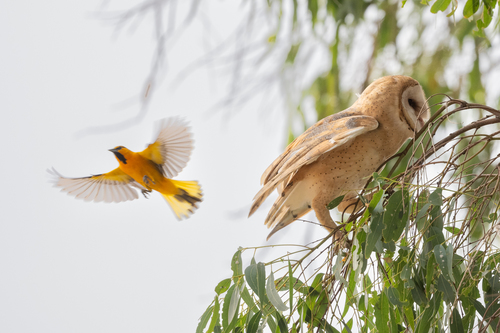
Scott's Oriole (Icterus parisorum) Scott's Oriole

Media

Loading…

In short

Bullock's Oriole and Scott's Oriole can be distinguished by plumage and habitat preferences. Bullock's Oriole has a more vibrant orange color with distinct black markings, while Scott's Oriole is more yellow with a black head and back. They also occupy different habitats, with Bullock's preferring open woodlands and Scott's favoring arid desert regions.

Identification tips

  1. Plumage: Look for the bright orange and black pattern in Bullock's Oriole males, versus the black and yellow in Scott's Oriole males. 2. Habitat: Note the environment; Bullock's in woodlands, Scott's in deserts. 3. Seasonal Movement: Be aware of Scott's Oriole's tendency to wander, which may lead to overlap in unexpected areas.

Size

Both species are similar in size, typical of medium-sized orioles.

Plumage

Bullock's Oriole males have bright orange underparts and face with a black line through the eye and a black back. Females and immature males are duller with a yellowish head and breast. Scott's Oriole males have a striking black head, back, and throat with bright yellow underparts. Females are more muted with a yellowish-green body and less black.

Behaviour

Both species exhibit typical oriole behaviors such as weaving intricate nests and foraging for insects and fruit. However, Scott's Oriole is noted for its tendency to wander outside its usual range.

Habitat

Bullock's Oriole is found in open woodlands, often near water, while Scott's Oriole prefers arid desert regions with yuccas and other desert vegetation.

Voice

Both species have melodious songs, but specific vocal differences are not well-documented in the provided sources.

Submit a better description

Use the same sections as the comparison. Your text is published immediately.

Bullock's Oriole and Scott's Oriole can be distinguished by plumage and habitat preferences. Bullock's Oriole has a more vibrant orange color with distinct black markings, while Scott's Oriole is more yellow with a black head and back. They also occupy different habitats, with Bullock's preferring open woodlands and Scott's favoring arid desert regions.

  1. Plumage: Look for the bright orange and black pattern in Bullock's Oriole males, versus the black and yellow in Scott's Oriole males. 2. Habitat: Note the environment; Bullock's in woodlands, Scott's in deserts. 3. Seasonal Movement: Be aware of Scott's Oriole's tendency to wander, which may lead to overlap in unexpected areas.

Both species are similar in size, typical of medium-sized orioles.

Bullock's Oriole males have bright orange underparts and face with a black line through the eye and a black back. Females and immature males are duller with a yellowish head and breast. Scott's Oriole males have a striking black head, back, and throat with bright yellow underparts. Females are more muted with a yellowish-green body and less black.

Both species exhibit typical oriole behaviors such as weaving intricate nests and foraging for insects and fruit. However, Scott's Oriole is noted for its tendency to wander outside its usual range.

Bullock's Oriole is found in open woodlands, often near water, while Scott's Oriole prefers arid desert regions with yuccas and other desert vegetation.

Both species have melodious songs, but specific vocal differences are not well-documented in the provided sources.

Discard your changes?

You have unsaved edits. If you leave now, those changes will be lost.

Bullock's Oriole · Scott's Oriole · My Tricky Birds