
Birdr

Burchell's Sandgrouse vs Ludwig's Bustard

Pterocles burchelli versus Neotis ludwigii

Play a quiz with Burchell's Sandgrouse and Ludwig's Bustard
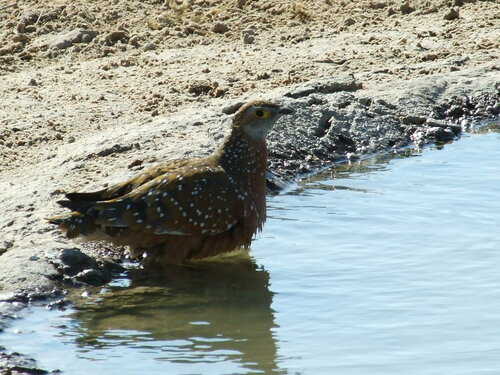
Burchell's Sandgrouse (Pterocles burchelli) Burchell's Sandgrouse
Ludwig's Bustard (Neotis ludwigii) Ludwig's Bustard

Media

Loading…

In short

Burchell's Sandgrouse and Ludwig's Bustard are distinct in size and structure, with the sandgrouse being much smaller and more compact. Burchell's Sandgrouse is typically found in arid environments, while Ludwig's Bustard prefers open grasslands and semi-deserts. Their behavior and flight patterns also differ significantly.

Identification tips

1. Size and Structure: Use size as a primary differentiator; sandgrouse are much smaller. 2. Flight Pattern: Observe flight; sandgrouse have rapid, direct flight, while bustards fly more slowly. 3. Plumage: Look for the bold wing patterns of Ludwig's Bustard in flight. 4. Habitat: Consider habitat; sandgrouse are in arid areas, bustards in grasslands. 5. Calls: Listen for the soft cooing of sandgrouse, especially at dawn and dusk.

Size

Burchell's Sandgrouse is significantly smaller and more compact than Ludwig's Bustard, which is a large and robust bird.

Plumage

Burchell's Sandgrouse has a more uniform, cryptic plumage with intricate patterns that blend into sandy environments, whereas Ludwig's Bustard has a more contrasting plumage with bold patterns, including a distinctive black and white wing pattern visible in flight.

Behaviour

Burchell's Sandgrouse is often seen in flocks and is known for its rapid, direct flight. In contrast, Ludwig's Bustard is more solitary or seen in small groups and has a slower, more deliberate flight.

Habitat

Burchell's Sandgrouse inhabits arid and semi-arid regions, often near water sources. Ludwig's Bustard prefers open grasslands, semi-deserts, and scrubby areas.

Voice

Burchell's Sandgrouse has a distinctive, soft, and repetitive 'cooing' call, often heard at dawn and dusk. Ludwig's Bustard is generally quieter, with occasional deep, booming calls during the breeding season.

Submit a better description

Use the same sections as the comparison. Your text is published immediately.

Burchell's Sandgrouse and Ludwig's Bustard are distinct in size and structure, with the sandgrouse being much smaller and more compact. Burchell's Sandgrouse is typically found in arid environments, while Ludwig's Bustard prefers open grasslands and semi-deserts. Their behavior and flight patterns also differ significantly.

1. Size and Structure: Use size as a primary differentiator; sandgrouse are much smaller. 2. Flight Pattern: Observe flight; sandgrouse have rapid, direct flight, while bustards fly more slowly. 3. Plumage: Look for the bold wing patterns of Ludwig's Bustard in flight. 4. Habitat: Consider habitat; sandgrouse are in arid areas, bustards in grasslands. 5. Calls: Listen for the soft cooing of sandgrouse, especially at dawn and dusk.

Burchell's Sandgrouse is significantly smaller and more compact than Ludwig's Bustard, which is a large and robust bird.

Burchell's Sandgrouse has a more uniform, cryptic plumage with intricate patterns that blend into sandy environments, whereas Ludwig's Bustard has a more contrasting plumage with bold patterns, including a distinctive black and white wing pattern visible in flight.

Burchell's Sandgrouse is often seen in flocks and is known for its rapid, direct flight. In contrast, Ludwig's Bustard is more solitary or seen in small groups and has a slower, more deliberate flight.

Burchell's Sandgrouse inhabits arid and semi-arid regions, often near water sources. Ludwig's Bustard prefers open grasslands, semi-deserts, and scrubby areas.

Burchell's Sandgrouse has a distinctive, soft, and repetitive 'cooing' call, often heard at dawn and dusk. Ludwig's Bustard is generally quieter, with occasional deep, booming calls during the breeding season.

Discard your changes?

You have unsaved edits. If you leave now, those changes will be lost.

Burchell's Sandgrouse · Ludwig's Bustard · My Tricky Birds