

Butterfly Coquette vs Golden-winged Sparrow
Lophornis verreauxii versus Arremon schlegeli
Play a quiz with Butterfly Coquette and Golden-winged Sparrow
 Butterfly Coquette
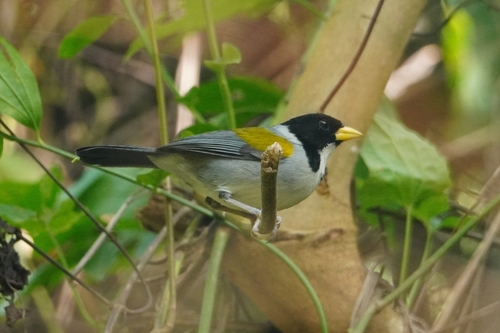 Golden-winged Sparrow
In short
The most reliable field mark to separate Butterfly Coquette from Golden-winged Sparrow is overall structure and plumage: Butterfly Coquette is a tiny, compact hummingbird with iridescent green and maroon tones, often showing a long, red-tipped crest and facial 'whiskers' in males, while Golden-winged Sparrow is a much larger, chunky songbird with a distinctive black head, yellow bill, and greenish or gray upperparts. In flight or perched, the coquette's small size and rapid movements contrast sharply with the sparrow's bulkier, ground-foraging jizz. Female and immature coquettes lack the ornate headgear but remain much smaller and more metallic than any sparrow. Confusion is most likely with female/immature coquettes and juvenile sparrows, but bill shape, head pattern, and overall proportions remain clear separators.
Identification tips
- Size and structure: Butterfly Coquette is tiny, about half the length and a fraction of the mass of Golden-winged Sparrow. Even at a distance, the coquette's small, delicate build and rapid, hovering flight are diagnostic.
- Bill shape: Coquette has a slender, straight hummingbird bill (adapted for nectar feeding); sparrow has a thick, conical seed-eater's bill, bright yellow in adults and black in juveniles.
- Head pattern (males): Male coquette shows a deep green head with a long, red-tipped crest and green 'whiskers' with white tips—unique among hummingbirds and not present in sparrows. Male sparrow has a completely black head, face, malar, and chin, with a yellow bill and white throat.
- Head pattern (females/immatures): Female coquette lacks crest and whiskers but shows a whitish malar patch and metallic green tones. Female sparrow retains a black head (less intense in juveniles), buffier underparts, and yellow or black bill.
- Upperparts: Coquette is metallic green with golden highlights and reddish or bronzy uppertail coverts; sparrow is gray with a green patch on the back (some subspecies all gray), never iridescent.
- Tail: Coquette's tail is maroon or bronzy green, short and squared; sparrow's tail is typical for a songbird, longer and not colorful.
- Underparts: Coquette is green below with white thighs; sparrow is white-throated with gray or buffy underparts (females buffier).
- Flight style: Coquette hovers and darts, rarely perching for long; sparrow walks or hops on the ground, flies in short bursts, and perches upright.
- Habitat: Coquette prefers humid forest edges and clearings with abundant flowers; sparrow is found in dry forests, shrubland, and degraded woodland, often on the ground or in low vegetation.
- Vocalizations: Sparrow sings a repeated, high-pitched series of notes; coquette is mostly silent or gives thin chips, never a structured song.
- Sex/age pitfalls: Female and immature coquettes lack ornate headgear but remain much smaller, more metallic, and have a slender bill. Juvenile sparrows have a black bill and less intense black head, but still show the thick bill and ground-foraging behavior.
- Subspecies variation: Coquette subspecies may be darker or bronzier, but never lose the metallic tones or small size. Sparrow subspecies may lack green on the back (gray instead), but always have the black head and yellow/black bill.
- Contextual clues: If seen feeding at flowers with rapid wingbeats, it's a coquette; if seen foraging on the ground or singing from a low perch, it's a sparrow.
- Geographic range: Both occur in Colombia and Venezuela, but sparrow is restricted to drier habitats, while coquette is more widespread and favors humid areas.
- Mistaken identity: Most confusion arises when female/immature coquettes are seen poorly, but bill shape, size, and lack of black head in coquette are always reliable.
Size
Butterfly Coquette is dramatically smaller, measuring only about 7.5–9.1 cm in length and weighing far less than the Golden-winged Sparrow (which averages 28 g and is about 15 cm long). The coquette is a typical hummingbird: tiny, delicate, with a proportionally short tail and slender bill. In contrast, Golden-winged Sparrow is a robust, medium-sized songbird with a thick, conical bill and a much heavier body. Even at a distance, the sparrow's size and bulk are obvious compared to the diminutive coquette.
Plumage
- Juvenile/immature flight patterns: No distinctive upperwing or flight marks are described for either species at any age, so separation relies on structure and plumage.
- Adult males: Butterfly Coquette males have a deep green head with a long, red-tipped green crest and long green 'whiskers' with white tips, green back with golden highlights, reddish uppertail coverts, a white rump band, green underparts with white thighs, and a maroon tail. Golden-winged Sparrow males have a completely black head, yellow bill, gray upperparts with a green patch on the back, white throat, gray nape, and no iridescence or ornate headgear.
- Females/immatures: Female coquettes lack the crest and whiskers but show a whitish malar patch, less intense red uppertail coverts, and golden highlights on the breast. Female sparrows have buffier underparts but retain the black head (though less intense in juveniles), yellow or black bill (juveniles have black bills), and no iridescence. Both sexes of the coquette are much more metallic and compact than the sparrow at any age.
- Subspecies: Some coquette subspecies are darker overall, with bronzy olive uppertail coverts and bronzy green tails, but still retain the basic hummingbird structure and metallic tones. Golden-winged Sparrow subspecies vary in back color (some with more gray, some with green), but always have the black head and yellow or black bill.
Behaviour
Butterfly Coquette is a classic hummingbird, hovering at flowers and feeding on nectar with rapid, darting movements, rarely perching for long. Golden-winged Sparrow forages on or near the ground, feeding on seeds, fruit, and insects, often seen hopping or walking rather than flying. Sparrows are usually found singly or in pairs, sometimes in low vegetation, and are much less active in flight than coquettes.
Habitat
Butterfly Coquette inhabits a range of forested habitats across Bolivia, Brazil, Colombia, Ecuador, Peru, and Venezuela, but is generally associated with humid forest edges and clearings. Golden-winged Sparrow is restricted to Colombia and Venezuela, favoring subtropical or tropical dry forests, shrubland, and degraded former forest, often in drier, more open habitats than the coquette. If seen in dry, scrubby woodland or open thickets, sparrow is far more likely; coquette prefers wetter, flower-rich areas.
Voice
Golden-winged Sparrow has a distinctive, high-pitched song described as repeated 'Zeut-zeut-zeut-zee' or 'Soot-soot-soot-see,' most often heard in the early morning during the wet season. Butterfly Coquette, like most hummingbirds, is generally quiet or gives only thin, high-pitched chips or trills, not a structured song. If you hear a repeated, structured song, it points strongly to the sparrow.
Butterfly Coquette · Golden-winged Sparrow · My Tricky Birds