

Butterfly Coquette vs Tumbes Hummingbird
Lophornis verreauxii versus Thaumasius baeri
Play a quiz with Butterfly Coquette and Tumbes Hummingbird
 Butterfly Coquette
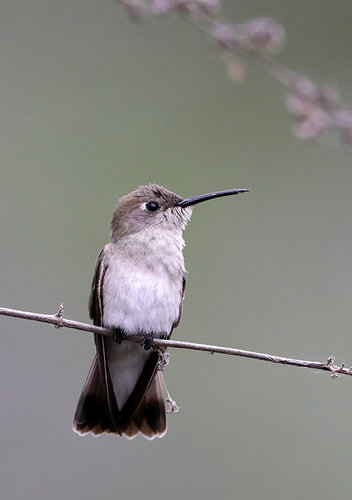 Tumbes Hummingbird
In short
The most reliable field mark to separate Butterfly Coquette from Tumbes Hummingbird is the presence of a long, red-tipped green crest and striking green 'whiskers' with white tips in adult male Butterfly Coquette, features entirely absent in Tumbes Hummingbird of any age or sex. Female Butterfly Coquette lacks the crest but shows a distinct whitish malar patch, while Tumbes Hummingbird of both sexes is plainer-faced. In all plumages, Butterfly Coquette is more richly colored above and below, with golden highlights and maroon or bronzy tail, compared to the pale golden-green upperparts and grayish-white underparts of Tumbes Hummingbird. Structure also differs: Butterfly Coquette is slightly shorter and more compact, while Tumbes Hummingbird is longer and slimmer with a straight black bill. These differences hold in perched and in-flight views, but especially watch for the male coquette's ornate head pattern.
Identification tips
- Crest and whiskers (adult male Butterfly Coquette only): Look for the spectacular long, red-tipped green crest and green whiskers with white tips—these are unique to adult male Butterfly Coquette and never shown by Tumbes Hummingbird.
- Head pattern (female Butterfly Coquette): Females lack the crest but have a distinctive whitish malar patch, absent in Tumbes Hummingbird, which has a plain face.
- Upperparts color: Butterfly Coquette (both sexes) has deep green upperparts with golden highlights, while Tumbes Hummingbird is pale golden-green above—less saturated and more uniform.
- Rump and uppertail coverts: Butterfly Coquette shows a white rump band and, in males, deep reddish (maroon) uppertail coverts; in females, these are less intense. Tumbes Hummingbird lacks the white rump band and has pale green tail feathers with bronzy or dusky tips.
- Tail color and pattern: Butterfly Coquette's tail is maroon (or bronzy green in klagesi), contrasting with the pale green tail of Tumbes Hummingbird. The latter has a dusky gray band near the end and whitish or grayish tips depending on sex.
- Underparts: Butterfly Coquette is green below with white thighs and golden highlights (especially in females), while Tumbes Hummingbird is pale grayish, becoming white on the belly—much paler overall.
- Bill shape and color: Tumbes Hummingbird has a nearly straight black bill; Butterfly Coquette's bill shape and color are not specified as diagnostic, but the lack of a straight black bill may help in some views.
- Size and structure: Butterfly Coquette is slightly shorter and more compact (7.5–9.1 cm), while Tumbes Hummingbird is longer and slimmer (8–11 cm). This is subtle but can be helpful with experience.
- Sexual dimorphism: Tumbes Hummingbird sexes are essentially alike, while Butterfly Coquette shows strong sexual dimorphism—males with ornate crests and whiskers, females with a malar patch.
- Subspecies variation: If viewing L. v. klagesi (Butterfly Coquette), expect overall darker birds with bronzy-olive uppertail coverts and bronzy-green tail, but still with the key coquette features.
- Geographic range: Tumbes Hummingbird is only found in Ecuador and Peru; Butterfly Coquette ranges more widely. Use range to support ID if location is known.
- No age-specific flight marks: Neither species is described as having distinctive juvenile or immature upperwing patterns, so do not rely on flight marks for separation.
- No distinctive vocalizations: No vocal differences are described; do not use voice for separation.
- Contextual clues: If you see a hummingbird with a strikingly ornate head pattern in the coquette style, it is not Tumbes Hummingbird. Conversely, a plain-faced, pale-bellied, golden-green hummingbird in Ecuador or Peru is likely Tumbes Hummingbird.
- Common pitfalls: Immature or female Butterfly Coquette may be mistaken for Tumbes Hummingbird due to lack of crest, but the malar patch and richer upperparts should help. Always check for subtle facial and rump/tail differences.
Size
Butterfly Coquette is slightly smaller, measuring 7.5–9.1 cm in length, while Tumbes Hummingbird is 8–11 cm long and weighs about 4.5 g. The coquette is more compact overall, whereas Tumbes Hummingbird appears longer and slimmer. This difference is subtle but can be useful with direct comparison or when judging proportions on a perch.
Plumage
Adult male Butterfly Coquette is unmistakable with its deep green head, long red-tipped green crest, and long green whiskers tipped white. Its back is green with golden highlights, uppertail coverts are deep reddish (maroon), and the tail is maroon. Underparts are green with white thighs, and a white rump band is present. Females lack the crest and whiskers but have a whitish malar patch, less intense red uppertail coverts, and golden highlights on the breast. Subspecies klagesi is overall darker with bronzy-olive uppertail coverts and bronzy-green tail. In contrast, Tumbes Hummingbird of both sexes is much plainer: upperparts are pale golden-green, underparts are pale grayish to white on the belly, and tail feathers are pale green with bronzy or dusky tips and a whitish or grayish terminal band (depending on sex). No age-specific upperwing or flight pattern marks are described for either species, so separation relies on head and body plumage, especially in males.
Behaviour
Both species forage for nectar and small arthropods, but the notes do not describe any diagnostic behavioral differences. Tumbes Hummingbird is noted to forage from understory to mid-strata, but this is not necessarily distinctive in the field. No unique flight style or display behavior is reported for either species.
Habitat
Butterfly Coquette ranges widely in northern and western South America (Bolivia, Brazil, Colombia, Ecuador, Peru, Venezuela), while Tumbes Hummingbird is restricted to Ecuador and Peru. If seen outside Ecuador or Peru, Tumbes Hummingbird can be ruled out. Both occur in similar lowland to foothill habitats, so habitat alone is not diagnostic within their shared range.