Birdr

Canada Jay vs Pinyon Jay

Perisoreus canadensis versus Gymnorhinus cyanocephalus

Play a quiz with Canada Jay and Pinyon Jay
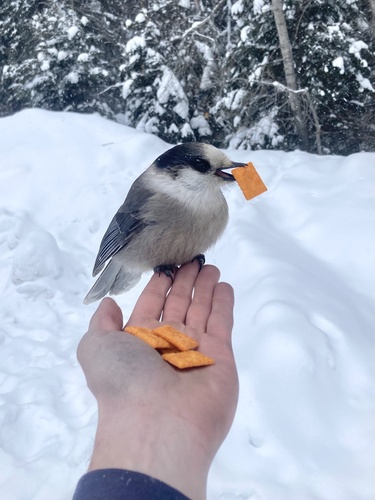
Canada Jay (Perisoreus canadensis) Canada Jay
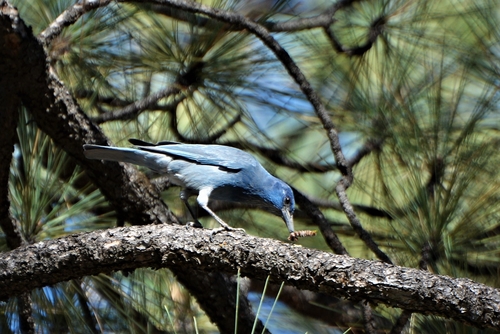
Pinyon Jay (Gymnorhinus cyanocephalus) Pinyon Jay

Media

Loading…

In short

The Canada Jay and Pinyon Jay can be distinguished primarily by their plumage and habitat preferences. Canada Jays are generally found in boreal forests and have a more grayish appearance, while Pinyon Jays are associated with pinyon pine habitats and exhibit a bluish hue. Both species are social, but their vocalizations and behaviors differ significantly.

Identification tips

Look for habitat: Canada Jays are in boreal forests, Pinyon Jays in pinyon-juniper woodlands. Check plumage: Canada Jays are gray with a lighter face; Pinyon Jays are bluish-gray. Listen for calls: Canada Jays have soft whistles; Pinyon Jays have loud, harsh calls. Observe behavior: Canada Jays are solitary or in pairs, while Pinyon Jays are in large flocks.

Size

Both species are similar in size, but the Pinyon Jay may appear slightly larger due to its longer wings and tail.

Plumage

Canada Jays have a grayish body with a lighter face and throat, and a darker cap. Pinyon Jays are more uniformly bluish-gray with no distinct cap or facial markings.

Behaviour

Canada Jays are known for their curious and bold behavior, often approaching humans for food. Pinyon Jays are highly social, often seen in large flocks, and are known for their cooperative breeding and seed caching behavior.

Habitat

Canada Jays inhabit boreal and subalpine forests across North America, while Pinyon Jays are found in the pinyon-juniper woodlands of the western United States.

Voice

Canada Jays have a variety of soft, whistled calls, while Pinyon Jays are louder with more varied calls, including harsh 'kaw' sounds.

Submit a better description

Use the same sections as the comparison. Your text is published immediately.

The Canada Jay and Pinyon Jay can be distinguished primarily by their plumage and habitat preferences. Canada Jays are generally found in boreal forests and have a more grayish appearance, while Pinyon Jays are associated with pinyon pine habitats and exhibit a bluish hue. Both species are social, but their vocalizations and behaviors differ significantly.

Look for habitat: Canada Jays are in boreal forests, Pinyon Jays in pinyon-juniper woodlands. Check plumage: Canada Jays are gray with a lighter face; Pinyon Jays are bluish-gray. Listen for calls: Canada Jays have soft whistles; Pinyon Jays have loud, harsh calls. Observe behavior: Canada Jays are solitary or in pairs, while Pinyon Jays are in large flocks.

Both species are similar in size, but the Pinyon Jay may appear slightly larger due to its longer wings and tail.

Canada Jays have a grayish body with a lighter face and throat, and a darker cap. Pinyon Jays are more uniformly bluish-gray with no distinct cap or facial markings.

Canada Jays are known for their curious and bold behavior, often approaching humans for food. Pinyon Jays are highly social, often seen in large flocks, and are known for their cooperative breeding and seed caching behavior.

Canada Jays inhabit boreal and subalpine forests across North America, while Pinyon Jays are found in the pinyon-juniper woodlands of the western United States.

Canada Jays have a variety of soft, whistled calls, while Pinyon Jays are louder with more varied calls, including harsh 'kaw' sounds.

Discard your changes?

You have unsaved edits. If you leave now, those changes will be lost.

Canada Jay · Pinyon Jay · My Tricky Birds