Birdr

Canebrake Wren vs Riverside Wren

Cantorchilus zeledoni versus Cantorchilus semibadius

Play a quiz with Canebrake Wren and Riverside Wren

Canebrake Wren (Cantorchilus zeledoni) Canebrake Wren
Riverside Wren (Cantorchilus semibadius) Riverside Wren

Media

Loading…

In short

The Canebrake Wren and Riverside Wren are similar in size and structure, but differ in plumage and habitat preferences. The Canebrake Wren has more uniform coloration, while the Riverside Wren displays distinct barring on its underparts.

Identification tips

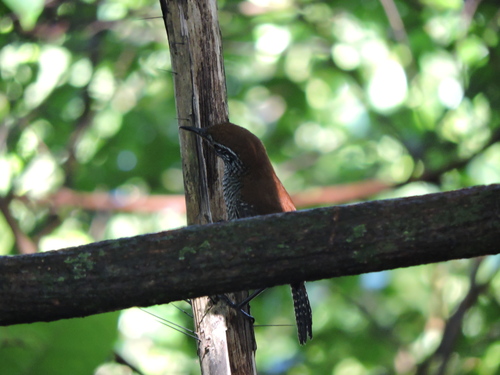
Look for the distinct barring on the underparts of the Riverside Wren. Observe the habitat: Riverside Wrens are more likely near water. Note group behavior: Riverside Wrens often stay in family groups year-round.

Size

Both species are similar in size, typical of small wrens.

Plumage

The Canebrake Wren has more uniform brownish upperparts and less distinct barring below. In contrast, the Riverside Wren features chestnut upperparts with whitish underparts heavily barred with blackish, and its wing coverts and tail are also barred.

Behaviour

Both species are often found in pairs or small family groups. The Riverside Wren tends to remain in these groups throughout the year.

Habitat

The Canebrake Wren prefers dense vegetation, while the Riverside Wren is found near water bodies, from sea level to about 1200 m.

Submit a better description

Use the same sections as the comparison. Your text is published immediately.

The Canebrake Wren and Riverside Wren are similar in size and structure, but differ in plumage and habitat preferences. The Canebrake Wren has more uniform coloration, while the Riverside Wren displays distinct barring on its underparts.

Look for the distinct barring on the underparts of the Riverside Wren. Observe the habitat: Riverside Wrens are more likely near water. Note group behavior: Riverside Wrens often stay in family groups year-round.

Both species are similar in size, typical of small wrens.

The Canebrake Wren has more uniform brownish upperparts and less distinct barring below. In contrast, the Riverside Wren features chestnut upperparts with whitish underparts heavily barred with blackish, and its wing coverts and tail are also barred.

Both species are often found in pairs or small family groups. The Riverside Wren tends to remain in these groups throughout the year.

The Canebrake Wren prefers dense vegetation, while the Riverside Wren is found near water bodies, from sea level to about 1200 m.

Discard your changes?

You have unsaved edits. If you leave now, those changes will be lost.

Canebrake Wren · Riverside Wren · My Tricky Birds