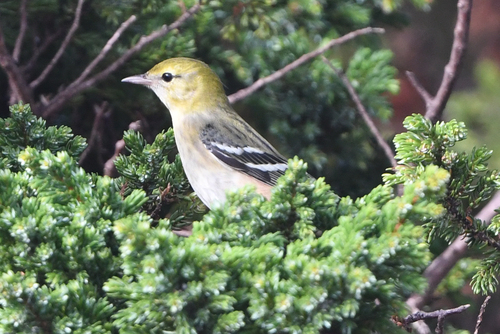
Cape May Warbler vs Bay-breasted Warbler
Setophaga tigrina versus Setophaga castanea
Play a quiz with Cape May Warbler and Bay-breasted Warbler
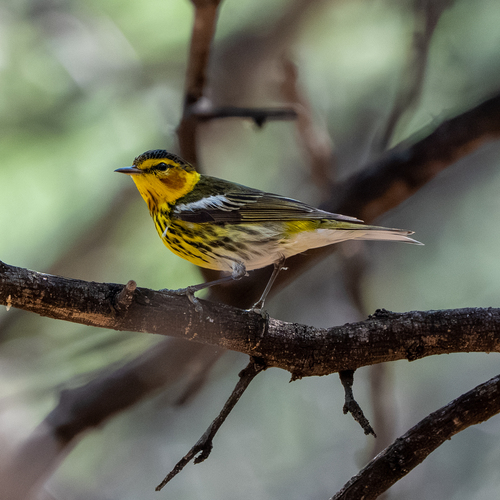
Cape May Warbler
Bay-breasted Warbler
In short
The Cape May Warbler and Bay-breasted Warbler can be distinguished by plumage: the Cape May Warbler has a yellow breast streaked with black and chestnut ear-patches, while the Bay-breasted Warbler has a more subdued appearance with a buffy or chestnut wash on the flanks. Both species are spruce budworm specialists, often found in similar habitats.
Identification tips
- Look for the chestnut ear-patches and yellow breast streaked with black on the Cape May Warbler.
- Note the buffy or chestnut wash on the flanks of the Bay-breasted Warbler.
- During nonbreeding season, be cautious as Bay-breasted Warblers can resemble Blackpoll Warblers.
- Both species are more likely to be observed during spruce budworm outbreaks.
Size
Both species are similar in size, typical of small wood-warblers.
Plumage
The Cape May Warbler features a yellow breast with black streaks, a yellow rump, and distinctive chestnut ear-patches. In contrast, the Bay-breasted Warbler has a buffy or chestnut wash on the flanks and lacks the chestnut ear-patches. Nonbreeding and immature Bay-breasted Warblers can resemble Blackpoll Warblers, making them harder to distinguish.
Behaviour
Both species are highly dependent on spruce budworm outbreaks for feeding, showing similar foraging behaviors during these times.
Habitat
Both warblers inhabit boreal coniferous forests, particularly during budworm outbreaks. The Bay-breasted Warbler is more likely to be found in dense coniferous foliage.
Voice
Vocalizations are not a primary distinguishing feature between these two species in the field.