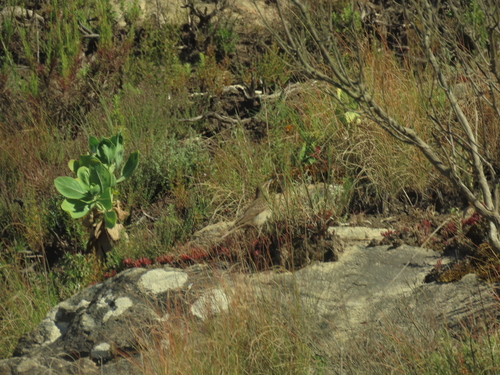
Capped Wheatear vs Nicholson's Pipit
Oenanthe pileata versus Anthus nicholsoni
Play a quiz with Capped Wheatear and Nicholson's Pipit
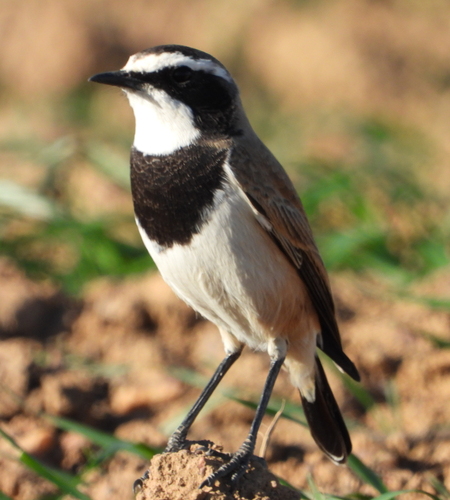
Capped Wheatear
Nicholson's Pipit
In short
The Capped Wheatear and Nicholson's Pipit can be distinguished primarily by their structure and behavior. The Capped Wheatear is more robust with a distinctive cap and contrasting plumage, while Nicholson's Pipit is slender and more uniformly brown with streaking.
Identification tips
- Look for the black cap and contrasting plumage of the Capped Wheatear. 2. Note the slender build and streaked appearance of Nicholson's Pipit. 3. Observe behavior: Capped Wheatear perches conspicuously, while Nicholson's Pipit is more ground-oriented. 4. Consider habitat: Capped Wheatear in open grasslands, Nicholson's Pipit in rocky, recently burned areas.
Size
Capped Wheatear is more robust and slightly larger than Nicholson's Pipit, which is slender and elongated.
Plumage
Capped Wheatear has a distinctive black cap, white eyebrow, and contrasting black and white plumage. Nicholson's Pipit is generally brown above and buffy below with variable streaking, lacking the stark contrast seen in the wheatear.
Behaviour
Capped Wheatear often perches conspicuously and may be seen hopping on the ground. Nicholson's Pipit is more likely to be seen walking or running on the ground, often in recently burned areas.
Habitat
Capped Wheatear prefers open habitats like grasslands and savannas. Nicholson's Pipit is found in rocky and stony slopes with grass clumps and low scrub, often visiting recently burned areas.
Voice
Vocalizations are not well-documented for these species in the provided notes. Capped Wheatear typically has a varied song, while pipits often have a simpler, repetitive call.