
Caspian Gull vs Herring Gull
Larus cachinnans versus Larus argentatus
Play a quiz with Caspian Gull and Herring Gull
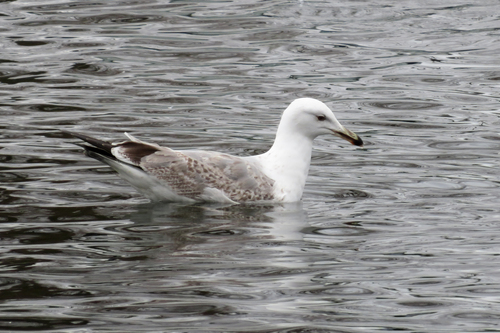 Caspian Gull
 Herring Gull
In short
The most reliable field mark for separating Caspian Gull from Herring Gull, especially in immature birds, is the wing and head pattern: first-winter Caspian Gulls show a pale head with dark streaking only on the nape and two pale lines across the wing, while Herring Gulls of the same age are more uniformly brown and streaked overall, lacking those pale wing lines. Structurally, Caspian Gulls are longer-legged, longer-necked, and have a more slender, parallel-sided bill compared to the chunkier, shorter-legged Herring Gull. In flight, Caspian Gulls often look more elegant and elongated. Adult plumage differences are subtle, but Caspian Gulls have a slightly darker mantle than Herring Gulls and a smaller, darker eye. Careful attention to age-related plumage and overall structure is key, as both species are variable and overlap in size.
Identification tips
- First-winter/juvenile wing pattern: Look for two pale lines across the wing (greater and median covert tips) on Caspian Gull; Herring Gull lacks these and is more uniformly brown. This is most reliable in autumn and winter.
- Head pattern in immatures: Caspian Gulls show a pale head with dark streaking restricted to the nape, while Herring Gulls are heavily streaked all over the head and neck.
- Bill shape: Caspian Gull has a long, slender, parallel-sided bill with a gradual curve; Herring Gull's bill is stouter, deeper, and more bulbous at the tip.
- Eye color: Adult Caspian Gulls often have a small, dark eye; Herring Gulls usually have a pale eye with a yellow orbital ring, though this can vary with age and population.
- Leg length and color: Caspian Gulls have longer legs, often appearing pale pink to yellowish; Herring Gulls have shorter, thicker legs, usually pink but sometimes yellowish in Baltic birds.
- Neck and body structure: Caspian Gulls are longer-necked and slimmer-bodied, often appearing more upright and elegant; Herring Gulls are bulkier and more compact.
- Mantle shade: Caspian's mantle is slightly darker grey than Herring's, but paler than Yellow-legged Gull; this is subtle and best judged in direct comparison.
- Primary pattern (adults): Caspian's outermost primary has a large white tip and a white 'tongue' running up the inner web; Herring has black wingtips with white 'mirrors', but the pattern is less extensive.
- Flight jizz: Caspian Gulls look longer-winged and more graceful in flight, with a slightly drooping bill and forward-leaning posture; Herring Gulls are heavier and more labored in flight.
- Plumage progression: Herring Gulls take four years to reach adult plumage, with second- and third-winter birds showing a mix of brown and grey; Caspian Gulls follow a similar but subtly different progression, with earlier loss of head streaking and more rapid acquisition of pale underparts.
- Bill color in immatures: Both species have dark bills in juvenile and first-winter plumage; this is not a good separator.
- Sex differences: Both species show little plumage difference between sexes; males are larger, but this is not reliable in the field.
- Habitat clues: If seen inland in eastern Europe or Central Asia, Caspian is more likely; on western European coasts or urban areas, Herring is more likely, but both can occur together.
- Pitfalls: Variation is high in both species, and hybrids or atypical individuals can be confusing. Use a combination of structure, plumage, and age-related marks for best results.
- Seasonal context: In late summer and autumn, fresh juveniles are easier to separate by wing pattern and head streaking; in late winter, plumage differences become less distinct, so structure and bill shape become more important.
Size
Both species are large gulls with overlapping size ranges. Caspian Gull averages a body mass of 1154 g [wikidata], while Herring Gull males range from 1050–1525 g and females from 710–1100 g [wikipedia]. Caspian Gull is typically at least as large as Herring Gull, sometimes slightly longer (Caspian: 56–68 cm; Herring: 55–67 cm), but the difference is not always apparent in the field. Wingspans overlap (Caspian: 137–155 cm; Herring: 125–155 cm). Structural differences (longer legs, neck, and bill in Caspian) are more useful than pure size.
Plumage
Juvenile and first-winter birds are the most reliably separated by plumage. First-winter Caspian Gulls have a pale head with dark streaking confined to the nape, pale underparts, and a greyish back. Their greater and median wing coverts have whitish tips, forming two pale lines across the wing—these pale lines are a key field mark and are visible both at rest and in flight. In contrast, Herring Gull juveniles and first-winters are overall brown with heavy, diffuse streaking on the head and body, and lack the sharply defined pale wing lines. Their bills and eyes are dark, and the overall impression is of a more uniformly brown bird. By second winter, Herring Gulls begin to show a whiter head and underparts, but still lack the Caspian's distinctive wing pattern. Adults of both species are similar, with light grey mantles, white heads and underparts, and black wingtips with white mirrors. Caspian Gulls have a slightly darker mantle than Herring Gulls, but this is subtle. Caspian's eye is often small and dark, while Herring's is pale with a yellow orbital ring. Leg color is variable: Caspian Gulls have pale pink to pale yellowish legs, while Herring Gulls are usually pink, but can show yellowish legs in some populations.
Behaviour
Caspian Gulls tend to appear more upright and elongated, with a long neck and legs, and a sloping forehead giving a distinctive profile, especially when alert or standing. In flight, Caspian Gulls look long-winged and graceful, often with a drooping bill and a slightly forward-leaning posture. Herring Gulls are bulkier, with a more compact, heavy build and a less elongated look both at rest and in flight. Both species are opportunistic feeders and can be found scavenging, but Caspian Gulls may be more likely to be seen in inland steppe or wetland habitats, while Herring Gulls are more common in coastal and urban environments.
Habitat
Both species can overlap in a variety of habitats, especially in winter or migration. Herring Gulls are widespread along northern and western European coasts, as well as urban areas, landfills, and inland water bodies. Caspian Gulls are more likely to be found in eastern Europe and Central Asia, often at large inland lakes, reservoirs, and steppe wetlands, but are increasingly recorded in western Europe, especially in winter. Habitat alone is not diagnostic, but context can support identification.