
Birdr

Chestnut-belted Gnateater vs Ash-throated Gnateater

Conopophaga aurita versus Conopophaga peruviana

Play a quiz with Chestnut-belted Gnateater and Ash-throated Gnateater
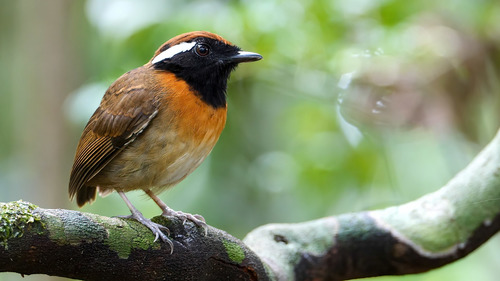
Chestnut-belted Gnateater (Conopophaga aurita) Chestnut-belted Gnateater
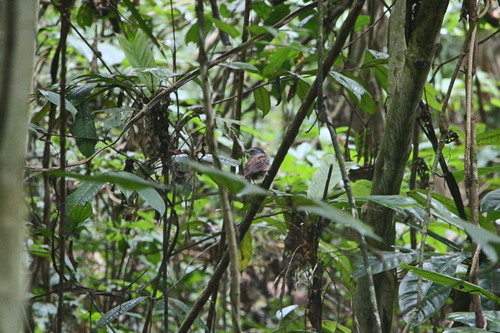
Ash-throated Gnateater (Conopophaga peruviana) Ash-throated Gnateater

Media

Loading…

In short

The Chestnut-belted Gnateater and Ash-throated Gnateater are similar Amazonian species, often distinguished by their range and plumage. The Chestnut-belted is typically found on the east and north banks of the Napo River, while the Ash-throated is on the west and south banks. Key differences include the male Chestnut-belted's black mask and throat, absent in the Ash-throated.

Identification tips

  1. Range: Check which side of the Napo River you are on; Chestnut-belted is east/north, Ash-throated is west/south. 2. Male plumage: Look for the black mask and throat in Chestnut-belted males. 3. Female plumage: Note the bright orange-rufous underparts in Ash-throated females. 4. Behavior: Both species are territorial and forage near the ground, often in pairs.

Size

Both species are relatively small gnateaters, similar in size.

Plumage

Male Chestnut-belted Gnateaters have a distinctive black mask and throat, while Ash-throated males are gray below and over the face with a brown crown. Female Chestnut-belted lack the black mask and throat, whereas female Ash-throated have bright orange-rufous underparts and face.

Behaviour

Both species forage for insects near the ground and are usually seen in isolated pairs, exhibiting territorial behavior.

Habitat

The Chestnut-belted Gnateater is found on the east and north banks of the Napo River, while the Ash-throated is on the west and south banks. They overlap in Peru south of the Amazon.

Submit a better description

Use the same sections as the comparison. Your text is published immediately.

The Chestnut-belted Gnateater and Ash-throated Gnateater are similar Amazonian species, often distinguished by their range and plumage. The Chestnut-belted is typically found on the east and north banks of the Napo River, while the Ash-throated is on the west and south banks. Key differences include the male Chestnut-belted's black mask and throat, absent in the Ash-throated.

  1. Range: Check which side of the Napo River you are on; Chestnut-belted is east/north, Ash-throated is west/south. 2. Male plumage: Look for the black mask and throat in Chestnut-belted males. 3. Female plumage: Note the bright orange-rufous underparts in Ash-throated females. 4. Behavior: Both species are territorial and forage near the ground, often in pairs.

Both species are relatively small gnateaters, similar in size.

Male Chestnut-belted Gnateaters have a distinctive black mask and throat, while Ash-throated males are gray below and over the face with a brown crown. Female Chestnut-belted lack the black mask and throat, whereas female Ash-throated have bright orange-rufous underparts and face.

Both species forage for insects near the ground and are usually seen in isolated pairs, exhibiting territorial behavior.

The Chestnut-belted Gnateater is found on the east and north banks of the Napo River, while the Ash-throated is on the west and south banks. They overlap in Peru south of the Amazon.

Discard your changes?

You have unsaved edits. If you leave now, those changes will be lost.

Chestnut-belted Gnateater · Ash-throated Gnateater · My Tricky Birds