Birdr

Chestnut-breasted Cuckoo vs Fan-tailed Cuckoo

Cacomantis castaneiventris versus Cacomantis flabelliformis

Play a quiz with Chestnut-breasted Cuckoo and Fan-tailed Cuckoo
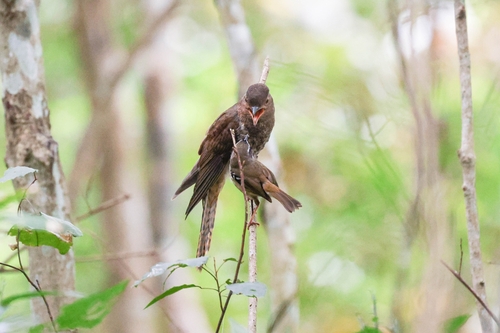
Chestnut-breasted Cuckoo (Cacomantis castaneiventris) Chestnut-breasted Cuckoo
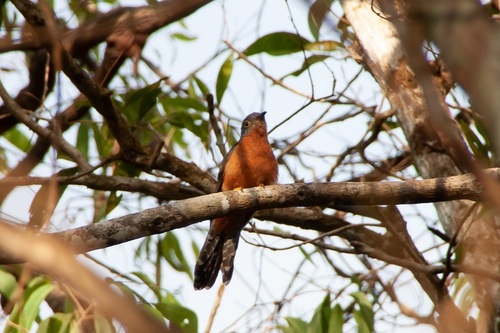
Fan-tailed Cuckoo (Cacomantis flabelliformis) Fan-tailed Cuckoo

Media

Loading…

In short

The Chestnut-breasted Cuckoo and Fan-tailed Cuckoo are similar in appearance, but can be distinguished by their plumage and vocalizations. The Chestnut-breasted Cuckoo has a more distinct chestnut underpart coloration, while the Fan-tailed Cuckoo is generally more uniform in color. Vocalizations differ, with the Fan-tailed Cuckoo having a more varied call.

Identification tips

  1. Look for the chestnut underparts on the Chestnut-breasted Cuckoo; the Fan-tailed Cuckoo is more uniformly grey. 2. Listen for vocal differences; the Fan-tailed Cuckoo has a more varied call. 3. Consider habitat adaptability; the Fan-tailed Cuckoo may be found in a broader range of environments.

Size

Both species are similar in size, typical of small to medium-sized cuckoos.

Plumage

The Chestnut-breasted Cuckoo has a prominent chestnut coloration on its underparts, contrasting with its grey upperparts. In contrast, the Fan-tailed Cuckoo tends to have more uniform grey plumage, with less distinct chestnut tones.

Behaviour

Both species exhibit typical cuckoo behavior, often seen perched quietly in the mid-canopy.

Habitat

Both species inhabit similar environments, often found in forested areas and edges. However, the Fan-tailed Cuckoo may be more adaptable to a wider range of habitats.

Voice

The Fan-tailed Cuckoo has a more varied and complex call compared to the simpler calls of the Chestnut-breasted Cuckoo.

Submit a better description

Use the same sections as the comparison. Your text is published immediately.

The Chestnut-breasted Cuckoo and Fan-tailed Cuckoo are similar in appearance, but can be distinguished by their plumage and vocalizations. The Chestnut-breasted Cuckoo has a more distinct chestnut underpart coloration, while the Fan-tailed Cuckoo is generally more uniform in color. Vocalizations differ, with the Fan-tailed Cuckoo having a more varied call.

  1. Look for the chestnut underparts on the Chestnut-breasted Cuckoo; the Fan-tailed Cuckoo is more uniformly grey. 2. Listen for vocal differences; the Fan-tailed Cuckoo has a more varied call. 3. Consider habitat adaptability; the Fan-tailed Cuckoo may be found in a broader range of environments.

Both species are similar in size, typical of small to medium-sized cuckoos.

The Chestnut-breasted Cuckoo has a prominent chestnut coloration on its underparts, contrasting with its grey upperparts. In contrast, the Fan-tailed Cuckoo tends to have more uniform grey plumage, with less distinct chestnut tones.

Both species exhibit typical cuckoo behavior, often seen perched quietly in the mid-canopy.

Both species inhabit similar environments, often found in forested areas and edges. However, the Fan-tailed Cuckoo may be more adaptable to a wider range of habitats.

The Fan-tailed Cuckoo has a more varied and complex call compared to the simpler calls of the Chestnut-breasted Cuckoo.

Discard your changes?

You have unsaved edits. If you leave now, those changes will be lost.

Chestnut-breasted Cuckoo · Fan-tailed Cuckoo · My Tricky Birds