
Birdr

Chestnut-capped Babbler vs Pin-striped Tit-Babbler

Timalia pileata versus Mixornis gularis

Play a quiz with Chestnut-capped Babbler and Pin-striped Tit-Babbler
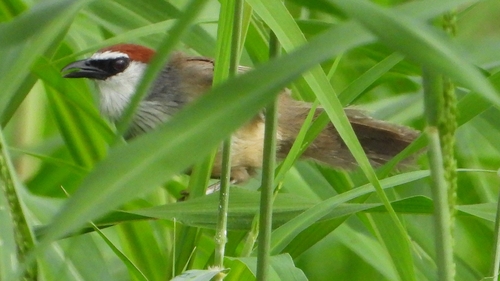
Chestnut-capped Babbler (Timalia pileata) Chestnut-capped Babbler
Pin-striped Tit-Babbler (Mixornis gularis) Pin-striped Tit-Babbler

Media

Loading…

In short

The Chestnut-capped Babbler and Pin-striped Tit-Babbler can be distinguished primarily by head coloration and plumage pattern. The Chestnut-capped Babbler has a distinctive chestnut cap, while the Pin-striped Tit-Babbler features fine streaking on its underparts. Both species inhabit similar environments, but their vocalizations can also aid in identification.

Identification tips

  1. Look for the chestnut cap on the Chestnut-capped Babbler. 2. Check for streaked underparts on the Pin-striped Tit-Babbler. 3. Listen for the Chestnut-capped Babbler's melodious whistles versus the Pin-striped Tit-Babbler's rapid notes. 4. Observe in dense vegetation; both species are often found in similar habitats.

Size

Both species are similar in size, typical of small babblers, making size an unreliable distinguishing feature.

Plumage

The Chestnut-capped Babbler has a prominent chestnut cap and a plain face, while the Pin-striped Tit-Babbler displays fine streaking on the throat and breast. The latter also has a more olive-brown back compared to the more uniform coloration of the Chestnut-capped Babbler.

Behaviour

Both species are active and often found in small groups, moving through dense undergrowth. Behavior alone is not a reliable differentiator.

Habitat

Both species prefer dense vegetation, such as scrub and secondary growth, often near water. They can overlap in range, so habitat alone may not distinguish them.

Voice

The Chestnut-capped Babbler has a series of melodious whistles, while the Pin-striped Tit-Babbler's song is a rapid series of notes. Listening for these differences can assist in identification.

Submit a better description

Use the same sections as the comparison. Your text is published immediately.

The Chestnut-capped Babbler and Pin-striped Tit-Babbler can be distinguished primarily by head coloration and plumage pattern. The Chestnut-capped Babbler has a distinctive chestnut cap, while the Pin-striped Tit-Babbler features fine streaking on its underparts. Both species inhabit similar environments, but their vocalizations can also aid in identification.

  1. Look for the chestnut cap on the Chestnut-capped Babbler. 2. Check for streaked underparts on the Pin-striped Tit-Babbler. 3. Listen for the Chestnut-capped Babbler's melodious whistles versus the Pin-striped Tit-Babbler's rapid notes. 4. Observe in dense vegetation; both species are often found in similar habitats.

Both species are similar in size, typical of small babblers, making size an unreliable distinguishing feature.

The Chestnut-capped Babbler has a prominent chestnut cap and a plain face, while the Pin-striped Tit-Babbler displays fine streaking on the throat and breast. The latter also has a more olive-brown back compared to the more uniform coloration of the Chestnut-capped Babbler.

Both species are active and often found in small groups, moving through dense undergrowth. Behavior alone is not a reliable differentiator.

Both species prefer dense vegetation, such as scrub and secondary growth, often near water. They can overlap in range, so habitat alone may not distinguish them.

The Chestnut-capped Babbler has a series of melodious whistles, while the Pin-striped Tit-Babbler's song is a rapid series of notes. Listening for these differences can assist in identification.

Discard your changes?

You have unsaved edits. If you leave now, those changes will be lost.

Chestnut-capped Babbler · Pin-striped Tit-Babbler · My Tricky Birds