Chestnut-capped Thrush vs Orange-headed Thrush
Geokichla interpres versus Geokichla citrina
Play a quiz with Chestnut-capped Thrush and Orange-headed Thrush
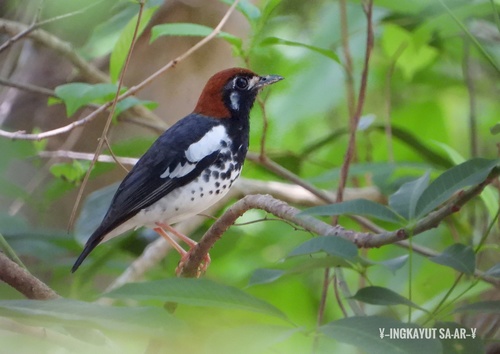
Chestnut-capped Thrush
Orange-headed Thrush
In short
The Chestnut-capped Thrush and Orange-headed Thrush can be distinguished primarily by their head coloration: the Chestnut-capped Thrush has a distinctive chestnut cap, while the Orange-headed Thrush features a bright orange head. Both species are similar in size and structure, making head color the most reliable field mark.
Identification tips
- Look for the chestnut cap on the Chestnut-capped Thrush versus the bright orange head on the Orange-headed Thrush. 2. Observe the wing and back pattern: contrasting black and white for the Chestnut-capped, more uniform for the Orange-headed. 3. Consider habitat: denser forests may favor the Chestnut-capped Thrush. 4. Use vocalizations cautiously as they are not reliably distinct.
Size
Both species are similar in size, typical of thrushes, with no significant differences in structure.
Plumage
The Chestnut-capped Thrush has a chestnut-colored cap and a more contrasting black and white pattern on its wings and back. In contrast, the Orange-headed Thrush has a bright orange head and a more uniform gray or blue-gray back and wings.
Behaviour
Both species exhibit typical thrush behavior, foraging on the ground and being generally elusive. No significant behavioral differences are noted.
Habitat
Both species inhabit forested areas, but the Orange-headed Thrush is more widespread and adaptable to various forest types, while the Chestnut-capped Thrush is often found in denser, more humid forests.
Voice
Vocalizations are not a primary distinguishing feature in the field; both species have melodious songs typical of thrushes, but specific differences are not well-documented.
Chestnut-capped Thrush · Orange-headed Thrush · My Tricky Birds