Birdr

Chestnut Forest Rail vs Forbes's Forest Rail

Rallicula rubra versus Rallicula forbesi

Play a quiz with Chestnut Forest Rail and Forbes's Forest Rail

Chestnut Forest Rail (Rallicula rubra) Chestnut Forest Rail
Forbes's Forest Rail (Rallicula forbesi) Forbes's Forest Rail

Media

Loading…

In short

The Chestnut Forest Rail and Forbes's Forest Rail are both small, elusive birds of the forest floor, but they can be distinguished by subtle differences in plumage and behavior. The Chestnut Forest Rail generally exhibits a richer chestnut coloration, while Forbes's Forest Rail tends to have a more muted tone. Observing their behavior and habitat preferences can also aid in identification.

Identification tips

Size

Both species are similar in size, typical of small forest rails, making size a less reliable differentiator.

Plumage

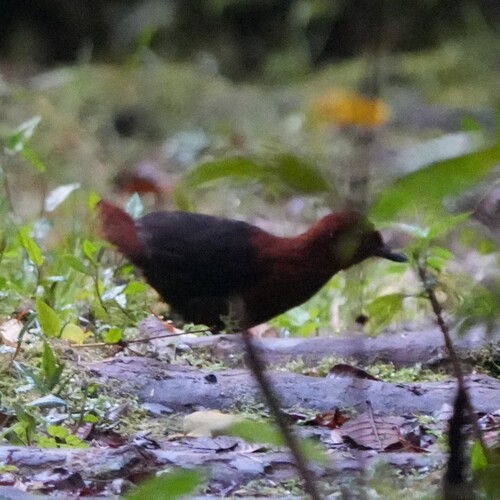
The Chestnut Forest Rail has a richer, more vibrant chestnut coloration on its body, whereas the Forbes's Forest Rail displays a more subdued, duller chestnut tone. Both species have similar patterns, so focus on the intensity of the chestnut color.

Behaviour

Both species are secretive and often remain hidden in dense undergrowth, but the Chestnut Forest Rail may be slightly more active and visible at times, especially when foraging.

Habitat

Both species inhabit dense forest undergrowth, but the Chestnut Forest Rail is more frequently found in slightly more open areas within the forest compared to the Forbes's Forest Rail.

Voice

Vocalizations are not well-documented for either species, making them unreliable for field identification.

Submit a better description

Use the same sections as the comparison. Your text is published immediately.

The Chestnut Forest Rail and Forbes's Forest Rail are both small, elusive birds of the forest floor, but they can be distinguished by subtle differences in plumage and behavior. The Chestnut Forest Rail generally exhibits a richer chestnut coloration, while Forbes's Forest Rail tends to have a more muted tone. Observing their behavior and habitat preferences can also aid in identification.

  • Focus on the chestnut coloration: richer in Chestnut Forest Rail, duller in Forbes's Forest Rail.
  • Observe behavior: Chestnut Forest Rail may be more active in open areas.
  • Consider habitat: slight preference for more open forest in Chestnut Forest Rail.
  • Vocalizations are not a reliable differentiator.

Both species are similar in size, typical of small forest rails, making size a less reliable differentiator.

The Chestnut Forest Rail has a richer, more vibrant chestnut coloration on its body, whereas the Forbes's Forest Rail displays a more subdued, duller chestnut tone. Both species have similar patterns, so focus on the intensity of the chestnut color.

Both species are secretive and often remain hidden in dense undergrowth, but the Chestnut Forest Rail may be slightly more active and visible at times, especially when foraging.

Both species inhabit dense forest undergrowth, but the Chestnut Forest Rail is more frequently found in slightly more open areas within the forest compared to the Forbes's Forest Rail.

Vocalizations are not well-documented for either species, making them unreliable for field identification.

Discard your changes?

You have unsaved edits. If you leave now, those changes will be lost.

Chestnut Forest Rail · Forbes's Forest Rail · My Tricky Birds