Birdr

Chestnut-headed Oropendola vs Montezuma Oropendola

Psarocolius wagleri versus Psarocolius montezuma

Play a quiz with Chestnut-headed Oropendola and Montezuma Oropendola
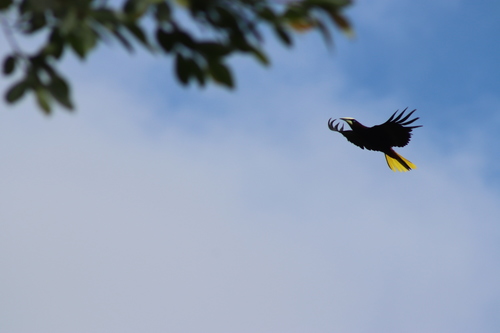
Chestnut-headed Oropendola (Psarocolius wagleri) Chestnut-headed Oropendola
Montezuma Oropendola (Psarocolius montezuma) Montezuma Oropendola

Media

Loading…

In short

The Chestnut-headed Oropendola and Montezuma Oropendola are both large, striking birds with distinctive coloration and vocalizations. The most reliable field mark is the head color: chestnut for the Chestnut-headed Oropendola and black with a pale patch of bare skin for the Montezuma Oropendola. Both species have yellow outer tail feathers, but their head colors are the key distinguishing feature.

Identification tips

  1. Head color: Chestnut-headed Oropendola has a chestnut head; Montezuma has a black head with pale skin patches. 2. Size: Montezuma is larger and more robust. 3. Vocalizations: Listen for the Montezuma's complex, gurgling song. 4. Habitat: Note the elevation and forest type; Montezuma prefers lowlands.

Size

Both species are large oropendolas, but the Montezuma Oropendola is generally larger and more robust than the Chestnut-headed Oropendola.

Plumage

The Chestnut-headed Oropendola has a chestnut-colored head with a dark body, while the Montezuma Oropendola features a black head with a pale patch of bare skin on the sides and a more colorful body. Both have yellow outer tail feathers.

Behaviour

Both species exhibit similar behaviors, such as hanging nests and social foraging, but the Montezuma Oropendola is often seen in larger flocks.

Habitat

Both species inhabit tropical forests, but the Montezuma Oropendola is more commonly found in lowland areas, while the Chestnut-headed Oropendola can also be found in foothills.

Voice

The Montezuma Oropendola is known for its distinctive, gurgling song, which is more complex and varied compared to the simpler calls of the Chestnut-headed Oropendola.

Submit a better description

Use the same sections as the comparison. Your text is published immediately.

The Chestnut-headed Oropendola and Montezuma Oropendola are both large, striking birds with distinctive coloration and vocalizations. The most reliable field mark is the head color: chestnut for the Chestnut-headed Oropendola and black with a pale patch of bare skin for the Montezuma Oropendola. Both species have yellow outer tail feathers, but their head colors are the key distinguishing feature.

  1. Head color: Chestnut-headed Oropendola has a chestnut head; Montezuma has a black head with pale skin patches. 2. Size: Montezuma is larger and more robust. 3. Vocalizations: Listen for the Montezuma's complex, gurgling song. 4. Habitat: Note the elevation and forest type; Montezuma prefers lowlands.

Both species are large oropendolas, but the Montezuma Oropendola is generally larger and more robust than the Chestnut-headed Oropendola.

The Chestnut-headed Oropendola has a chestnut-colored head with a dark body, while the Montezuma Oropendola features a black head with a pale patch of bare skin on the sides and a more colorful body. Both have yellow outer tail feathers.

Both species exhibit similar behaviors, such as hanging nests and social foraging, but the Montezuma Oropendola is often seen in larger flocks.

Both species inhabit tropical forests, but the Montezuma Oropendola is more commonly found in lowland areas, while the Chestnut-headed Oropendola can also be found in foothills.

The Montezuma Oropendola is known for its distinctive, gurgling song, which is more complex and varied compared to the simpler calls of the Chestnut-headed Oropendola.

Discard your changes?

You have unsaved edits. If you leave now, those changes will be lost.

Chestnut-headed Oropendola · Montezuma Oropendola · My Tricky Birds