Birdr

Chestnut-rumped Babbler vs Grey-headed Babbler

Stachyris maculata versus Stachyris poliocephala

Play a quiz with Chestnut-rumped Babbler and Grey-headed Babbler
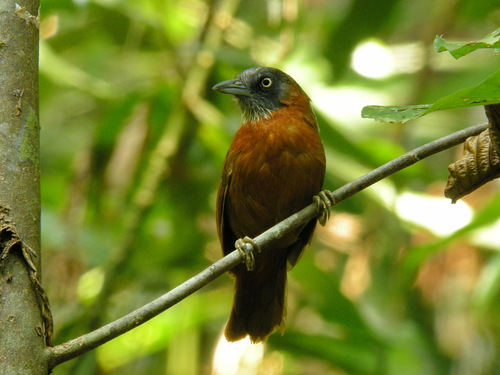
Chestnut-rumped Babbler (Stachyris maculata) Chestnut-rumped Babbler
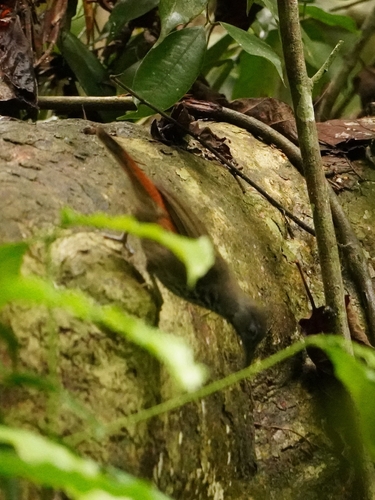
Grey-headed Babbler (Stachyris poliocephala) Grey-headed Babbler

Media

Loading…

In short

The Chestnut-rumped Babbler and Grey-headed Babbler can be distinguished by their head and rump coloration. The Chestnut-rumped Babbler has a distinctive chestnut rump, while the Grey-headed Babbler features a grey head. Both species share similar habitats and behaviors, making visual identification crucial.

Identification tips

  1. Look for the chestnut rump on the Chestnut-rumped Babbler. 2. Note the grey head of the Grey-headed Babbler. 3. Observe in good light to distinguish subtle plumage differences. 4. Use binoculars to confirm head and rump colors.

Size

Both species are similar in size, typical of small babblers.

Plumage

The Chestnut-rumped Babbler has a chestnut-colored rump and a more uniform brown body. In contrast, the Grey-headed Babbler has a grey head, which is a key distinguishing feature.

Behaviour

Both species exhibit similar foraging behavior, often seen in small flocks moving through dense undergrowth.

Habitat

Both species inhabit similar forested environments, often in lowland and foothill forests.

Voice

Vocalizations are not distinctly different enough for reliable field separation.

Submit a better description

Use the same sections as the comparison. Your text is published immediately.

The Chestnut-rumped Babbler and Grey-headed Babbler can be distinguished by their head and rump coloration. The Chestnut-rumped Babbler has a distinctive chestnut rump, while the Grey-headed Babbler features a grey head. Both species share similar habitats and behaviors, making visual identification crucial.

  1. Look for the chestnut rump on the Chestnut-rumped Babbler. 2. Note the grey head of the Grey-headed Babbler. 3. Observe in good light to distinguish subtle plumage differences. 4. Use binoculars to confirm head and rump colors.

Both species are similar in size, typical of small babblers.

The Chestnut-rumped Babbler has a chestnut-colored rump and a more uniform brown body. In contrast, the Grey-headed Babbler has a grey head, which is a key distinguishing feature.

Both species exhibit similar foraging behavior, often seen in small flocks moving through dense undergrowth.

Both species inhabit similar forested environments, often in lowland and foothill forests.

Vocalizations are not distinctly different enough for reliable field separation.

Discard your changes?

You have unsaved edits. If you leave now, those changes will be lost.

Chestnut-rumped Babbler · Grey-headed Babbler · My Tricky Birds