
Chimney Swift vs Vaux's Swift
Chaetura pelagica versus Chaetura vauxi
Play a quiz with Chimney Swift and Vaux's Swift
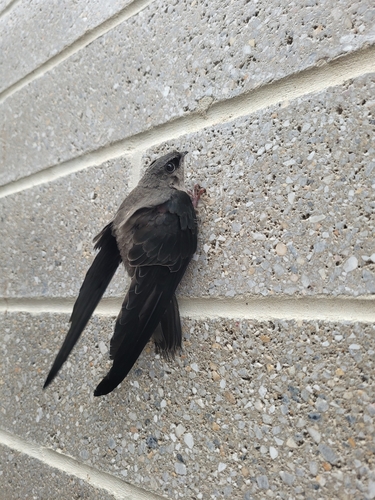 Chimney Swift
 Vaux's Swift
In short
The most reliable field mark between Chimney Swift and Vaux's Swift is overall size and structure: Chimney Swift is distinctly larger and longer-winged, with a more uniformly dark, sooty-olive plumage and a slightly paler throat, while Vaux's Swift is smaller, with a shorter, more squared tail and a duskier blackish upperpart tone. Juvenile Chimney Swifts can show whitish tips to the outer secondaries and tertials, a subtle mark not present in Vaux's. In flight, Chimney Swift appears as a 'cigar with wings'—long, slender, and with wings extending well past the tail—whereas Vaux's Swift is more compact, with a blunter tail and less elongated wings. Both species share a similar jizz and flight style, but careful attention to size, tail shape, and subtle plumage differences can separate them, especially in mixed flocks or migration.
Identification tips
- Size and Structure: Chimney Swift is noticeably larger and longer-winged than Vaux's Swift. In direct comparison or mixed flocks, look for the larger, more stretched bird for Chimney Swift.
- Tail Shape: Both have short, squared tails, but Chimney Swift's tail is slightly longer and shows spiny tips (shafts projecting up to 1.3 cm), while Vaux's Swift's tail is blunter and less spiny. This is subtle but can be seen when perched or in high-quality flight views.
- Wing Projection: Chimney Swift's wings extend well past the tail when folded (up to 3.8 cm), making the bird look even more elongated at rest. Vaux's Swift's wings are shorter relative to the tail.
- Plumage Uniformity: Chimney Swift is sooty olive above with little contrast between back and rump, and a paler throat. Vaux's Swift is dusky black above, with a more contrasting grayish brown rump and underparts, and a paler (sometimes whitish) throat, especially in northern birds.
- Juvenile Marks: Juvenile Chimney Swifts show whitish tips to the outer webs of the secondaries and tertials, best seen in fresh post-fledging plumage. Vaux's Swift juveniles have dusky bases to throat feathers, but no mention of wing markings.
- Flight Jizz: Chimney Swift appears as a 'cigar with wings,' with a long, slender body and wings. Vaux's Swift is more compact and less elongated in flight.
- Behavior at Roosts: Vaux's Swift forms enormous communal roosts in migration (notably at Portland's Chapman School), while Chimney Swift roosts in smaller numbers, often singly or in small groups.
- Bill and Feet: Both have tiny black bills and feet, not useful for separation in the field.
- Sexes: Both species are sexually monomorphic in plumage; do not use sex for identification.
- Voice: Vaux's Swift has a more varied call repertoire (chatters, squeaks, buzzes), while Chimney Swift's calls are not detailed here; use with caution.
- Habitat/Range: In the Pacific Northwest and western North America, Vaux's Swift is expected; Chimney Swift is more likely in the east. Overlap is possible in migration, so do not rely solely on range.
- Perched Views: Both cling to vertical surfaces, but Chimney Swift's spiny tail tips may be visible if seen well.
- Plumage Pitfalls: Both are overall dark and can look similar in poor light; focus on structure and size first.
- Mixed Flocks: Both species can occur together in migration; use multiple marks for confident separation.
- Age Pitfalls: Juvenile Chimney Swifts' whitish wing tips fade quickly; do not rely on this mark late in the season.
Size
Chimney Swift is consistently larger: body mass averages 23.6 g vs. 18.5 g for Vaux's Swift [wikidata]. In length, Chimney Swift measures 12–15 cm (wingspan 27–30 cm), while Vaux's Swift is 10.7–11.5 cm (wingspan not specified, but proportionally shorter). In the field, Chimney Swift looks longer-winged and more stretched, with wings extending up to 3.8 cm beyond the tail when folded, while Vaux's Swift is noticeably smaller, more compact, and with a shorter tail.
Plumage
Juvenile Chimney Swifts (in their first few months post-fledging) show whitish tips to the outer webs of the secondaries and tertials, a feature not described for Vaux's Swift juveniles, whose main difference is dusky bases to throat feathers. Adults of both species are overall dark, but Chimney Swift is sooty olive above and grayish brown below, with a paler rump and throat; the upperparts are very uniform with little contrast. Vaux's Swift is dusky black above, with grayish brown underparts, rump, and tail coverts, and a paler, sometimes whitish, throat in northern birds. The tail of Chimney Swift is short and square with projecting spiny tips; Vaux's Swift's tail is also short and squared but appears blunter and less spiny. Both have dark eyes, black bills, and feet, but Chimney Swift's plumage is more uniform and less contrasting overall.
Behaviour
Both species are highly aerial, rarely perching except on vertical surfaces. Chimney Swift's flight is described as highly erratic, with rapid, quivering flaps and long glides, often appearing as a 'cigar with wings.' Vaux's Swift also uses stiff wing-beats and unsteady glides, but may appear even more compact and less elongated in the air. Vaux's Swift is notably gregarious, often seen in large flocks, especially at migration roosts such as chimneys. Both species can be seen in mixed swift flocks, but Vaux's is especially known for massive communal roosts during migration.
Habitat
Both species use chimneys and similar vertical structures for roosting and nesting, especially in urban and suburban areas. Vaux's Swift is famous for its huge autumn roosts in brick chimneys in the Pacific Northwest, while Chimney Swift is widespread in eastern North America. Habitat overlap is possible during migration or in urban settings, but Vaux's Swift is more likely in western North America, and Chimney Swift in the east. Both can occur together in some migration corridors.
Voice
Vaux's Swift has a more varied vocal repertoire, with chattering, buzzes, squeaks, and chips, while Chimney Swift's voice is not detailed in the notes. Calls are not the most reliable field mark for separation, but Vaux's Swift may sound more varied and less monotonous.