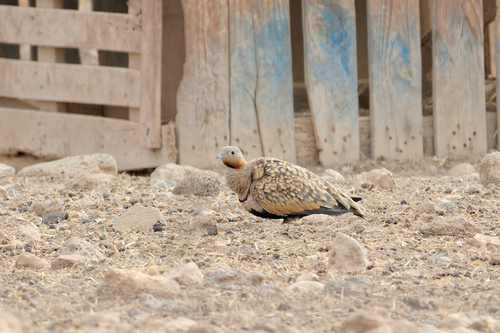
Chukar vs Black-bellied Sandgrouse
Alectoris chukar versus Pterocles orientalis
Play a quiz with Chukar and Black-bellied Sandgrouse
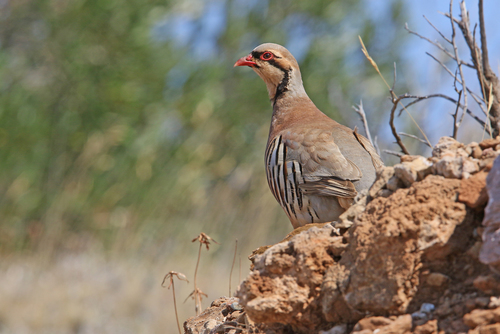
Chukar
Black-bellied Sandgrouse
In short
The Chukar and Black-bellied Sandgrouse are distinct in appearance and habitat, with the Chukar being a plump, ground-dwelling bird of rocky terrains, while the Black-bellied Sandgrouse is more streamlined and found in arid, open landscapes. Key differences include their body shape, plumage patterns, and preferred environments.
Identification tips
- Facial Pattern: Look for the bold black and white facial markings on the Chukar.
- Belly Color: Note the black belly of the Black-bellied Sandgrouse, which is absent in Chukars.
- Habitat: Consider the habitat; rocky terrains suggest Chukar, while open, arid areas suggest Black-bellied Sandgrouse.
- Behavior: Observe behavior; Chukars are more terrestrial, while Sandgrouse may be seen flying in flocks.
Size
The Chukar is a medium-sized, robust bird, while the Black-bellied Sandgrouse is slightly more slender and elongated.
Plumage
Chukars have a distinctive bold black and white facial pattern with a greyish body and barred flanks. In contrast, Black-bellied Sandgrouse have a sandy-brown body with a striking black belly and a more uniform appearance.
Behaviour
Chukars are often seen walking or running on rocky slopes, whereas Black-bellied Sandgrouse are more likely to be observed flying in flocks over open, arid areas.
Habitat
Chukars inhabit rocky, mountainous terrains and adjacent agricultural lands, thriving in overgrazed open ranges. Black-bellied Sandgrouse prefer arid, open landscapes such as deserts and steppes.
Voice
Chukars have a series of chuckling calls, while Black-bellied Sandgrouse produce a distinctive, soft, cooing call.