
Birdr

Cirl Bunting vs Yellowhammer

Emberiza cirlus versus Emberiza citrinella

Play a quiz with Cirl Bunting and Yellowhammer
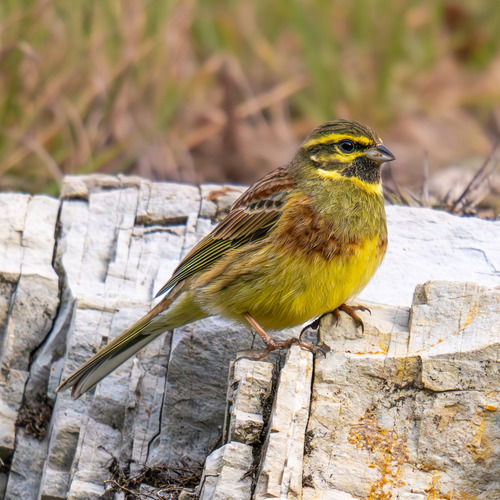
Cirl Bunting (Emberiza cirlus) Cirl Bunting
Yellowhammer (Emberiza citrinella) Yellowhammer

Media

Loading…

In short

Cirl Bunting and Yellowhammer are both Old World buntings with similar body shapes, but they can be distinguished by their head patterns and coloration. Cirl Bunting males have a distinctive black throat and face mask, while Yellowhammer males are more uniformly yellow with a less defined head pattern.

Identification tips

1. Look for the black throat and face mask in male Cirl Buntings, absent in Yellowhammers. 2. Note the overall color: Cirl Buntings have an olive tone, while Yellowhammers are brighter yellow. 3. Listen for the song: Yellowhammer's is more musical and distinctive. 4. Consider habitat: Cirl Buntings prefer mixed farmland, while Yellowhammers are more often in open countryside.

Size

Both species are similar in size, typical of buntings, with no significant differences in structure.

Plumage

Male Cirl Buntings have a black throat and face mask with olive-green upperparts, while Yellowhammer males are bright yellow with a more uniform head pattern. Females of both species are more subdued, but Cirl Bunting females have a more olive tone compared to the browner Yellowhammer females.

Behaviour

Both species exhibit similar feeding and perching behaviors typical of buntings, often seen foraging on the ground or perched in shrubs.

Habitat

Cirl Buntings are often found in mixed farmland with hedgerows, while Yellowhammers prefer open countryside with scattered bushes and trees. However, their habitats can overlap, especially in agricultural areas.

Voice

Yellowhammer's song is a distinctive 'little-bit-of-bread-and-no-cheese', while Cirl Bunting's song is a more rapid, less musical trill. Calls of both species are similar and may be hard to distinguish.

Submit a better description

Use the same sections as the comparison. Your text is published immediately.

Cirl Bunting and Yellowhammer are both Old World buntings with similar body shapes, but they can be distinguished by their head patterns and coloration. Cirl Bunting males have a distinctive black throat and face mask, while Yellowhammer males are more uniformly yellow with a less defined head pattern.

1. Look for the black throat and face mask in male Cirl Buntings, absent in Yellowhammers. 2. Note the overall color: Cirl Buntings have an olive tone, while Yellowhammers are brighter yellow. 3. Listen for the song: Yellowhammer's is more musical and distinctive. 4. Consider habitat: Cirl Buntings prefer mixed farmland, while Yellowhammers are more often in open countryside.

Both species are similar in size, typical of buntings, with no significant differences in structure.

Male Cirl Buntings have a black throat and face mask with olive-green upperparts, while Yellowhammer males are bright yellow with a more uniform head pattern. Females of both species are more subdued, but Cirl Bunting females have a more olive tone compared to the browner Yellowhammer females.

Both species exhibit similar feeding and perching behaviors typical of buntings, often seen foraging on the ground or perched in shrubs.

Cirl Buntings are often found in mixed farmland with hedgerows, while Yellowhammers prefer open countryside with scattered bushes and trees. However, their habitats can overlap, especially in agricultural areas.

Yellowhammer's song is a distinctive 'little-bit-of-bread-and-no-cheese', while Cirl Bunting's song is a more rapid, less musical trill. Calls of both species are similar and may be hard to distinguish.

Discard your changes?

You have unsaved edits. If you leave now, those changes will be lost.

Cirl Bunting · Yellowhammer · My Tricky Birds