Birdr

Collared Kingfisher vs Blue-tailed Bee-eater

Todiramphus chloris versus Merops philippinus

Play a quiz with Collared Kingfisher and Blue-tailed Bee-eater
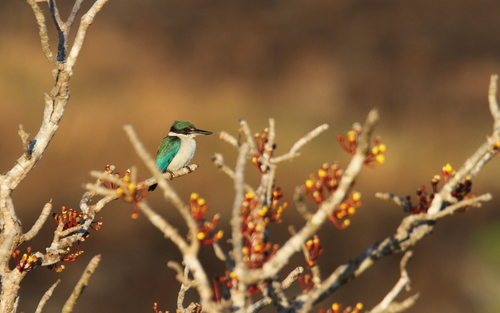
Collared Kingfisher (Todiramphus chloris) Collared Kingfisher
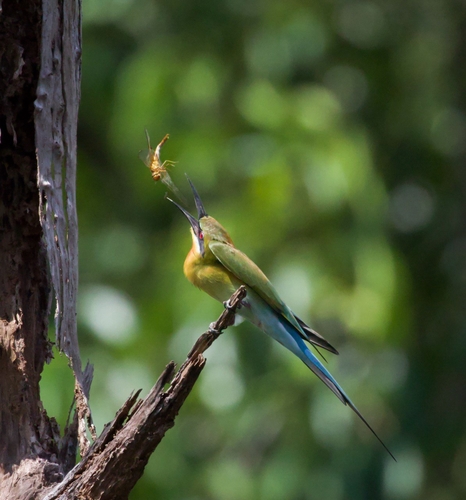
Blue-tailed Bee-eater (Merops philippinus) Blue-tailed Bee-eater

Media

Loading…

In short

The Collared Kingfisher and Blue-tailed Bee-eater can be distinguished by their bill shape and tail color. The kingfisher has a stout, dagger-like bill and a white collar, while the bee-eater has a slender, slightly curved bill and a distinctive blue tail.

Identification tips

  1. Bill Shape: Look for the stout, straight bill of the kingfisher versus the slender, curved bill of the bee-eater. 2. Tail Color: Note the blue tail of the bee-eater. 3. Collar: Check for the white collar on the kingfisher. 4. Throat Color: The bee-eater has a rufous throat, absent in the kingfisher. 5. Behavior: Observe social behavior; bee-eaters are more likely in groups. 6. Habitat: Consider the environment; kingfishers favor coastal areas, bee-eaters prefer open spaces.

Size

Both species are similar in size, but the Collared Kingfisher is slightly bulkier due to its robust build.

Plumage

The Collared Kingfisher has a blue-green back and wings with a white collar and underparts. In contrast, the Blue-tailed Bee-eater has a green body with a blue tail, a rufous throat, and a black eye stripe.

Behaviour

Collared Kingfishers are often seen perched alone or in pairs, while Blue-tailed Bee-eaters are more social, frequently observed in flocks.

Habitat

Collared Kingfishers are typically found in coastal and mangrove areas, whereas Blue-tailed Bee-eaters prefer open country, often near water.

Voice

The Collared Kingfisher has a loud, harsh call, while the Blue-tailed Bee-eater produces a softer, more musical 'prrr' or 'trill'.

Submit a better description

Use the same sections as the comparison. Your text is published immediately.

The Collared Kingfisher and Blue-tailed Bee-eater can be distinguished by their bill shape and tail color. The kingfisher has a stout, dagger-like bill and a white collar, while the bee-eater has a slender, slightly curved bill and a distinctive blue tail.

  1. Bill Shape: Look for the stout, straight bill of the kingfisher versus the slender, curved bill of the bee-eater. 2. Tail Color: Note the blue tail of the bee-eater. 3. Collar: Check for the white collar on the kingfisher. 4. Throat Color: The bee-eater has a rufous throat, absent in the kingfisher. 5. Behavior: Observe social behavior; bee-eaters are more likely in groups. 6. Habitat: Consider the environment; kingfishers favor coastal areas, bee-eaters prefer open spaces.

Both species are similar in size, but the Collared Kingfisher is slightly bulkier due to its robust build.

The Collared Kingfisher has a blue-green back and wings with a white collar and underparts. In contrast, the Blue-tailed Bee-eater has a green body with a blue tail, a rufous throat, and a black eye stripe.

Collared Kingfishers are often seen perched alone or in pairs, while Blue-tailed Bee-eaters are more social, frequently observed in flocks.

Collared Kingfishers are typically found in coastal and mangrove areas, whereas Blue-tailed Bee-eaters prefer open country, often near water.

The Collared Kingfisher has a loud, harsh call, while the Blue-tailed Bee-eater produces a softer, more musical 'prrr' or 'trill'.

Discard your changes?

You have unsaved edits. If you leave now, those changes will be lost.

Collared Kingfisher · Blue-tailed Bee-eater · My Tricky Birds